



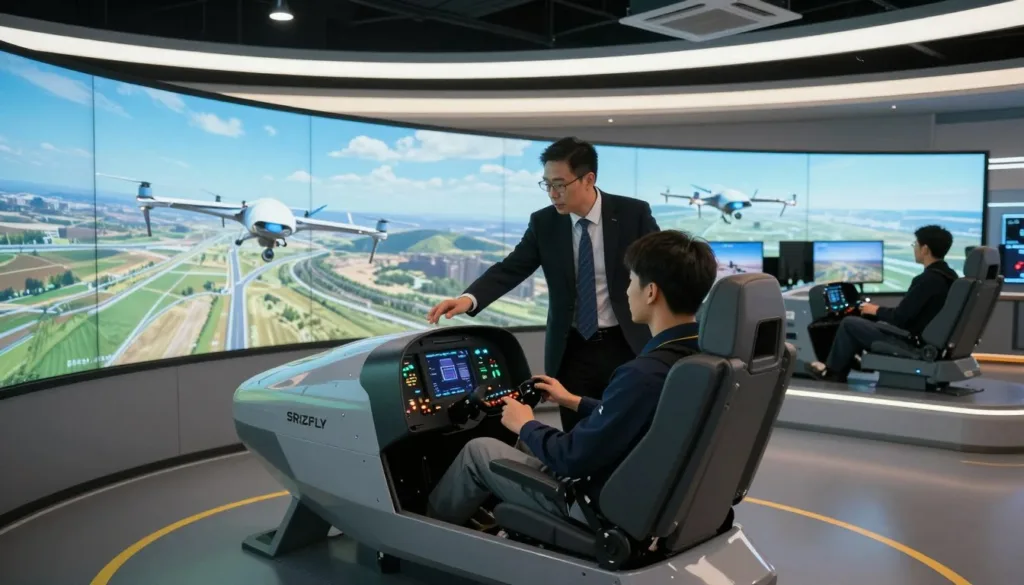
The SRIZFLY drone simulator is an AI-powered drone simulator designed for advanced flight training and aerial autonomy development in the United States. It moves pilot practice and algorithm testing into a realistic virtual space to speed skill acquisition, cut operating costs, and lower the risk of real-world accidents. The simulator supports drone pilot training USA programs, research teams, and commercial operators who need repeatable, measurable training scenarios.
Alongside SRIZFLY, Microsoft’s Project AirSim stands out as a major industry example. Project AirSim began as the open-source AirSim research project in 2017 and evolved into Project AirSim after five years of development. Both platforms show how simulation now serves not only pilot practice but also the training of deep learning models for delivery drones, search-and-rescue missions, infrastructure inspection, and drone taxis or cargo drones.
Training autonomous flight needs massive datasets and varied scenarios. Effective simulators model bad weather, collision avoidance, non-ideal landing sites, and payload effects such as how package weight changes battery life and handling. These realistic conditions make the SRIZFLY drone simulator and other advanced drone simulator platforms essential for validating autonomy before any real-world deployment.
Key Takeaways
- SRIZFLY is an AI-powered drone simulator built for pilot skill growth and autonomy testing.
- Project AirSim highlights the industry trend from research to robust simulation platforms.
- Simulators support drone flight training and deep learning model development for many missions.
- Realistic scenarios — weather, payload, and emergency cases — are critical to useful training.
- This article covers features, deployment needs, safety, and privacy for U.S. operators.
Why AI-powered drone simulator is transforming advanced flight training
The SRIZFLY platform shows how the benefits of AI drone simulator reach beyond simple flight hours. Trainers get repeatable scenarios. Engineers collect labeled data for machine learning. Pilots sharpen decision-making in a safe, low-cost setting.
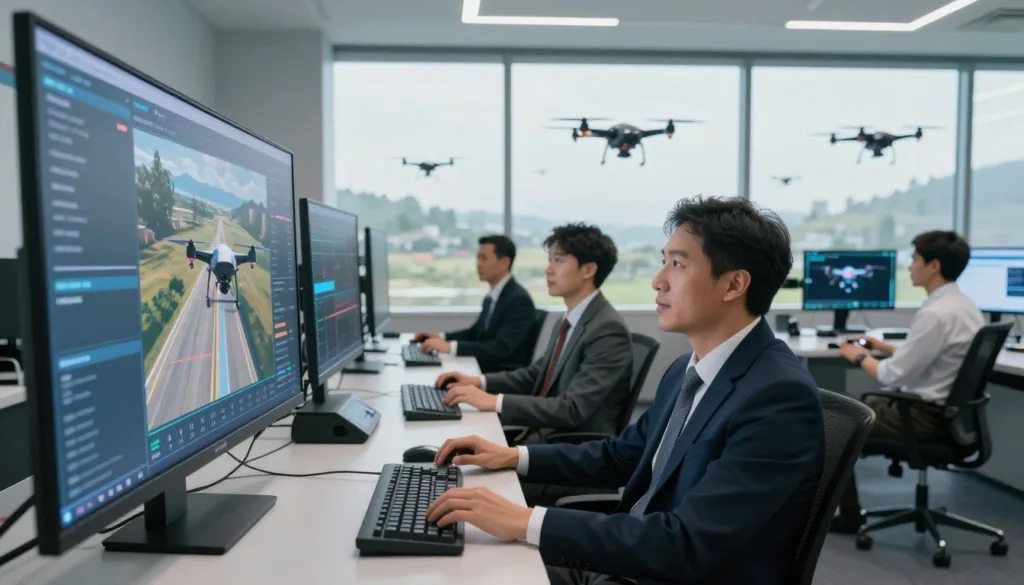
Simulators narrow the gap between pilot practice and full autonomy. They let human operators train on flight dynamics and emergency responses. The same runs feed models for autonomous drone testing and help validate control policies before live flights.
Project AirSim use cases provide libraries and tools that speed development for delivery, inspection, and search-and-rescue missions. Teams use those resources to test algorithms against urban clutter, varied weather, and realistic ground truth.
From pilot practice to autonomous systems testing
AI-driven sims link human skill work with machine learning pipelines. Pilots fly repeatable missions to capture telemetry and video. Engineers use that data to tune perception stacks and reinforcement learning agents for aerial autonomy use cases.
Commercial FPV simulators with blackbox import create virtual twins of real drones. That match between simulated and real hardware cuts tuning time and reduces surprises in field trials. SRIZFLY benefits include streamlined data export and integrated test suites that speed iterations.
Realistic scenarios reduce real-world risk
High-fidelity physics and terrain models let teams rehearse hard conditions safely. Developers simulate gusts, sensor dropouts, and tight landing zones to measure failure modes without exposing people or assets to danger.
Project AirSim use cases come with urban and rural map libraries so developers can evaluate mission plans against real terrain and infrastructure. Simulated runs lower cost and liability for tasks like tower inspections, turbine checks, and last-mile delivery.
Industry applications across the United States
Use cases range from medical deliveries to infrastructure inspection and public safety. Companies such as Zipline and Amazon push last-mile delivery while utilities and telecom firms expand inspection programs to cut downtime and risk.
Simulation accelerates regulatory readiness by producing repeatable evidence for FAA discussions. Autonomous drone testing and targeted pilot practice help fleets scale responsibly across American cities and rural areas.
| Use Case | Simulation Advantage | Example Outcome |
|---|---|---|
| Last-mile delivery | Route optimization, urban obstacle testing, battery modeling | Faster route certification and fewer mid-route failures |
| Infrastructure inspection | Close-proximity flight rehearsals, payload and sensor validation | Reduced field crew time and safer tower inspections |
| Search and rescue | Dynamic scenario replay, multi-drone coordination practice | Improved response times and better coverage in complex terrain |
| Urban Air Mobility and AAM | Traffic integration, vertiport approach modeling, contingency drills | Clearer safety cases and accelerated demonstration programs |
| Autonomy validation | Large-scale dataset generation, stress testing of perception | Robust models ready for limited live trials and FAA engagement |
Core features to look for in an AI-powered drone simulator
The right simulator blends realistic flight behavior with tools for AI development and team workflows. Look for a platform that balances practical simulator features with extensibility for research and commercial work. These elements help teams move from bench testing to safe field trials.
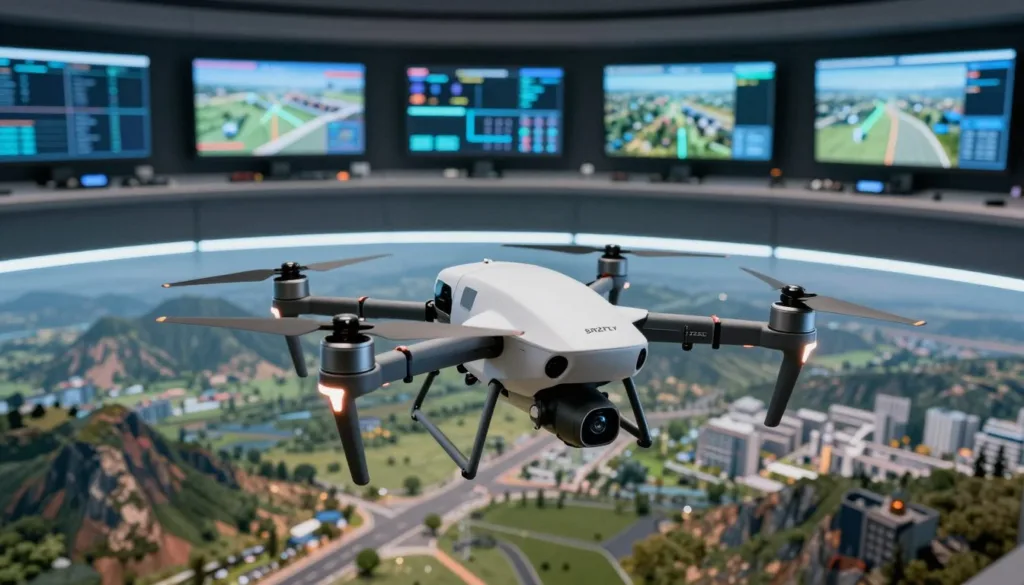
High-fidelity physics and hardware emulation
Accurate flight dynamics are essential. High-fidelity drone physics should reproduce aerodynamics, prop wash, battery drain, and payload effects so pilots and control systems face the same trade-offs found in real missions.
Blackbox import lets engineers load flight controller logs to match a virtual craft to a real airframe. That link between recorded flights and simulated models improves transfer learning and builds trust in sim-to-real results.
AI and deep learning training pipelines
Scalable data generation matters for robust models. Good simulators provide automated scenario batching and labeled outputs so teams can produce large, varied datasets for perception and planning.
Sensor fidelity is critical. Simulators that emulate cameras, LiDAR, radar, and realistic noise let deep learning pipelines train on inputs that mimic field conditions. Integration with TensorFlow, PyTorch, and other frameworks speeds iteration.
Real-world maps and scenario libraries
Access to scenario libraries speeds testing across use cases. Pre-built templates for inspection, last-mile delivery, and urban air mobility let teams validate concepts quickly.
Real-world maps and environmental variation—weather, lighting, traffic, and unexpected obstacles—help models generalize. A diverse scenario set uncovers edge cases before hardware flights.
Customization, community, and content sharing
Editors and asset importers extend simulator value. Custom map editors, Unreal Engine model import, and support for third-party assets let teams tailor tests to mission needs.
Community content sharing accelerates progress. Shared drone models, scenario templates, and user reviews help teams choose proven assets. Active repositories reduce duplication and improve quality.
Compare platforms for both polished tooling and open access. Commercial sims may offer turnkey editors, while open-source projects enable deeper research. Check how SRIZFLY features map to your requirements for onboarding, collaboration, and long-term support.
Operational and technical considerations for deployment
Deploying a simulator for flight training or autonomy needs clear planning. This passage outlines practical points to weigh before a SRIZFLY deployment. It covers data needs, validation paths, hardware and software fits, and rules for handling user telemetry and privacy.
Data requirements and training scale
Training strong models demands a large training data scale that spans weather, lighting, and obstacle types. Prepare pipelines that ingest flight logs, export sensor streams, and feed TensorFlow or PyTorch at high throughput.
Choose storage and compute that match intended experiments. GPUs such as NVIDIA RTX series or cloud TPUs speed model training. Factor in labeled datasets, automated labeling tools, and scenario generators for robust autonomy.
Validation, safety, and regulatory alignment
Validation needs reproducible stress tests plus pilot-in-the-loop trials to prove safety for specific missions like inspection or delivery. Create verifiable metrics for detection rates, obstacle avoidance, and failure modes.
Align test plans with regulatory alignment FAA guidance early. Use simulator logs and blackbox-style replay to support waiver requests and to document compliance with local rules.
System requirements and integration
Review simulator system requirements before rollout. Typical labs run 64-bit OS on mid to high tier CPUs like Intel Core i5 or AMD Ryzen 5, with dedicated GPUs and 20+ GB of storage. Enterprise setups may use Linux nodes and headless rendering for scale.
Plan integration with mission planning tools and autopilot stacks such as PX4 or ArduPilot. Tie simulation outputs to CI/CD pipelines for automated model deployment. Networked training and cloud clusters help with multi-agent and urban air mobility scenarios.
Privacy, cookies, and telemetry considerations
Telemetry and analytics are core to improving performance. Treat privacy and telemetry as mandatory design items. Get explicit consent for data capture, anonymize logs, and state retention periods in policy documents.
Offer cookie controls on portals and options to opt out of non-essential analytics. In enterprise modes, allow configuration to exclude sensitive map areas and check third-party analytics against corporate rules.
| Area | Key Actions | Typical Specs |
|---|---|---|
| Training data scale | Automated labeling, scenario generation, scalable ingestion | Multi-TB storage, GPU/TPU clusters |
| Validation & safety | Reproducible stress tests, pilot trials, blackbox replay | Versioned logs, test harnesses, metric dashboards |
| Regulatory alignment FAA | Map tests to FAA guidance, prepare waiver docs, maintain audit trails | Compliance reports, time-stamped logs |
| Simulator system requirements | Hardware checks, OS support, headless rendering options | 64-bit OS, Intel Core i5/Ryzen 5 or better, NVIDIA GTX/RTX, 20+ GB |
| Integration | Connect PX4/ArduPilot, TensorFlow/PyTorch, CI/CD | APIs, containerized services, cloud links |
| Privacy and telemetry | Consent, anonymization, opt-out, configure sensitive exclusions | Encrypted storage, retention policy, cookie control |
Conclusion
The AI-powered drone simulator conclusion is clear: platforms like SRIZFLY and research tools such as Microsoft Project AirSim accelerate pilot training and autonomy development while cutting cost and real-world risk. They deliver high-fidelity physics, realistic map libraries, and AI training pipelines that let teams iterate faster. For organizations in the United States, an advanced flight training simulator USA becomes a force multiplier for both operators and engineers.
When you choose drone simulator solutions, use a concise checklist: realistic physics and blackbox export, deep learning pipeline compatibility, extensive real-world scenario libraries, customization and community tools, robust validation suites, clear system requirements, and strong privacy and telemetry controls. These items help verify fidelity and make simulation-to-field transitions predictable and auditable under FAA guidance.
Test before you commit. Trial SRIZFLY demos or Project AirSim experiments, export blackbox data for side-by-side validation, and build a staged validation plan that moves models from simulation to supervised field tests. Align each step with FAA UAS guidance and local operational rules to reduce risk and document safety cases.
For next steps, download a demo, subscribe for updates, or contact vendor support to discuss deployment in the United States. A focused evaluation and a clear validation roadmap will ensure the SRIZFLY summary and broader AI-powered drone simulator tools deliver measurable gains in training effectiveness and autonomy readiness.