



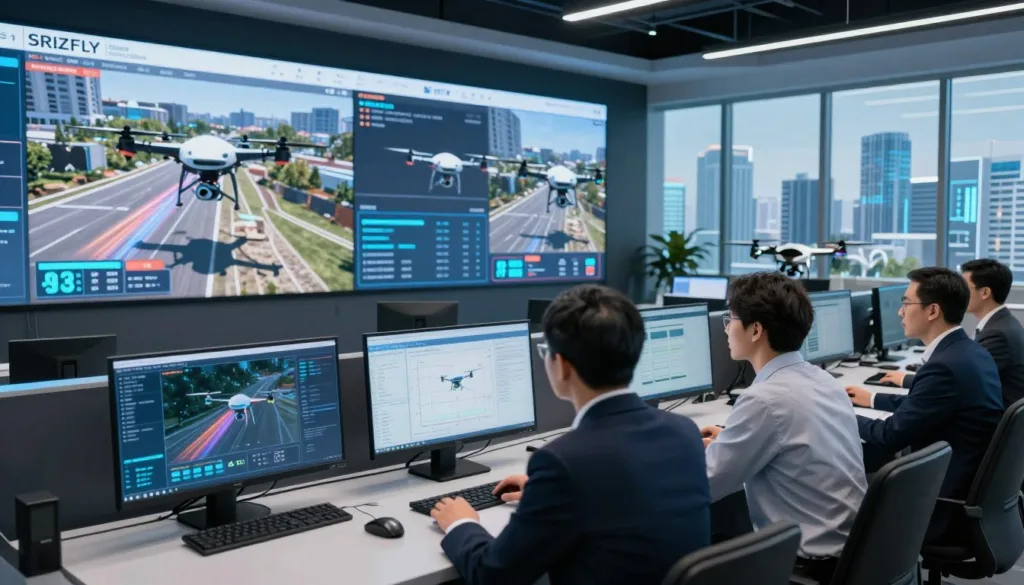
SRIZFLY delivers Drone Security Simulation Software designed for the demands of U.S. drone security teams. We combine realistic threat modeling with instructor-led and self-paced coursework to create training that matches field realities. Our SRIZFLY simulators integrate drone threat intelligence and repeatable exercises to reduce operational risk and validate readiness.
Organizations in tower inspection, mapping, logistics, agriculture, and public safety trust drone simulators to build skills fast. Our C-UAS training cuts training time and improves detection and response rates—measurable gains that matter to law enforcement, military units, and government agencies.
We emphasize feature depth, price competitiveness, and flexibility. The platform supports digital and physical certification, automated threat feeds, and DTIP-style intelligence fusion. Try SRIZFLY’s 10-day free trial for risk-free simulation trials that prove performance.
We are committed to delivering efficient, safe, and innovative simulation solutions that shape the future of drone security. Your success drives us forward—partner with us to improve readiness, streamline operations, and strengthen response across missions.
Key Takeaways
- SRIZFLY simulators blend realistic scenarios with C-UAS training formats used by specialist trainers.
- Drone Security Simulation Software speeds certification and improves incident response metrics.
- Integrated drone threat intelligence and repeatable simulation trials reduce operational risk.
- Cost-effective pricing and a 10-day free trial let organizations validate capabilities with no risk.
- Suitable for enterprises, training schools, distributors, and U.S. government teams across mission types.
Understanding drone threat landscapes and Counter-UAS challenges
We map current drone threats to help defenders prioritize risk and resources. Threat intelligence platforms such as DTIP and commercial feeds show patterns in weaponization, contraband, ISR, and smuggling. These trend signals guide patrols, airspace design, and procurement choices for public safety and critical infrastructure teams.
Documented incidents include explosive and payload drops at prisons, drone incursions near airports, and attacks on military sites. Case studies from law enforcement and military reporting highlight weaponized drones used for targeted strikes and drone smuggling of narcotics across borders. Tracking drone incident trends gives defenders an operational picture of intent and repeatable tactics.
Common malicious UAS use cases and real-world incidents
Smuggling of contraband to correctional facilities and borders is widespread; remote operators exploit low-cost platforms for delivery. Stadiums and public events have seen ISR and nuisance flights that create safety hazards. Airports face severe disruption when commercial flights divert because of unauthorized UAS in terminal airspace.
We rely on aggregated incident sets to quantify frequency and lethality. Analysis shows a rise in payload-enabled events since 2015. Trainers and incident responders use those cases to build realistic scenarios for exercises and risk assessments.
Attack vectors: cyber, physical and operational risks
Drone hacking targets command-and-control links, allowing takeover or forced landing. UTM vulnerabilities expose flight planning and traffic management to spoofing and data manipulation. Supply-chain weaknesses in firmware and third-party modules have produced compromised systems.
Payload risks range from explosives to narcotics. Autonomous swarms and asynchronous tactics create asymmetric threats against fixed defenses. Operational gaps—poor perimeter detection, weak comms, incomplete SOPs—amplify impact when technical failures occur.
Why simulations and red-team exercises matter
Simulations provide a safe environment to validate countermeasures against jamming, spoofing, and interception. We run red-team exercises to emulate adversary tradecraft and swarm behaviors without risking personnel or public safety. These tests reveal false positives in sensors and gaps in response playbooks.
Training courses teach collection, identification, triage, and reporting of UAS threat intelligence. Expert instructors—hackers, ex-military pilots, and threat analysts—replicate drone hacking scenarios and assess UTM vulnerabilities. Repeatable exercises speed readiness and measure performance for law enforcement, C-UAS vendors, and security teams.
| Threat Category | Primary Vector | Typical Targets | Mitigation Focus |
|---|---|---|---|
| Weaponized drones | Explosive or kinetic payload delivery | Prisons, military bases, public gatherings | Detection, geofencing, kinetic and non-kinetic countermeasures |
| Drone smuggling | Payload transport to restricted sites | Correctional facilities, border zones | Perimeter sensors, persistent monitoring, intelligence sharing |
| ISR and reconnaissance | High-resolution sensors, covert observation | Commercial facilities, secure compounds | Signal denial, privacy zones, rapid incident reporting |
| Drone hacking | Command-and-control takeover, firmware compromise | Enterprise fleets, UTM services | Secure firmware, encrypted telemetry, vendor vetting |
| UTM vulnerabilities | Data manipulation, spoofed traffic | Urban air mobility corridors, controlled airspace | Resilient architecture, audit trails, interoperability testing |
| Autonomous swarms | Coordinated multi-UAS tactics | Critical infrastructure, events | Swarm modeling, layered detection, scenario-based drills |
Drone Security Simulation Software
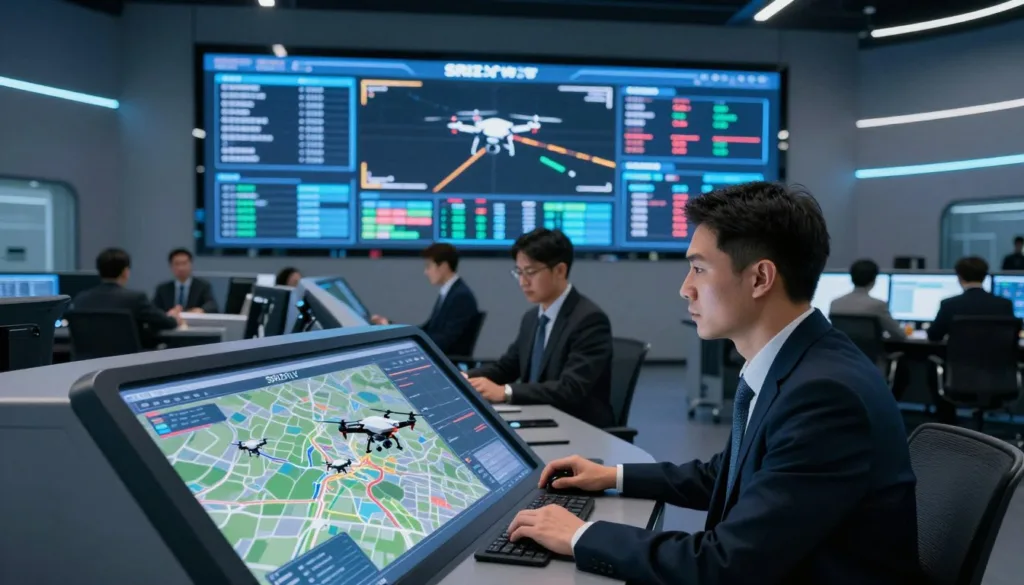
We present the functional anatomy of modern drone security simulation software. This short overview explains core modules, integration points, and how outputs inform operations. Our aim is to show practical value for teams responsible for safety, resilience, and mission success.
Core capabilities and modular features
At the heart of any suite sits a threat scenario builder that models weaponized drones, smuggling runs, ISR missions, and swarm attacks. Users set payload type, flight profile, autonomy level, and operator tradecraft to recreate realistic incidents.
Sensor integration supports synthetic feeds for testing. Systems include RF simulation for interference and signature testing, radar simulation for detection layers, and EO/IR emulation for visual tracking and identification. UTM feed simulation injects realistic airspace traffic to stress situational awareness tools.
Emulated adversary toolsets let teams run jamming, spoofing, cyber intrusion, and command-and-control hijack scenarios. Automation creates a central operating picture that aggregates incidents, timelines, and correlations so analysts can trace intent and trends across exercises.
Use cases across industries and mission types
Critical infrastructure operators and airports use these simulators to test perimeter detection, take-off point identification, and layered response plans. Exercises expose gaps in sensor placement and SOPs.
Prisons and stadium security teams run operational drills for detection, triage, response, and evidence preservation after contraband or explosive deliveries. Simulated incidents help refine chain-of-custody procedures and rapid containment tactics.
Military and government units apply red-team scenarios to shape doctrine, validate secure drone operations, and conduct cross-domain training. Commercial enterprises—tower inspection, mapping, and logistics teams—validate friendly-drone protections while checking counter-threat readiness.
Metrics, reporting and threat intelligence fusion
Reporting captures objective metrics: detection latency, false-positive rates, mitigation success, and trainee proficiency progression. Post-exercise analytics produce vulnerability rankings and prioritized mitigation steps.
Threat intelligence integration strengthens realism. DTIP integration and curated threat feeds let planners model emerging tactics, techniques, and procedures to forecast likely attack patterns. Outputs feed C-UAS analytics platforms for continuous improvement.
Actionable reports combine vulnerability assessments, mitigation-effectiveness measurements, and compliance guidance. These deliverables help security leaders make informed investments in sensors, training, and policy.
Designing an effective simulation program and training curriculum
We lay out a practical blueprint for a simulation-led training program that moves teams from core fundamentals to advanced red-team exercises. The curriculum aligns learning paths with recognized drone security certification milestones and mirrors market-proven course bundles. Our aim is to speed competency while keeping training defensible and auditable.
Learning paths and certification alignment
Start with a clear progression: beginner fundamentals, OSINT for drone investigations, C-UAS site assessments, then offensive and defensive tradecraft modules. Each track pairs hands-on labs with assessments that validate practical skills.
Offer blended learning that mixes instructor-led videos, self-paced modules, and live scenarios. This blended learning model cuts classroom time while improving retention. Include digital badges and mailed physical credentials to support formal drone security certification.
Protect course IP with watermarking and controlled content access. Use assessment-driven checkpoints so certified learners demonstrate competency in real-world tasks before receiving credentials.
Operationalizing lessons: policies, playbooks and SOPs
Translate simulation outcomes into actionable counter-drone SOPs for incident triage, evidence handling, and escalation paths. Use exercise results to build step-by-step playbooks that teams can follow during live events.
Run site vulnerability assessment exercises to map take-off points, sensor blind spots, and response times. Those findings feed a defensible mitigation roadmap tailored to the site and mission.
Design playbooks with cross-disciplinary input—cybersecurity, aviation safety, physical security, and legal teams. Regular drills reinforce roles for rapid coordination and clear decision authority during incidents.
Vendor selection, privacy and legal considerations in the United States
Apply rigorous vendor vetting: favor trainers with red-team, military, or threat-intel experience and proven records of securing UTM or UAM systems. Ask for case studies and references showing work with government or enterprise clients.
Review U.S. drone regulations before defining detection and mitigation actions. FAA rules and federal statutes limit certain countermeasures; ensure policies align with law to reduce operational risk.
Protect learner and incident data with access controls, secure storage, and watermarking of materials. Maintain audit logs for simulation outputs and apply retention policies that meet privacy and compliance needs.
We recommend trialing SRIZFLY simulators for up to 10 days to validate training fit, compare delivery modes, and confirm instructor expertise. Group discounts and options for live, in-person training help scale programs for intelligence, enterprise, and public-sector customers.
Conclusion
We have shown how simulation software links threat intelligence and hands-on training to deliver measurable C-UAS readiness for U.S. drone security. Simulations let teams validate countermeasures safely and repeatedly, turning theoretical threat feeds into operational outcomes. When drone simulation pilots practice realistic scenarios, detection latency and mitigation success become trackable metrics that inform policy and procurement.
Regular exercises, certified training, and threat intelligence fusion reduce risk across critical infrastructure, airports, corrections facilities, and enterprise drone teams. Proven programs delivered to government and law enforcement demonstrate improved hiring pipelines and faster operational readiness. These results drive clear simulation ROI: fewer incidents, faster response, and stronger compliance.
Practical next steps are straightforward: run a site vulnerability assessment, pilot a tailored simulation, and integrate threat feeds to measure effectiveness. Invest in certification and cross-disciplinary training to build internal C-UAS expertise and resilience. Use scenario results to create defensible mitigation roadmaps that stakeholders and regulators can trust.
We invite you to evaluate SRIZFLY with a 10-day SRIZFLY trial to test core modules, scenario builders, and reporting tools risk-free. Partner with us for expert-led training and measurable outcomes that improve efficiency, safety, and innovation in U.S. drone security. Your success drives our work—start with a pilot and see how simulation ROI accelerates readiness.
FAQ
What is drone security simulation software and who should use it?
Drone security simulation software models UAS threats, operator tradecraft, sensors, and mitigation tools to train teams and validate defenses without operational risk. SRIZFLY builds enterprise-grade simulators for tower inspection and mapping companies, logistics and agricultural operators, drone training schools, regional distributors, and U.S. government agencies—including emergency rescue, urban management, corrections, and airport security teams.
How do SRIZFLY simulators position themselves versus other solutions?
SRIZFLY combines realistic threat modeling, instructor-led and self-paced coursework, and integrated threat intelligence to accelerate readiness and reduce risk. We emphasize feature depth, price competitiveness, modular flexibility, and a 10-day free trial so organizations can evaluate core modules, scenario builders, and reporting tools risk-free.
What real-world drone threats does the platform simulate?
The platform covers weaponization, explosive payload delivery, contraband and narcotics smuggling, ISR and building-penetration reconnaissance, autonomous swarms, and asymmetric tactics. Simulations also model cyber attack vectors such as command-and-control hijack, telemetry tampering, and vulnerabilities in UTM/UAM software and supply chains.
Which attack vectors and supply-chain risks should defenders worry about?
Defenders must consider physical payload threats, RF jamming and spoofing, perimeter and sensor-gap exploitation, plus supplier and firmware compromise. SRIZFLY emulates those vectors—allowing teams to test hardened telemetry, secure firmware strategies, and vetted vendor scenarios so mitigation roadmaps address operational and supply-chain vulnerabilities.
Why are red-team exercises and simulation-led training important?
Simulations let teams safely validate detection, jamming, spoofing, and mitigation tactics without real-world danger. Repeatable red-team drills speed up detection, incident response, and evidence preservation workflows. They produce measurable metrics—detection latency, false-positive rates, and mitigation success—that drive continuous improvement and certifiable readiness.
What core capabilities does SRIZFLY offer in the simulator?
Core modules include a threat scenario builder for weaponized drones, smuggling, ISR, and swarm attacks; sensor and environment integration with simulated radar, RF, and EO/IR feeds; emulated adversary toolsets for jamming, spoofing and cyber intrusion; automation for incident aggregation and timelines; and reporting with post-exercise analytics and mitigation recommendations.
Can SRIZFLY integrate with threat-intel feeds and other systems?
Yes. The platform supports integration with DTIP-style feeds and other threat-intelligence sources to model emerging TTPs. It also exports a central operating picture and structured outputs for SIEM, C-UAS vendors, and operational dashboards so teams can correlate incidents and forecast intent across exercises.
What measurable outcomes should organizations expect after using the simulator?
Organizations see validated improvements in detection and response workflows, reduced detection latency, lower false-positive rates, and higher mitigation success. Training efficiency improves—often dramatically—through repeatable exercises and assessment-driven certification that prove practical skills for security teams, law enforcement, and military units.
How are learning paths and certifications structured?
Learning paths run beginner-to-advanced: fundamentals, OSINT for drone investigations, C-UAS site assessments, and offensive/defensive tradecraft. Assessments yield digital and physical certifications, with watermarking and access controls to protect content. Delivery is blended—self-paced modules, instructor-led video, and hands-on labs that mirror SRIZFLY’s training model.
How do simulation results translate into operational playbooks and SOPs?
Post-exercise analytics produce vulnerability rankings, recommended mitigations, and site-specific mitigation roadmaps. Teams can convert findings into SOPs for incident triage, evidence handling, escalation paths, and layered response plans—aligning cyber, aviation, and physical security stakeholders around defensible procedures.
What legal, privacy, and vendor-selection issues should U.S. organizations consider?
U.S. organizations must ensure detection and mitigation policies comply with FAA and federal/state laws. Choose vendors with red-team, military, and threat-intel experience. Protect training outputs with watermarking, secure storage, and access controls. SRIZFLY follows these practices and offers options for controlled content and enterprise data handling.
Which industries benefit most from drone security simulations?
High-value sectors include critical infrastructure and airports, prisons and stadiums, military and government units, and commercial enterprises such as tower inspection, mapping, logistics, and agriculture. Each use case benefits from scenario-driven validation of detection coverage, take-off point identification, and layered response plans.
How does SRIZFLY support custom scenarios and site-specific modeling?
The scenario builder allows configurable payloads, flight profiles, autonomy levels, and operator tradecraft. Teams can model site-specific sensor coverage, synthetic UTM traffic, and environmental conditions to test realistic worst-case and common threat patterns tailored to their mission.
What reporting and analytics does the platform produce after exercises?
Reports include detection and mitigation metrics, timelines, vulnerability assessments, and actionable recommendations. Outputs support compliance guidance, procurement decisions, and training progression tracking. They help prioritize fixes—sensor placement, SOP updates, and vendor remediation actions.
Can SRIZFLY training accelerate hiring and internal capability building?
Yes. Assessment-driven certification validates practical skills and accelerates hiring pipelines. Organizations use SRIZFLY courses to build internal C-UAS expertise—reducing reliance on external contractors and improving cross-disciplinary readiness across security, aviation, and cyber teams.
Is there a way to evaluate SRIZFLY risk-free?
SRIZFLY offers a 10-day free trial that provides access to core modules, the scenario builder, and reporting tools. The trial lets teams validate features, integration, and measurable outcomes before committing—aligning with our mission to deliver efficient, safe, and innovative simulation solutions.
Who develops the training content and threat modeling used in SRIZFLY courses?
Training and threat models are authored by subject-matter experts—hackers, ex-military pilots, and threat-intel analysts with practical red-team experience dating to documented vulnerabilities since 2015–2016. Content reflects industry practices used by specialist trainers and mirrors automated incident aggregation methods used by established intelligence platforms.
How does SRIZFLY help organizations stay ahead of evolving drone threats?
By fusing threat-intel feeds, red-team tradecraft, and repeatable simulations, SRIZFLY enables teams to model emerging TTPs, forecast trends, and validate mitigations. Regular exercises and metrics-driven reporting create a feedback loop that hardens defenses and informs procurement and policy decisions.
What are the next recommended steps for organizations new to simulation-led training?
Begin with a site vulnerability assessment, pilot a tailored simulation, and use results to build a defensible mitigation roadmap. Integrate threat-intel feeds, track metrics like detection latency and mitigation success, and invest in certification and cross-disciplinary training to institutionalize C-UAS expertise.