



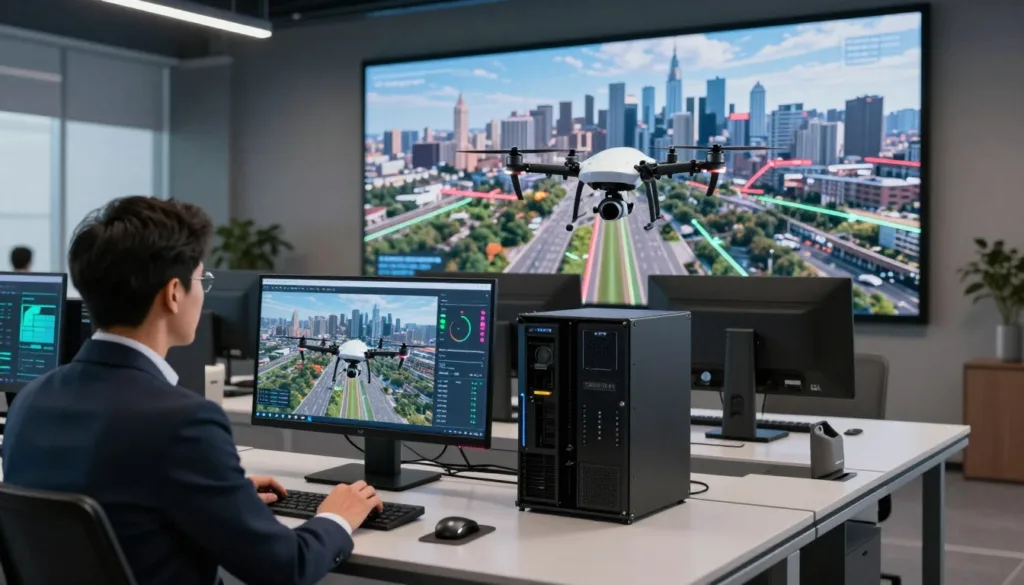
The race to build safer, faster, and more cost-effective drone programs is underway across American industry. Enterprise-level drone simulation software gives teams a controlled space to test aircraft designs, train pilots, and rehearse complex missions before committing hardware to the field. For many organizations, a drone simulator for enterprises has moved from a nice-to-have into a strategic tool that reduces risk and accelerates time to operations.
SRIZFLY simulator stands out as a practical example of how enterprise UAV simulation ties together flight physics, mission planning, and training workflows. Platforms like SRIZFLY and cloud-native competitors such as SIMNET illustrate common capabilities: high-fidelity flight models, virtual testing, and integrated pilot training linked to learning management systems. These capabilities support use cases from R&D labs at Boeing and Embry-Riddle Aeronautical University to inspection teams using DroneDeploy and Pix4D workflows.
Market reports show rapid expansion in the simulator market through 2030, driven by commercial inspections, public safety, and defense modernization. Modern US drone training software emphasizes autonomous planning, AI-enabled data processing, and secure fleet management. These trends shape procurement requirements for enterprises seeking scalable, interoperable simulation solutions.
Key Takeaways
- Enterprise-level drone simulation software reduces risk and lowers prototyping costs.
- SRIZFLY simulator models illustrate how training, design, and operations converge.
- Cloud-native platforms like SIMNET speed development and scale training across teams.
- Real-world integrations with tools like DroneDeploy and DJI Terra matter for workflows.
- Market growth and regulatory demands make simulator investment timely for US businesses.
Why enterprise-level drone simulation software matters for US businesses
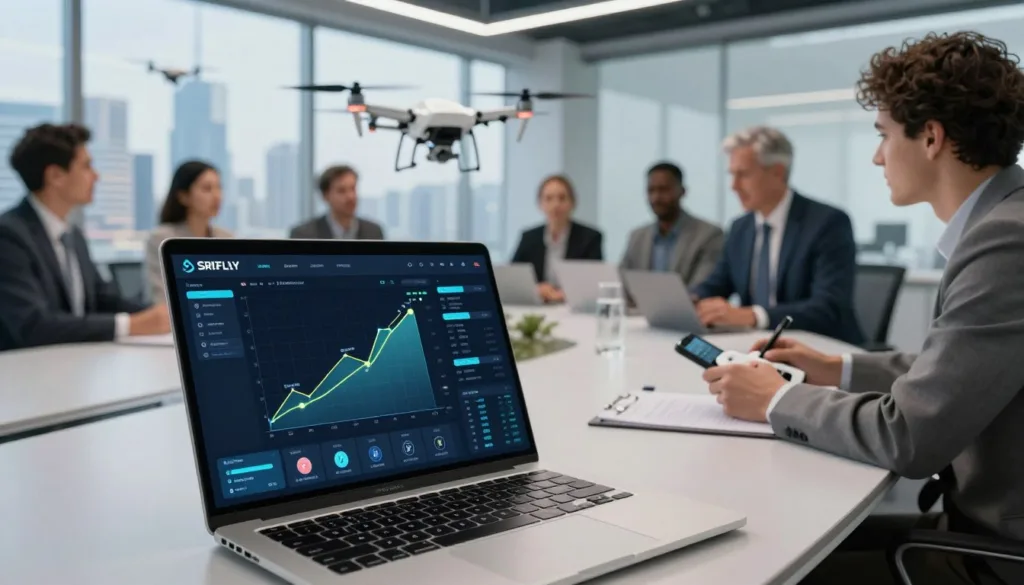
Enterprise drone simulation software shapes how companies design aircraft, train crews, and plan missions. Firms from defense contractors to utilities use simulators to cut risk and speed decision making. The link between investment and measurable outcomes makes business value drone simulation a boardroom topic.
Market growth and industry drivers
The drone simulator market growth is driven by demand in both commercial and defense sectors. Legacy aerospace names like CAE, Lockheed Martin, Boeing, and Raytheon supply high-fidelity systems for mission rehearsal and hardware-in-the-loop testing. That pedigree answers public safety and military needs for realistic, repeatable scenarios.
Cloud-native vendors such as DroneSimPro and SIMNET meet commercial buyers in construction, agriculture, mining, and energy. These platforms scale across teams and lower entry costs. Trends such as AI analytics, digital twins, BVLOS planning, and integration with ArduPilot and PX4 increase adoption across industries.
Business outcomes and ROI
Companies report faster prototyping when they run virtual wind tunnel and CFD analyses in simulation before building hardware. That reduces material costs and shortens design cycles. When teams perform flight control tuning in software, field failures drop and certification timelines shrink.
Training programs show clear enterprise drone ROI. Simulators remove risk, reduce wear on real aircraft, and let organizations scale remote learning with LMS integration. Auto-graded exercises provide objective metrics for regulators and managers, supporting safer BVLOS approvals and documented competency.
Operational teams gain value by validating failsafe routines and terrain-following logic before live flights. That lowers mission aborts, cuts insurance exposure, and improves on-time mission delivery for inspection and logistics tasks.
Cross-industry use cases
Development teams use simulation for airframe and control-system validation, trade studies, and turnkey client demonstrations. Simulators let engineers test sensor suites and autonomy without the cost of repeated prototypes.
Utilities, rail operators, and public safety agencies rehearse BVLOS missions and contingency procedures. They generate evidence for regulators and tighten operational risk management. Mapping and surveying firms test flight plans and sensor setups before mobilizing crews to remote sites.
Training providers and universities such as Embry-Riddle and Elizabeth City State University integrate simulation into curricula. LMS interfaces track proficiency and let instructors scale courses while keeping training standards high.
| Use Case | Primary Benefit | Representative Vendor or Institution |
|---|---|---|
| Airframe and control validation | Lower prototyping costs; faster design iterations | SIMNET |
| Mission rehearsal for BVLOS | Safer approvals; regulator-ready evidence | Lockheed Martin |
| Training and certification | Scalable remote learning; objective assessment | Embry-Riddle |
| Inspection and mapping planning | Optimized flight plans and sensor configuration | DroneSimPro |
| Hardware-in-the-loop testing | Realistic system integration checks before flight | CAE |
Core features to evaluate in enterprise-level drone simulation software
Choosing a simulator for enterprise use means looking past marketing claims. Focus on capabilities that protect investment, speed development, and scale training. Look for precise flight models, cloud-native delivery, test and analysis tools, training workflows, mission rehearsal with digital twins, and robust data security.
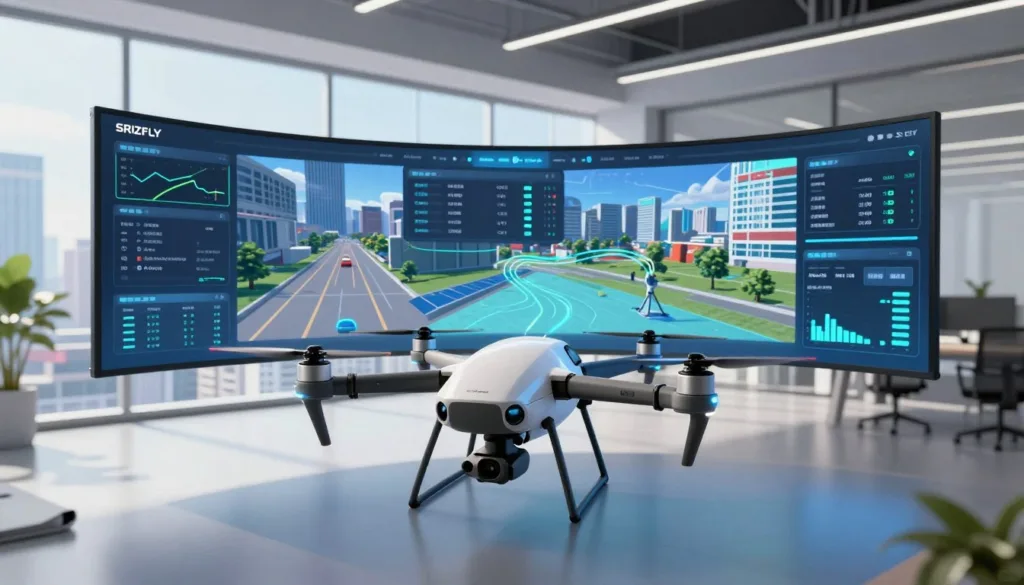
High-fidelity flight physics and hardware-in-the-loop capabilities
Accurate flight dynamics are essential for valid test results. Suppliers such as CAE and Lockheed Martin emphasize high-fidelity flight physics to match real-world handling. Systems should support both manual and autonomous modes, USB transmitters, gamepads, and SITL/SIL links for ArduPilot and PX4.
Hardware-in-the-loop setups let engineers validate autopilots and sensors before bench tests. This reduces costly failures during flight test. Look for configurable AI-driven scenarios and repeatable test sequences when evaluating HIL performance.
Cloud-native architecture and scalability
Cloud-native drone simulator platforms let teams run large numbers of concurrent sessions. Options from modern vendors enable global sharing of scenarios and central management of updates. A cloud-native approach cuts local compute needs and supports web-based access for distributed teams.
Key features include multi-user collaboration, global 3D terrain, VR support for headsets like Meta Quest, session recording, and CSV export for analysis. Scalability should match pilot counts and simulation fidelity without major hardware purchases.
Design, analysis, and virtual testing toolsets
Integrated design tools shorten the path from CAD to test. Look for export options such as STEP and STL, plus performance prediction for range, speed, and endurance. Built-in virtual wind tunnel and CFD visualization speed aerodynamic checks early in development.
Exportable design reports and CAD files streamline iterations. Trade-study panes and automated test suites help compare configurations and quantify gains before committing to prototypes.
Pilot training, LMS integration, and certification support
Training readiness is a must for enterprise fleets and providers. The best systems include cataloged exercises and instructor tools to scale across locations. LMS integration for drone training allows auto-graded courses and proficiency tracking across pilots.
Support for certified content and customizable course creation helps meet regulatory needs. Integration with platforms that issue certificates speeds compliance with agency requirements and corporate policies.
Mission rehearsal, digital twins, and operational planning
Digital twin drone simulation enables mission rehearsal in realistic environments. Creating twins of aircraft and operational areas helps validate BVLOS flights, SORA assessments, and failsafe responses under variable weather and failure modes.
Workflows that link ground control software to the simulator let planners rehearse complex missions. These rehearsals improve operator confidence and reduce risk during real deployments.
Data security, interoperability, and integration
Enterprises must protect intellectual property and flight telemetry. Data security drone software should include encryption, role-based access, and secure protocols to meet IT requirements. Audit logs and secure key management are important for audits.
Interoperability with ground control stations like QGroundControl and Mission Planner matters. Export compatibility with DroneDeploy, Pix4D, and DJI Terra keeps mapping and photogrammetry workflows intact. APIs and standard formats smooth integration into fleet management and enterprise IT.
| Feature Area | What to verify | Why it matters |
|---|---|---|
| Flight Dynamics | High-fidelity flight physics, SITL/PX4 links, USB transmitter support | Ensures simulation matches real handling for development and pilot training |
| Hardware Testing | Hardware-in-the-loop, sensor simulation, repeatable test scripts | Makes bench validation safer and reduces flight test failures |
| Cloud & Scale | Cloud-native drone simulator, multi-user sessions, global terrain | Scales training and development without heavy local infrastructure |
| Design Tools | Virtual wind tunnel, CFD visualization, STEP/STL export | Speeds design iteration and reduces need for physical prototypes |
| Training | LMS integration for drone training, auto-graded courses, instructor tools | Supports compliance and scalable pilot proficiency tracking |
| Operations | Digital twin drone simulation, mission rehearsal, GCS integration | Enables safe BVLOS planning and real-world mission validation |
| Security & Integration | Data security drone software, APIs, interoperability with mapping tools | Protects data and preserves downstream workflows for mapping and inspection |
Top enterprise vendors and competitive landscape for drone simulators
Choosing the right simulator starts with understanding who leads the market and why their strengths matter to your program. Legacy firms bring deep simulation heritage and secure, mission-ready systems. New entrants emphasize cloud-first workflows, rapid iteration, and lower cost of entry. This mix shapes procurement, deployment speed, and long-term support for US businesses.
CAE leads with proven training systems and high-fidelity solutions built for scale. A CAE drone simulator offers immersive scenarios, hardware-in-the-loop options, and AI-driven scenario customization. Lockheed Martin focuses on defense-grade HIL and SIL tools. Lockheed Martin UAV simulation products target mission rehearsal and compliance with strict military standards.
Boeing delivers modular platforms that fit R&D and operator readiness needs. Raytheon and L3Harris provide secure, mission-critical architectures with mixed-reality integration for government customers. General Atomics and Leonardo supply high-fidelity suites for long-endurance UAVs, while Elbit Systems offers interactive platforms with real-time analytics for training institutes.
Commercial and cloud-native innovators
SIMNET represents a new class of cloud-native drone simulation providers. SIMNET blends design, simulation, and training with real-time performance prediction, a virtual wind tunnel, global terrain, VR, and LMS integration. Universities and development teams use SIMNET for rapid prototyping and collaborative testing.
Smaller firms such as DroneSimPro Inc. and Aero Simulation Technologies deliver cost-effective, customizable simulators that run on desktop, cloud, and VR setups. Adjacent platforms like DroneDeploy, Pix4D, and DJI Terra add mapping and automation tools that intersect with simulator toolchains for development and operational planning.
Choosing between enterprise and specialist platforms
Enterprise legacy vendors deliver unmatched fidelity and secure architectures. Large defense contracts and strict certification needs often favor these suppliers despite higher costs and longer procurement cycles.
Cloud-native options win on speed, ease of use, and collaboration. For rapid product development or scaling training at lower cost, cloud-native drone simulation providers reduce setup time and simplify updates.
For organizations weighing SIMNET vs legacy simulators, match the platform to the mission. Choose legacy vendors for mission-critical defense work and public safety exercises where security and fidelity are non-negotiable. Pick cloud-native innovators to accelerate R&D, enable distributed teams, and integrate with modern DevOps pipelines.
Implementation considerations for US businesses deploying simulators
Deploying an enterprise simulator requires clear choices around architecture, licensing, integration, and people. Early decisions shape cost, compliance, and time to value. This section outlines practical steps to guide a smooth drone simulator deployment for U.S. operations.
Deployment models and licensing
Choose between on-premises, cloud-hosted SaaS, hybrid stacks, or VR-enabled desktop clients based on security and latency needs. Cloud-native providers such as SIMNET let teams scale quickly and offer flexible licensing models drone software teams expect.
Negotiate licensing that maps to real roles: developer seats for engineers, operator seats for field pilots, instructor/admin accounts, and student pricing for academy use. For OEMs, turnkey client simulators reduce installation friction and speed testing cycles.
Integration with existing workflows and tools
Verify compatibility with common ground control stations like QGroundControl and Mission Planner and with autopilot stacks such as ArduPilot and PX4. Ensure CAD exports (STEP, STL) and photogrammetry outputs from DroneDeploy or Pix4D import cleanly for mission planning.
Make sure simulation logs export to CSV and that recording and analytics feed enterprise BI and engineering toolchains. Plan how to integrate and automate reporting so teams can easily integrate drone simulator with LMS and other learning platforms.
Regulatory readiness and documentation
Use robust simulation scenarios and digital twins to produce SORA simulation evidence for BVLOS and other approvals. Record failsafe tests, terrain-following runs, and mission risk assessments to support regulators.
Keep traceable documentation: scenario definitions, time-stamped test logs, performance reports, and signed training completion records. These records simplify audits and strengthen safety cases for the FAA and other agencies.
Change management and pilot onboarding
Design training pathways that combine auto-graded practical exercises and instructor-led sessions. Integrate competency assessments into the LMS so managers can track progress and certify staff.
Set up pilot onboarding simulation curricula that begin with basics and progress to mission rehearsal. Offer sandbox environments and continuous updates so pilots validate changes before live flights. Provide technical support and a clear escalation path to maintain operational readiness.
Practical checklist
- Confirm target deployment model and security posture.
- Map user roles to licensing to avoid overpaying.
- Test data flows with GCS, autopilots, CAD, and photogrammetry tools.
- Produce SORA simulation evidence and store audit-ready logs.
- Integrate pilot onboarding simulation into the LMS with assessment tracking.
Case studies and practical ROI examples from enterprise deployments
The examples below show how enterprise teams use simulation to speed development, prove safety, and scale training. Each story highlights measurable gains and real workflows from recognized institutions and operators.
Drone development teams speeding prototype cycles
A cloud-native platform lets engineers import CAD models, run virtual wind-tunnel and CFD scenarios, and test control laws before a single part is printed. This prototype acceleration drone workflow cut physical prototype iterations for a commercial VTOL project by more than half.
Teams exported STEP and STL files from simulation to 3D printing, reducing time-to-first-flight. Validating control algorithms in simulation reduced flight-test failures and saved material costs during qualification.
Operators improving BVLOS safety and regulatory approvals
Operators use mission rehearsal and digital twins to rehearse complex BVLOS routes. Simulations test failsafe logic, terrain following, and dynamic-weather scenarios to build evidence for regulators under SORA processes.
These BVLOS simulation benefits include fewer cancelled missions, faster approvals, and clearer operational envelopes. Simulated failure cases demonstrated robust mitigations, which shortened review cycles and improved operational margins.
Training providers scaling remote learning
Web-based simulators integrated with LMS platforms let training firms expand remote course catalogs and reach new students. Institutions such as Embry-Riddle Aeronautical University and New Jersey Institute of Technology report wider enrollment without proportional hardware purchases.
Simulation-based training ROI shows up as lower delivery costs, faster trainee proficiency, and automated assessment. Auto-graded modules give instructors objective metrics on skills and readiness while providers focus on content and student outcomes.
Below is a concise comparison of practical gains across these deployments.
| Use Case | Primary Gain | Key Metric | Example Benefit |
|---|---|---|---|
| Prototype acceleration drone | Faster design iterations | Prototypes per quarter | 50% reduction in physical builds |
| BVLOS operational planning | Regulatory readiness | Approval time | 30% faster route acceptance |
| Remote simulator training | Scalable education | Student throughput | 2x enrollment with same instructor hours |
These drone simulation case studies underline repeatable processes: validate early in virtual environments, export validated artifacts into production, and use rehearsal evidence to satisfy regulators. Tracking simulation-based training ROI and BVLOS simulation benefits helps justify platform investments and operational changes.
Implementation checklist and procurement guidance for US enterprises
Before issuing an RFP, gather clear requirements for each user group. List developers, operators, instructors, and students with seat counts. Define mission types such as R&D, BVLOS operations, inspection, mapping, and training. Capture integration points for autopilot stacks like ArduPilot and PX4, ground control stations, CAD tools, learning management systems, and enterprise IT constraints.
Set measurable performance targets. Specify terrain fidelity, flight physics accuracy, HIL/SIL needs, multi-user collaboration, VR support, and export formats. Record required sensor models for LiDAR, thermal, and camera payloads. Note expected concurrent users, offline modes, and acceptable latency for cloud or on-premise deployments.
Requirements gathering
- Map user roles to workflows and seat licensing.
- List mission profiles and test-case scenarios.
- Document integration needs: autopilot, GCS, CAD, LMS, and security policies.
- Define performance KPIs: physics fidelity, terrain detail, HIL/SIL, VR, and export types.
Technical evaluation criteria
Run hands-on tests that validate flight dynamics and hardware interfaces. Confirm support for global 3D terrain, simulation recording in CSV, real-time monitoring panels, and VR. Measure cloud scalability with stress tests for concurrent users and latency. Verify compatibility with common payloads and sensor simulations.
- Assess fidelity of flight physics and repeatability.
- Test HIL/SIL integration with real autopilots and sensors.
- Validate design toolsets: wind tunnel, trade studies, CAD export (STEP/STL), and automated reports.
- Include a scripted technical evaluation drone simulator checklist for reproducible scoring.
Security, support, and vendor due diligence
Inspect vendor security practices. Require encryption at rest and in transit, role-based access control, and documented secure communication. Ask for compliance evidence when applicable. Request customer references and case studies from vendors with defense-grade practices, similar to those used by L3Harris or Raytheon, to confirm maturity.
- Verify SLAs for support, patch cadence, and training materials.
- Confirm availability of turnkey services and custom engineering.
- Ensure vendors can provide exportable simulation logs and documentation for regulatory submissions.
- Perform simulator vendor due diligence that includes penetration testing results and SOC/ISO reports when available.
Budgeting and total cost of ownership
Estimate license fees, cloud compute, and storage costs. Add onboarding, training, custom content creation, and integration engineering. Plan for long-term maintenance, scaling seats, and support tiers. Evaluate on-premise costs if sensitive operations require offline modes.
| Cost Category | Short-term | Long-term | Notes |
|---|---|---|---|
| Licensing | Subscription or perpetual fee | Renewals, seat expansion | Compare enterprise legacy vs cloud-native models |
| Cloud compute & storage | Initial provisioning | Ongoing usage and backups | Include costs for high-fidelity terrain and sensor data |
| Integration & engineering | API integration, connectors | Custom feature maintenance | Account for CAD, GCS, LMS work |
| Training & onboarding | Instructor time, materials | Refresher courses, new hires | Consider vendor-led vs internal training |
| Security & compliance | Baseline audits | Ongoing certifications and pen tests | Necessary for regulated BVLOS and defense work |
Estimate drone simulation TCO by adding direct and indirect costs. Build payback timelines using reduced prototyping costs, fewer flight tests, and scaled training efficiency. Compare legacy aerospace vendors with higher upfront customization against cloud-native providers that offer subscription pricing and faster time to value.
Use a targeted drone simulator procurement checklist when scoring vendors. Include measurable technical metrics and clear governance for contract terms. Keep the evaluation focused on measurable outcomes like simulation fidelity, integration ease, regulatory traceability, and long-term drone simulation TCO.
Conclusion
Enterprise-level drone simulation is now central to modern UAV development, training, and operations. This enterprise drone simulation conclusion emphasizes choosing platforms with high-fidelity flight physics, hardware-in-the-loop support, cloud-native scalability, and strong data security to meet FAA and SORA needs.
Use the implementation checklist to align procurement with business goals. Define user roles, test technical fidelity with your aircraft and missions, and validate vendor support and interoperability. For US teams focused on operational readiness, SRIZFLY enterprise simulator and cloud-native offerings such as SIMNET deliver measurable ROI through faster prototyping, safer BVLOS approvals, and scalable training.
Next steps are practical: schedule demos with shortlisted vendors, request trial access to verify mission rehearsal and digital twins, and gather regulatory evidence from trial runs for submissions. When you choose drone simulator US businesses, prioritize vendors that prove fidelity, security, and clear total cost of ownership to ensure lasting value.
FAQ
What is enterprise-level drone simulation software and who uses it?
Enterprise-level drone simulation software is a suite of tools that replicates real-world flight physics, sensor behavior, and mission environments for development, training, and operational rehearsal. Typical users include UAV development teams, fleet operators in utilities, energy, construction and surveying, public safety agencies, training providers, and universities such as Embry-Riddle that integrate simulation into curricula. Vendors range from legacy aerospace firms like CAE Inc., Lockheed Martin, Boeing, Raytheon, L3Harris, General Atomics, Leonardo, and Elbit Systems to cloud-native innovators such as SIMNET, DroneSimPro Inc., Aero Simulation Technologies, and SRIZFLY-style enterprise simulators.
Why should a US business invest in an enterprise drone simulator?
Investing in simulation reduces prototyping costs, lowers risk in early flight testing, and accelerates time-to-certification for BVLOS operations. Simulators let teams run virtual wind-tunnel and CFD analyses, validate control logic with HIL/SIL testbeds, and rehearse mission profiles for regulatory evidence such as SORA. Training ROI is measurable: fewer hardware flight hours, scalable remote learning through LMS integration, and auto-graded practical exercises that track proficiency and compliance.
What market trends are driving adoption of drone simulators?
Rapid market growth—forecast to more than double by 2030—is driven by commercial use in construction, mining, agriculture, energy, and surveying, plus defense and public safety needs. Key trends include cloud-native platforms, AI/ML analytics, autonomous BVLOS planning, digital twins, integration with autopilots (ArduPilot, PX4), and interoperability with mapping tools like DroneDeploy, Pix4D, DJI Terra, and Agisoft Metashape.
What core technical features should we evaluate?
Evaluate fidelity of flight physics, HIL/SIL support for avionics and control testing, global 3D terrain, sensor models (LiDAR, thermal, RGB), virtual wind tunnel and CFD visualization, and CAD export (STEP, STL). Also confirm SITL/SITL connectivity with ArduPilot/PX4, multi-user cloud scalability, VR support, simulation recording and CSV export, and LMS and API integration for training and analytics.
How important is cloud-native architecture versus on-premises deployment?
Cloud-native solutions offer rapid scaling, centralized updates, global digital-twin sharing, and lower local compute needs—useful for distributed training and remote teams. On-premises or hybrid deployments can be required for sensitive operations, classified workloads, or where latency and offline operation matter. Choose cloud for agility and cost-efficiency; choose on-premises or hybrid when security, certification, or air-gap requirements dominate.
How do simulators support pilot training and certification?
Enterprise simulators integrate with LMS platforms to deliver cataloged exercises, instructor tools, and auto-graded assessments. They can track seat types (developer, operator, instructor, student), record training logs, and generate completion reports for audits. Simulations provide objective metrics for proficiency, help prepare pilots for FAA or SORA processes, and reduce live flight hours.
Can simulation data be used for regulatory submissions like SORA and FAA BVLOS approvals?
Yes. Mission rehearsal and digital twin outputs can document failsafe behavior, terrain-following, contingency handling, and performance margins. Simulators produce traceable logs, scenario records, and performance reports that form part of a SORA evidence package or FAA risk assessment. Verify the vendor can export audit-ready logs, CSVs, and test reports to support submissions.
How do I ensure data security and enterprise interoperability?
Require encryption at rest and in transit, role-based access control, secure APIs, and compliance with enterprise security standards. Confirm compatibility with ground control stations like QGroundControl and Mission Planner, autopilot stacks (ArduPilot, PX4), mapping tools (DroneDeploy, Pix4D), and BI systems via exportable logs and CSVs. Assess vendor security practices, SLAs, and support for private-cloud or on-premise deployments for sensitive data.
What are the differences between legacy aerospace vendors and cloud-native innovators?
Legacy vendors (CAE, Lockheed Martin, Boeing, Raytheon, L3Harris, General Atomics, Leonardo, Elbit) offer unmatched fidelity, HIL/SIL expertise, secure architectures, and deep defense relationships. Cloud-native innovators (SIMNET, DroneSimPro, Aero Simulation Technologies, SRIZFLY-style platforms) emphasize rapid deployment, cost-effective scaling, easy web collaboration, and faster update cycles. Selection depends on use case: choose legacy for mission-critical defense and high-stakes public safety; choose cloud-native for rapid R&D, scalable training, and integration with modern DevOps.
Which integrations with mapping and photogrammetry tools are typical?
Leading simulators integrate with DroneDeploy, Pix4D, DJI Terra, Agisoft Metashape, Bentley iTwin Capture Modeller, WebODM, and Virtual Surveyor. They export flight plans, sensor captures, and geotagged imagery for downstream photogrammetry and inspection workflows. Confirm export formats (GeoTIFF, EPT, LAS, JPG, CSV) and compatibility with client processing pipelines.
What does a procurement and implementation checklist look like?
Define user roles and seat counts, identify mission types (R&D, BVLOS, inspection, mapping, training), capture integration needs (autopilots, GCS, CAD, LMS), and set performance targets (terrain fidelity, HIL/SIL, multi-user). Evaluate vendor security, support SLAs, update cadence, and demos with your aircraft and missions. Model total cost of ownership including licensing, cloud compute, storage, onboarding, and integration engineering.
How should we budget for licensing, cloud compute, and long-term costs?
Budget for subscription or license fees, cloud compute and storage, onboarding/training, custom scenario or content creation, and integration engineering. Include support tiers and future seat scaling. Compare higher upfront costs and customization time from legacy vendors against subscription-based, faster-ROI cloud offerings. Factor in savings from reduced prototyping and fewer failed test flights when calculating payback.
What demonstration or trial steps should we request from vendors?
Request hands-on demos with your aircraft models and mission profiles, trial access to test fidelity with ArduPilot/PX4 SITL, and the ability to run virtual wind-tunnel or CFD scenarios. Ask for exports (STEP/STL, CSV logs), LMS integration examples, and evidence of SORA-supporting reports. Evaluate cloud latency and concurrency, VR support, and sensor models that match your payloads.
How do simulators speed up drone development and reduce prototyping time?
Simulators let engineers run trade studies, validate control laws, tune flight controllers, and perform virtual wind-tunnel and CFD analyses without physical builds. The ability to export validated CAD or STL files speeds iteration and reduces 3D-print cycles. Teams report fewer in-flight failures and faster time-to-certification by validating systems in simulation first.
What support and change-management practices work best for enterprise rollouts?
Establish structured training pathways, LMS-based curricula, instructor-led and self-guided modules, and competency assessments with auto-graded exercises. Provide sandbox environments for safety-critical validation, clear onboarding documentation, and SLAs for vendor support. Track key readiness metrics via LMS and integrate simulator results into operational SOPs and audits.
Are there real-world examples of universities or operators using these simulators?
Yes. Institutions like Embry-Riddle Aeronautical University and technical university teams have adopted cloud-native platforms such as SIMNET to teach design, simulation, and pilot training. Operators in utilities and infrastructure use mission rehearsal and digital twins to validate BVLOS routes and failsafe behaviors. Vendors provide case studies showing measurable reductions in training costs and faster prototype cycles.
How do I choose between feature sets like HIL/SIL, VR, or detailed CFD?
Prioritize features based on use case. R&D and control validation require HIL/SIL and detailed CFD. Operator training and mission rehearsal benefit from multi-user cloud, digital twins, and VR for situational immersion. Mapping and inspection teams need accurate sensor models and photogrammetry export. Balance fidelity needs with budget and deployment speed.
What KPIs should we track to measure simulator ROI?
Track reduced physical test flights, decreased prototyping cycles, training hours saved, pass/fail rates on practical assessments, time-to-certification for BVLOS approvals, mission cancellation rates, and incident reductions after rehearsal. Monitor cloud usage, seat utilization, and LMS proficiency scores to measure operational and training impact.
Can simulators integrate with our existing ground control stations and autopilot stacks?
Most enterprise platforms support integration with QGroundControl, Mission Planner, ArduPilot, and PX4 via SITL and API connections. Confirm specific connector support and test end-to-end mission planning and replay workflows to ensure seamless integration with your ground control and fleet management systems.
What export and reporting formats should I insist on?
Require exportable CSV simulation logs, flight recordings, CAD exports (STEP, STL), georeferenced imagery (GeoTIFF, JPG), LiDAR point clouds (LAS), and PDF performance reports. These formats enable audits, regulatory submissions, and downstream photogrammetry or BI analysis.
How do digital twins and mission rehearsal reduce operational risk?
Digital twins recreate mission environments, terrain, and dynamic weather so teams can rehearse BVLOS routes, validate failsafe logic, and exercise contingency procedures without risking hardware. This uncovers edge cases, optimizes flight plans, and produces evidence for regulators—leading to fewer real-world failures and safer margins.
What support should we expect for custom content and scenario creation?
Enterprise vendors typically offer custom scenario creation, turnkey client simulators, and professional services for building mission-specific digital twins and sensor models. Confirm pricing, delivery timelines, and ownership of custom assets. Cloud-native vendors often provide faster turnaround for iterative content updates.
How do simulators handle sensor and payload modeling like LiDAR and thermal cameras?
Robust platforms include configurable sensor models for RGB, multispectral, thermal, and LiDAR, with adjustable parameters for resolution, noise, and sampling rates. Verify test datasets, export compatibility with processing tools such as Pix4D, DroneDeploy, Agisoft Metashape, and Virtual Surveyor, and the ability to validate sensor placement and settings before field deployment.
What licensing models are common and how should we plan seat types?
Licensing options include per-seat subscriptions, bulk institutional licenses, enterprise agreements, and developer or operator seat tiers. Plan for developer seats for engineers, operator seats for pilots, instructor/admin roles, and student pricing for educational programs. Ensure the license covers cloud compute and content creation or factor those as add-ons.