



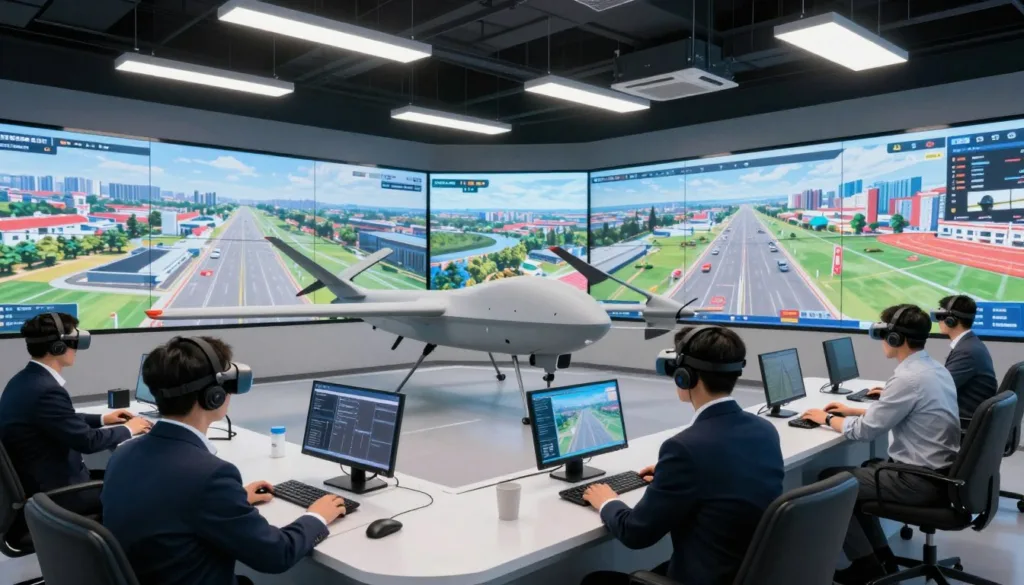
We deliver practical, industry-proven guidance for unmanned aerial vehicle simulation training. Our approach fuses Airbus UAS Simulation Trainer capabilities with open-source SITL workflows and high-fidelity 3D visualization built on Unreal Engine and Cesium. The result is a coherent path from ab‑initio instruction to mission rehearsal for complex ISTAR, mapping, and inspection tasks.
SRIZFLY simulators integrate MAVLink visualization and SITL training to replicate real message flows without hardware. This reduces wear on fleets, cuts training cost, and accelerates drone R&D cycles. Ground control systems such as QGroundControl and Mission Planner pair with 3D scenes to give pilots both 2D mission planning and immersive spatial context.
Academic and industry voices — including leaders who focus on reproducible research, vision-based agile flight, and multi-robot simulation — validate this layered architecture. We are committed to delivering drone training solutions that improve safety, scale quickly, and raise operational efficiency for U.S. enterprises, training centers, distributors, and government agencies.
Key Takeaways
- Combines Airbus-grade trainers, SITL/MAVLink ecosystems, and Unreal/Cesium visualization.
- SRIZFLY simulators cut hardware wear and lower training costs.
- SITL training enables realistic MAVLink visualization without onboard systems.
- Supports drone R&D by providing risk-free algorithm testing and mission rehearsal.
- Designed for enterprises, education providers, distributors, and public-sector operators.
Overview of Unmanned Aerial Vehicle Simulation Training
We present a clear view of modern UAV simulation training designed for U.S. operators. Training blends basics with mission-focused work so teams gain practical skills fast. Our approach supports enterprises, training centers, and public agencies seeking measurable improvements in safety and efficiency.
What UAV simulation training covers
Core modules teach flight fundamentals: flight dynamics, navigation, and mission procedures. Trainees move from ab-initio drone training to complex scenarios without exposing hardware to risk.
System-specific lessons cover small tactical UAS, MALE platforms, and multi-role systems. Instructor tools let trainers author realistic scenarios and replay missions for focused debriefs.
Sensor modeling includes EO IR SAR simulation to prepare crews for ISTAR training and reconnaissance tasks. Simulation architectures use SITL, MAVLink, and tools like DroneKit to emulate autopilots and automate missions.
High-fidelity visualization through engines such as Unreal and Cesium delivers textured geospatial context. This makes urban navigation, adverse weather handling, and emergency response practice more realistic.
Benefits for U.S. pilots and operators
Simulation gives risk-free drone practice that reduces crashes and hardware wear. Training saves costs while improving operational readiness across civil and defense users.
Mission-readiness training shortens transition times from classroom to field. Data-driven scenario replay and instructor assessment boost learning efficiency by focusing on weak points.
ISTAR training with EO IR SAR simulation readies crews for surveillance and search missions. Swarm and autonomy modules support multi-robot coordination and sim-to-real research used by academic and industry programs.
We are committed to delivering SRIZFLY solutions that accelerate readiness while lowering operational risk for U.S. operators. Consider a trial to see how a structured UAV training curriculum improves safety and mission outcomes.
| Training Element | Purpose | Key Technologies |
|---|---|---|
| Ab-initio drone training | Build basic handling and safety habits | SITL, MAVLink, DroneKit |
| Sensor and ISTAR modules | Prepare for surveillance and reconnaissance missions | EO IR SAR simulation, realistic sensor models |
| Mission rehearsal | Practice complex scenarios and emergency responses | Unreal Engine, Cesium, scenario authoring tools |
| Assessment and replay | Measure performance and guide remediation | Instructor tools, data-driven analytics |
| Advanced autonomy | Develop swarm coordination and AI benchmarks | Reinforcement learning frameworks, sim-to-real toolchains |
Key Components of Effective Simulation Platforms
We build simulators that mirror real operations. Core architectures combine SITL simulation with middleware like MAVProxy to replicate autopilot messaging and mission timing. DroneKit scripts run mission logic and automation, while Pixhawk integration with ArduPilot and PX4 ensures the same command flow used in fielded systems.
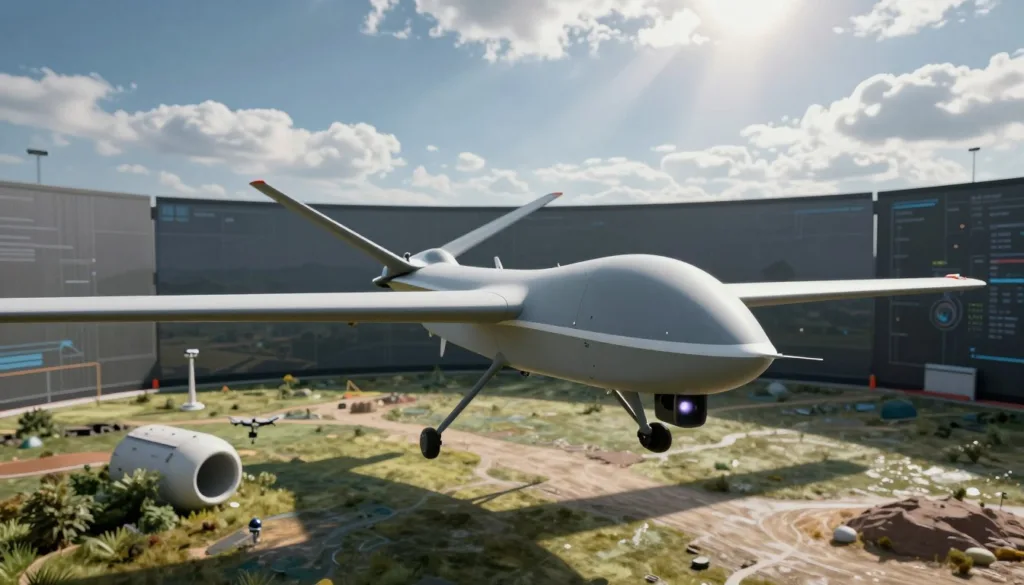
Flight dynamics must be accurate and predictable. SITL links let teams test control laws before hardware is flown. MAVProxy provides a lightweight command layer for telemetry and logging; DroneKit supports mission scripting and rapid prototyping. This stack speeds validation across ArduPilot, PX4, and Pixhawk setups.
Flight dynamics and software-in-the-loop architectures
We validate aircraft models with layered tests: SITL for algorithm checks, hardware-in-the-loop for actuator response, and flight tests for end-to-end verification. MAVProxy logs and replay tools help diagnose anomalies. DroneKit automates repetitive scenarios so instructors focus on assessment.
High-fidelity visualization and geospatial context
Visual realism improves situational awareness and decision training. Unreal Engine simulation delivers photorealistic terrains and dynamic lighting for pilot immersion. Cesium geolocation brings accurate, global-scale maps and textured cities into scenarios where spatial context matters.
Sensor, environment and mission modeling
Operational training requires synthetic sensor feeds: EO/IR SAR LiDAR simulation and 3D point clouds for inspection and ISTAR tasks. We inject controlled sensor noise modeling to improve sim-to-real transfer and to harden automation against imperfect inputs.
Environment modeling covers weather, terrain, and traffic. Mission authors can script urban obstacles, multi-vehicle interactions, and dynamic threats. Layered validation — SITL, HIL, flight test — reduces risk and confirms fidelity before live missions.
- Real autopilot stacks: ArduPilot and PX4 with Pixhawk hardware.
- Middleware and tools: MAVProxy and DroneKit for mission control.
- Visualization: Unreal Engine simulation with Cesium geolocation for accurate scenes.
- Sensors: EO/IR SAR LiDAR simulation plus sensor noise modeling for robust training.
Popular Simulators, Tools, and Research Trends
We survey the current simulator landscape and research shaping training solutions for enterprises and institutions. Our focus is practical: which tools scale, which reproduce sensors, and which support sim-to-real research for safer deployments.
Open-source stacks and commercial engines are both essential. AirSim and Gazebo provide broad integration with autopilot ecosystems. FlightGoggles and Flightmare push visual realism for agile flight and vision-based navigation.
Webots serves education and rapid prototyping. Aerial Gym and Gym-PyBullet-Drones enable reinforcement learning benchmarks. RotorPy models multirotor aerodynamics while QuadSwarm targets multi-agent learning at scale.
Open-source and commercial simulators used in training
Airbus and other vendors show demand for platform-independent trainers that mirror real sensor payloads. Combining Unreal or Cesium visualization with open stacks like MAVLink and Mission Planner improves geospatial fidelity and interoperability.
AirSim excels with LiDAR and camera plugins. Gazebo integrates tightly with ROS for SITL workflows. FlightGoggles offers photoreal scenes for vision pipelines. Flightmare balances speed and realism for control research.
Gym-PyBullet-Drones and Aerial Gym accelerate control tuning and RL experiments. RotorPy supports detailed aerodynamic studies. QuadSwarm scales experiments for formation flight and cooperative missions.
Academic and industry research shaping training solutions
Research emphasizes reproducibility and provable safety. MARSIM highlights LiDAR fidelity; sensor noise injection studies for AirSim aim to narrow sim-to-real gaps. Data-oriented tools like Potato enable large-swarm datasets.
Notable work on vision-based agile flight and safe learning control informs curriculum design. SITL workflows and simulation-guided testing are now standard for validation and certification pipelines.
| Tool / Project | Primary Strength | Typical Use |
|---|---|---|
| AirSim | High-fidelity sensors and Unreal visuals | Vision and LiDAR testing, sim-to-real experiments |
| Gazebo | ROS/SITL integration and extensibility | Autopilot integration, flight dynamics testing |
| FlightGoggles | Photorealistic scenes for agile navigation | Research on vision-based flight and perception |
| Flightmare | Fast simulation with realistic visuals | Control benchmarking and dataset generation |
| Webots | Education-ready, cross-platform support | Prototyping and academic courses |
| Aerial Gym | NVIDIA-accelerated RL benchmarks | Reinforcement learning and controller evaluation |
| Gym-PyBullet-Drones | Lightweight RL environment | Policy learning and rapid experiments |
| RotorPy | Detailed multirotor aerodynamics | Aerodynamic modeling and control tuning |
| QuadSwarm | Multi-agent DRL for swarms | Formation, coordination, and swarm testing |
| MARSIM | LiDAR-focused sensor simulation | Perception validation and sim-to-real studies |
We recommend combining high-fidelity visualization with robust middleware. That approach supports reproducible sim-to-real research and helps teams move from simulation to safe field operations. Your success drives our choices when we evaluate platforms.
Use Cases and Industry Applications in the United States
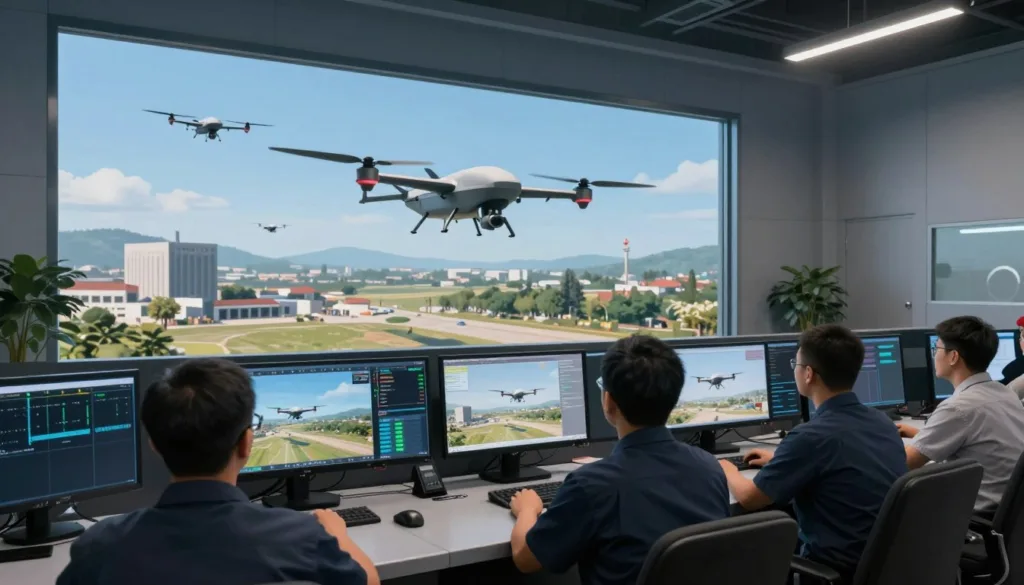
We outline real-world UAV training use cases that drive operational readiness across defense, utilities, agriculture, and academia. Our focus is on practical scenarios that reduce risk and lower costs while improving mission outcomes. SRIZFLY partners with organizations to deliver cloud-based drone simulation that supports multi-user rehearsal and standardized assessment.
Defense, public safety, and ISTAR missions
Airbus-style mission training is useful for ISTAR simulation that combines EO/IR and SAR feeds with multi-crew coordination. We train crews on small tactical and MALE systems for complex mission planning. These exercises translate to improved situational awareness and faster decision cycles for defense units and public safety teams.
Emergency response drone training benefits first responders during disaster drills. Cloud-based drone simulation enables joint rehearsals with multiple agencies and vendors. This model supports regulatory compliance and cross-organizational drills without airspace disruption.
Commercial inspections, agriculture, and infrastructure
Utilities gain value from powerline inspection simulation that creates synthetic data to improve segmentation and detection algorithms. Training in a simulated environment reduces field risk and speeds technician certification. SRIZFLY simulators mirror real sensor suites to validate workflows before live deployments.
Precision agriculture drones are trained on route planning, crop-health monitoring, and coverage optimization. Simulated scenarios help agribusinesses test sensor fusion and autonomy before committing to hardware. These exercises lower operating costs and increase data quality for farm managers.
Urban planning and emergency mapping use cases rehearse coordinated search-and-rescue and disaster assessment missions. Simulations provide repeatable training that sharpens team coordination and improves response times.
Research, education, and R&D pipelines
University drone labs adopt simulators for autonomy research, algorithm validation, and student instruction. Tools like LiDAR and swarm testing platforms are common in reproducible research workflows. These environments speed development and support peer-reviewed experiments.
Cloud-based drone simulation supports collaborative R&D across campuses and companies. We see reproducible testbeds used for benchmarking perception stacks and MAVLink-compatible SITL deployments. This approach accelerates innovation while keeping costs manageable.
SRIZFLY combines validated SITL/MAVLink stacks with Unreal and Cesium visualization plus instructor tools. Our platform helps U.S. customers scale training for defense, public safety, utilities, agriculture, and university drone labs. Try our platform to reduce training time and operational risk with an industry-leading 10-day free trial.
Implementation Best Practices and Training Program Design
We present a clear framework for program design that balances theory, hands-on practice, and measurable outcomes. This framework helps training centers, enterprises, and public agencies adopt drone training best practices while reducing risk and speeding certification.
Designing curricula for ab-initio to mission-level training
Adopt a layered UAV curriculum: start with basic flight skills, add sensor operation, then teach mission planning and team coordination. Use modular lessons so instructors can tailor paths for inspections, mapping, or ISTAR roles.
Pair classroom briefings with simulator hours. Simulators from SRIZFLY and industry platforms let trainees practice complex tasks before live flights.
Bridging simulation and real-world operations
Validate systems progressively. Begin with software-in-the-loop tests, move to hardware-in-the-loop, then controlled flight trials. This staged workflow lowers risk and confirms that code and behaviors carry over to actual aircraft.
Apply sim-to-real techniques: synthetic data, sensor noise modeling, and domain randomization improve perception and autonomy robustness. Research using AirSim-style methods shows these techniques shrink the reality gap.
Instructor tools, scenario authoring, and assessment
Equip instructors with scenario authoring tools that enable custom missions, replay, and debrief. Record flight telemetry and video streams for post-mission review.
Implement performance analytics to track metrics such as control stability, mission time, and rule compliance. Use those insights to grade proficiency and determine readiness for certification.
- Multi-user cloud environments support distributed crew training and standardized evaluations.
- Integrate GCS tools like Mission Planner or QGroundControl with 3D visualization for richer situational awareness.
- Offer trial deployments to validate configuration: SRIZFLY provides a 10-day free trial to reduce procurement risk.
| Training Stage | Key Tools | Validation Method | Outcome |
|---|---|---|---|
| Foundations | Flight sims, basic GCS, instructor-led labs | Instructor observation, simulator checklists | Basic stick-and-sensor proficiency |
| Intermediate | Scenario authoring tools, multi-user sims | Recorded debriefs, performance analytics | Mission planning and crew coordination skills |
| Advanced | Hardware-in-the-loop rigs, LiDAR/sensor injectors | HITL tests, controlled flight trials | System-level readiness for operational deployment |
Conclusion
We synthesize the article’s key UAV simulation conclusions: platforms that integrate SITL and MAVLink, realistic autopilot stacks like ArduPilot and PX4, immersive visualization engines such as Unreal Engine plus Cesium, and high-fidelity sensor models (EO/IR/SAR/LiDAR) deliver safer, more efficient training and R&D workflows. Airbus’s UAS Simulation Trainer shows the operational value of mission-focused, platform-independent systems in real operations.
Across defense, industry, and academia in the United States, these simulators accelerate readiness, lower hardware risk, and cut costs while enabling advanced research in reinforcement learning, swarm autonomy, and sim-to-real transfer. For practical drone training recommendations, assess mission complexity, sensor fidelity, and multi-user support when you choose UAV simulator solutions.
Adopt a progressive simulation validation workflow: SITL to HIL to live flights, with instructor tools for scenario authoring and assessment. We are committed to helping you select and deploy the right solution. Consider SRIZFLY simulators for superior features, price, and flexibility and start with the SRIZFLY trial—a 10-day free test to validate performance and fit; your success drives us forward.
FAQ
What does Unmanned Aerial Vehicle simulation training cover?
Simulation training covers pilot fundamentals—flight dynamics, navigation, and mission procedures—plus system-specific instruction for small tactical and MALE UAS. It includes sensor operation (EO, IR, SAR, LiDAR), mission planning, multi-crew coordination, and emergency-response rehearsal. We use SITL/MAVLink stacks, DroneKit automation, and instructor-authorable scenarios to mirror real ISTAR and inspection workflows.
What are the main benefits of UAV simulation for U.S. pilots and operators?
Simulators reduce risk and cost by avoiding hardware wear and crashes during training. They improve readiness through repeatable mission rehearsal, accelerate skill development, and enable testing of autonomy and perception algorithms without endangering aircraft. Data-driven replay, analytics, and instructor assessment increase training efficiency and safety for defense, public safety, utilities, and commercial operators.
How do flight dynamics and software-in-the-loop (SITL) architectures work?
SITL emulates flight controllers and autopilot behavior in software, using MAVLink for message exchange. MAVProxy or similar middleware routes telemetry while DroneKit-Python scripts automate missions and tests. This setup replicates real controller responses and supports ArduPilot, PX4, and Pixhawk workflows before moving to hardware-in-the-loop.
Why combine Unreal Engine and Cesium for visualization?
Unreal Engine delivers high-fidelity 3D rendering and Blueprints-based scene logic. Cesium supplies accurate geolocation and textured global terrain. Together they add spatial context missing from 2D GCSs, enabling realistic urban and terrain navigation, immersive mission rehearsal, and multi-user collaboration for joint training scenarios.
What sensor and environment models are essential for realistic training?
Effective platforms simulate EO, IR, SAR, and LiDAR, plus dynamic weather, terrain, and urban obstacles. Synthetic sensor feeds with noise injection and domain randomization help close the sim-to-real gap. Multi-vehicle interactions and swarm behaviors are supported for coordinated missions and autonomy testing.
Which open-source and commercial simulators are commonly used?
Popular options include Gazebo, AirSim (Unreal-based), FlightGoggles, Flightmare, and Webots. Research and DRL-focused tools include Gym-PyBullet-Drones, RotorPy, QuadSwarm, and NVIDIA Aerial Gym. Commercial trainers like the Airbus UAS Simulation Trainer provide platform-independent, mission-focused systems with EO/IR/SAR fidelity for ISTAR missions.
How is academic and industry research influencing simulation platforms?
Researchers such as Davide Scaramuzza and Angela Schoellig drive vision-based agile flight and safe learning control. Workshops emphasize reproducible research, SITL workflows, multi-robot simulation, and sim-to-real techniques like LiDAR noise injection. These advances improve benchmarks for autonomy and speed practical adoption in training systems.
What United States use cases benefit most from high-fidelity simulation?
Defense and public safety use simulations for ISTAR, multi-crew coordination, and mission rehearsal. Utilities and infrastructure teams use synthetic data for asset inspection and algorithm training. Agriculture benefits from route optimization and crop monitoring scenarios. Universities and labs rely on simulators for autonomy research and student training.
How should a training curriculum be designed from ab‑initio to mission-level instruction?
Adopt layered progression: basic flight skills, sensor operation, and mission planning; then team coordination and ISTAR mission execution. Integrate instructor-led scenario authoring, replay, and proficiency metrics. Validate learning outcomes with progressive testing: SITL → hardware-in-the-loop → controlled flight tests.
What practices bridge simulation and real-world operations (sim-to-real)?
Use sensor noise modeling, domain randomization, and synthetic data to train perception systems. Perform layered validation: start in SITL, move to HIL, then limited live flights. Record and analyse mission logs to verify behaviors and tune models before full deployment.
What instructor tools and assessment features should a simulator provide?
Key tools include scenario authoring, mission replay, flight and sensor recording, debrief dashboards, and proficiency metrics. Multi-user networking and cloud collaboration enable distributed drills and standardized evaluations across teams and agencies.
Can multi-vehicle and swarm scenarios be simulated?
Yes. Modern platforms support multi-robot coordination, swarm testing, and reinforcement-learning benchmarks. Tools like QuadSwarm and Potato-style large-scale simulators enable research and operational rehearsal for coordinated missions and autonomous behaviors.
How do simulators help algorithm development and R&D pipelines?
Simulators provide repeatable, labeled datasets and controlled environments for training and validating algorithms. They reduce hardware cost, allow rapid iteration, and enable benchmarking for reinforcement learning and perception stacks—accelerating research and minimizing field failures.
What integration exists with Ground Control Stations (GCS) like Mission Planner and QGroundControl?
SITL and MAVLink enable seamless interfacing with Mission Planner, QGroundControl, and APM Planner 2 for 2D mission views and telemetry. Coupling these GCS tools with 3D Unreal/Cesium visualization enhances situational awareness and mission planning fidelity.
How do cloud and multi-user simulations support large organizations?
Cloud-hosted environments enable standardized testing, distributed training, and joint mission rehearsals across agencies. They reduce deployment friction, support remote certification exercises, and allow scalable evaluation of procedures and software updates.
What measures reduce procurement and deployment risk when choosing a simulator?
Match simulator fidelity to mission needs—sensor modeling, mission complexity, and multi-user capability matter. Use progressive validation workflows and pilot trials. We offer a 10-day free trial so organizations can validate fit, configuration, and performance before procurement.
How does SRIZFLY combine industry-grade trainers and open-source ecosystems?
We integrate validated SITL/MAVLink stacks, ArduPilot/PX4 compatibility, Unreal/Cesium visualization, and instructor tools. This hybrid approach leverages Airbus-class mission fidelity and open-source interoperability to deliver scalable, safe training tailored to U.S. defense, public safety, enterprise, and academic needs.
What outcomes can organizations expect after adopting SRIZFLY simulation solutions?
Expect faster readiness, lower training cost, fewer hardware incidents, and improved mission safety. Organizations gain repeatable testbeds for autonomy, better instructor-driven assessment, and cloud-enabled collaboration. Our solutions drive measurable training efficiency and operational resilience.