



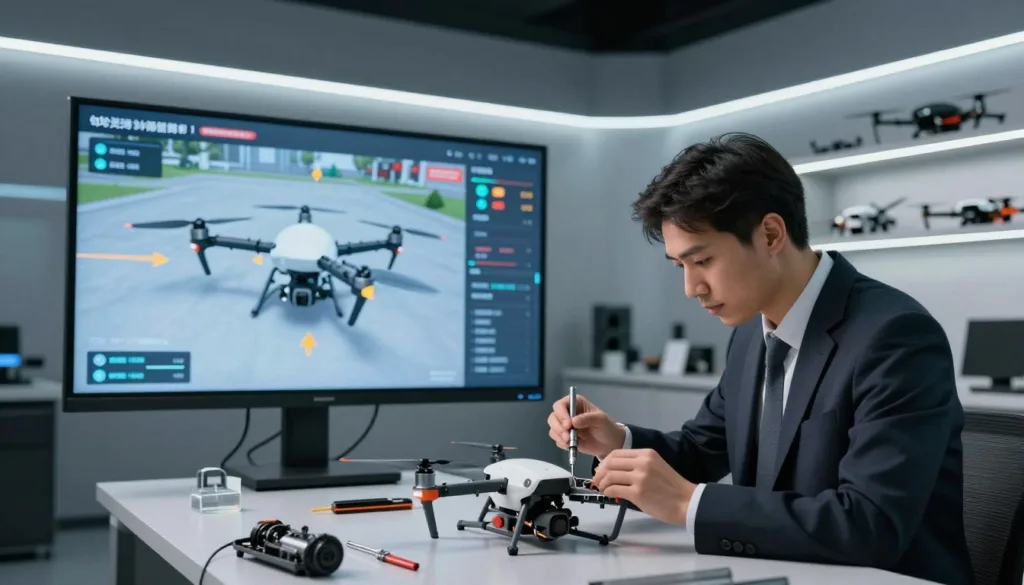
This guide explains a complete workflow for drone assembly and disassembly simulation. We focus on safe, cost-effective learning for enterprises, training centers, regional distributors, and government teams across the United States.
Our approach combines physical inspection, precision measurement, high-resolution documentation, and CAD reconstruction—SIEMENS NX is recommended for accuracy. The workflow creates digital twins for UAV virtual teardown, design analysis, and training integration.
SRIZFLY simulators improve training outcomes: they cut hands-on risk, speed time-to-competence, and increase drone simulator efficiency. Virtual teardowns reveal component-level design intent, enable trade studies, and lower prototyping costs.
We deliver industry-leading drone simulation training technology that is efficient, safe, and innovative. Consider SRIZFLY simulators with best-in-class features, flexible pricing, and a 10-day free trial to evaluate risk-free.
Key Takeaways
- Virtual UAV virtual teardown shortens development cycles and reduces physical prototyping costs.
- Drone assembly and disassembly simulation improves safety and accelerates technician competence.
- SRIZFLY simulators deliver measurable drone simulator efficiency for enterprise and education use.
- Combine inspection, measurement, and SIEMENS NX CAD modeling to build accurate digital twins.
- Use this drone training guide to plan integration across tower inspection, mapping, logistics, agriculture, and emergency response.
Introduction to Drone Assembly and Disassembly Simulation
Virtual teardown lets teams inspect internal drone mechanics without physical risk. We use systematic analysis to map parts, capture measurements, and create precise 3D reproductions with tools like Siemens NX. This method speeds problem solving and keeps prototypes intact.
For learners and professionals, virtual teardown supports drone education by linking classroom theory to hands-on practice. Engineering students, hobbyists, designers, and maintenance crews gain clear views of assembly sequences and component interaction. That knowledge reduces errors during real-world builds.
UAV component analysis helps engineers tune performance across industries. Farms rely on drones for precision spraying, emergency teams use them in search and rescue, filmmakers capture aerial scenes, and inspectors assess bridges and towers. Understanding parts drives reliability and mission success.
Drone disassembly benefits teams by cutting costs and lowering safety exposure. Digital practice lets technicians rehearse repairs, document assemblies, and refine designs before committing to hardware. The result: faster iterations and better documentation for future projects.
Riga Technical University’s FPV drone course shows a clear path: students train on simulators, perform virtual teardowns, practice controlled indoor assembly, then move to supervised flight. This progression highlights how simulation, UAV component analysis, and hands-on work combine to build real competence.
We are committed to practical, data-driven training. Our simulators and workflows improve training efficiency and readiness. Your success drives us to refine tools that make drone education safe, efficient, and industry-ready.
Essential tools, software, and workspace setup
We begin with physical tools. A reliable kit of drone teardown tools speeds work and protects parts. Include digital calipers, micrometers, precision rulers, screwdrivers, pliers, and magnifiers. Use labeled containers and trays to separate fasteners and modules. Photograph parts on a neutral background with a scale for reference.
Documentation is critical. High-resolution cameras and steady video capture preserve each step. Adopt a naming system that ties photos to part IDs and measurements. Record dimensions immediately after removal to avoid guesswork during CAD modeling.
Organize your bench for repeatable efficiency. A clean, well-lit drone workspace setup should have numbered sections and a logical flow: start with external components like propeller guards and landing gear, then move to propulsion, flight control, and camera subsystems. Clear labels reduce reassembly errors.
For CAD and simulation we recommend industry-grade tools. Use SIEMENS NX for parametric 3D modeling and advanced surface work. Pair that with cloud-native SIMNET to link design files to flight scenarios and training content. Consider FEA and motion simulation modules when analyzing stresses and dynamic behavior.
Measure with care. Use digital calipers for tight spaces and repeatable accuracy. Log material properties and tolerances alongside dimensions. In one teardown we documented 82 parts with 36 unique components; precise measurement improved model fidelity and reduced iteration time in the simulator software.
Training environments need hardware parity with field gear. Riga Technical University and other institutions show the value of FPV workstations, controllers and goggles, and consumer frames like Pavo20 Pro for hands-on labs. This full-stack approach links bench teardown to flight practice through integrated simulator software.
We prioritize safety and traceability. Label parts, back up photo and measurement records to the cloud, and maintain a consistent set of drone teardown tools for all teams. Your success depends on discipline in the workspace and the right blend of SIEMENS NX modeling and SIMNET training integration.
Drone assembly and disassembly simulation
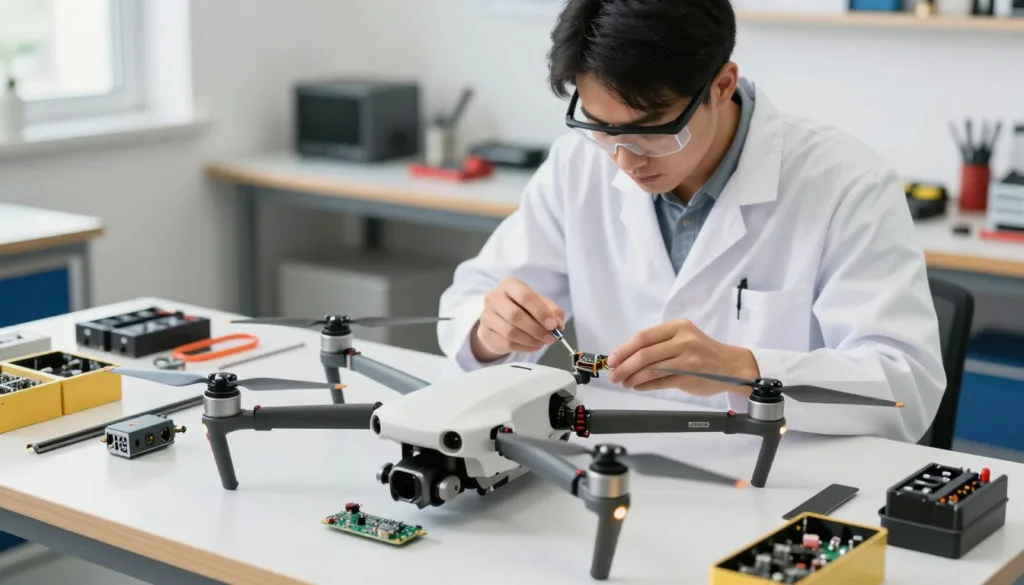
We begin the disassembly process with a disciplined workspace. Clear surfaces, labeled trays, and calibrated calipers set the tone. Remove external components first—propellers, landing gear, battery—so internal subsystems remain stable.
Next, work by subsystem: propulsion, flight controller, power distribution, sensors, and remote controller. Photograph each step from multiple angles and record video clips. Label parts with function- and location-based names such as motor_mount_front_left or battery_connector_positive.
Measure every part and log material, dimensions, and tolerances. Create a detailed drone parts catalog entry for each component: name, function, material, dimensions, tolerances, and links to mating parts. Highlight small fasteners and connectors because they determine fit and sequence.
Import measured components into CAD platforms like SIEMENS NX for virtual assembly. Recreate spatial relationships and constraints, annotate surface finishes, and use exploded views to verify fit. Virtual assembly reveals interference and sequence issues before any physical work begins.
UAV component cataloging feeds both maintenance and training. A thorough catalog supports parts ordering, life-cycle tracking, and simulated repair scenarios. Case metrics from a consumer teardown showed 82 parts and 36 unique components, underscoring the benefit of structured cataloging.
Integrate simulation into a SRIZFLY training workflow: start with simulator-led teardown, move to supervised bench work, then to live test flights. This staged approach improves safety, reduces damage, and shortens learning curves.
We use data-driven checks at each stage: torque specs, clearance reports, and checklist completion. These controls keep assembly consistent and let trainers scale lessons across teams and sites.
Modeling, analysis, and motion simulation techniques
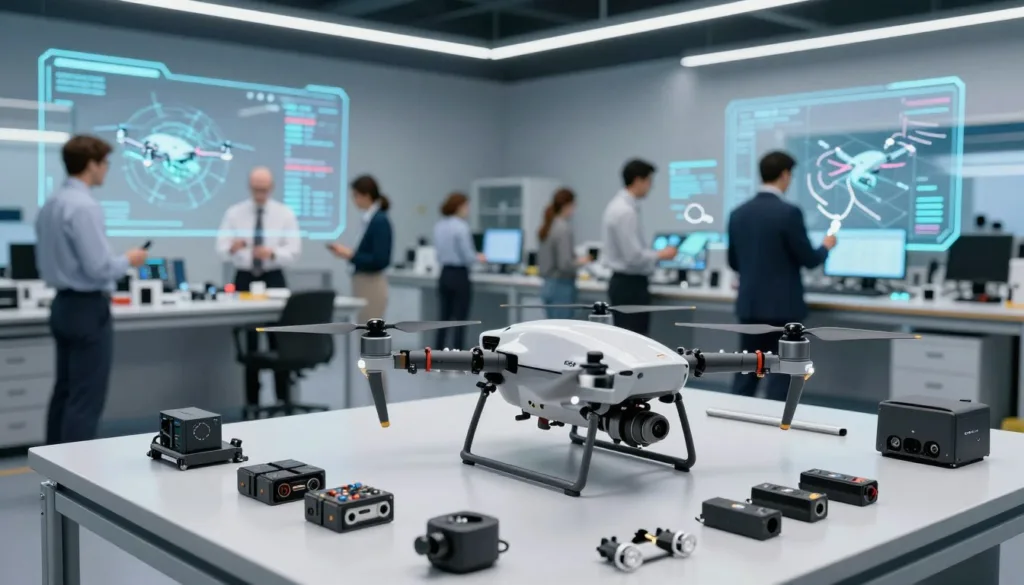
We use SIEMENS NX commands to build accurate drone geometry. Start with solid modeling commands: extrusion for frames, chamfer for edges, delete body for cleanups. For complex arms and mounts, combine curve projection with sweep to match real-world paths.
Surface modeling matters for propellers and fairings. Apply bridge curve, through curve mesh, and N-sided surface tools to capture aerodynamic shapes. Sew and extract geometry to assemble mixed solids and ready parts for analysis.
Document drafting and tolerances early. Specify perpendicularity, concentricity, and H7 fits for shafts and motor bores. Add surface finish notes for controllers and blade protectors to ensure ergonomic feel and consistent flight behavior.
Motion studies reveal dynamic responses. Simulate rotor folding and extension with scalar torque inputs. Test remote controller mechanisms—ball-and-socket joysticks and sliding nests—to confirm range of motion and user comfort.
Run performance prediction studies in SIMNET or cloud platforms to estimate flight time, range, and speed. Trade studies let teams compare weight, battery capacity, and aerodynamic changes without costly prototypes.
Integrate CAD outputs with cloud tools to speed collaboration. Cloud-native workflows reduce local hardware needs and let distributed teams iterate on designs and catch issues earlier.
Apply drone FEA to find stress points and vibration sources. Combine these results with rotor dynamics simulations to identify resonance and balance issues. Use findings to refine materials and inform maintenance checks.
We emphasize SRIZFLY simulation features that support rapid trade studies and team workflows. These tools improve design confidence and help institutions prepare realistic training scenarios for enterprise deployments.
Conclusion
Virtual disassembly and simulation create precise digital twins that accelerate training, reduce risk, and enable design optimization. Our combined workflow—from measurement through modeling in Siemens NX to motion analysis—bridges hands-on learning and advanced engineering to boost UAV readiness.
We recommend a simulator-first approach: start with cloud platforms and SIEMENS NX for modeling, add motion analysis and performance prediction, then move to supervised hands-on assembly and controlled flight practice. This sequence supports a simulation-driven curriculum and simplifies drone training implementation for enterprises and training centers.
Measured benefits are clear: simulation lowers prototyping costs, shortens training time, and improves safety. Case studies show marked efficiency gains when virtual and physical training are combined, delivering better outcomes for tower inspection, mapping, logistics, and agriculture teams.
SRIZFLY delivers flexible, feature-rich simulators built for efficiency, safety, and innovation. Explore a SRIZFLY trial with our 10-day free offer to evaluate features, price, and adaptability for your programs. Your success drives us forward—contact SRIZFLY to arrange a demo, set up a pilot training program, or start a tailored trial that proves value fast.