



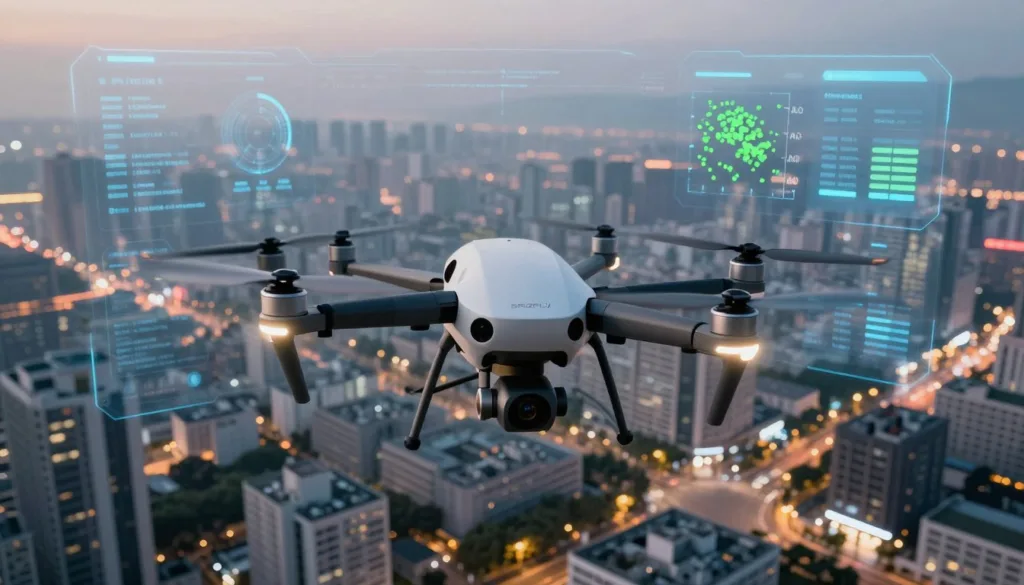
The SRIZFLY drone simulator leads a new wave of simulation software for AI-based defect detection drones. It gives engineers and inspection teams a safe space to build, test, and refine drone inspection workflows before sending hardware into the field.
Using a drone inspection simulator speeds development for bridge inspection drone simulation, building façade surveys, roof inspections, and aircraft exterior checks. Simulated missions replicate sensors, flight dynamics, and environmental conditions so teams can validate AI models and plan safer operations.
Simulation reduces risk and cost. Operators rehearse complex maneuvers over high piers or cable towers without exposing staff to hazards. Teams can also trim manpower and vehicle needs by optimizing routes and tasks in simulation first.
High-quality data and digital twin drone simulation enable consistent, objective inspections. Combining high-resolution imagery, 3D models, and AI-in-the-loop drone testing yields standardized defect records and lets owners forecast deterioration trends before committing field time.
Practical integrations make simulation actionable. Missions exported to platforms like Riebo’s TongTu and commercial tools such as Hammer Missions and AeroMapPro tie simulated planning to real-world flight plans, centralized defect tracking, and automatic reporting.
Key Takeaways
- Simulation software for AI-based defect detection drones accelerates development and reduces field risk.
- Drone inspection simulator environments allow validation of sensors and AI models without exposing personnel.
- Digital twin drone simulation produces repeatable, high-quality data for objective defect tracking.
- AI-in-the-loop drone testing shortens deployment time and improves model reliability before field use.
- Integrations with platforms like Riebo TongTu and Hammer Missions streamline inspection workflows and reporting.
Simulation Software for AI-based Defect Detection Drones
Simulation software accelerates adoption of autonomous inspection workflows by letting teams rehearse missions, tune sensors, and validate AI models before live flights. This approach highlights drone inspection simulation benefits when safety, cost, and operational readiness matter. Early use of digital twin simulation and realistic sensor modeling for UAVs produces repeatable conditions for testing. AI-in-the-loop drone testing runs detection models on simulated feeds to measure latency and accuracy under controlled stressors. Teams gain objective inspection performance benchmarks from those trials.
Why simulate drone inspections: risk reduction and cost savings
Simulators remove the need to expose crews to high-risk sites such as piers, towers, and aircraft surfaces. Operators can rehearse complex approaches for confined areas or GPS-challenged zones. This reduces aborted flights and limits rework.
Pre-validating missions in simulation shortens field time. A well-planned route often lets a single technician complete a job with one vehicle and one payload set. That drives direct cost reduction in labor and logistics.
Simulated rehearsals also improve emergency readiness. Teams can practice lighting tweaks, controller failures, or sudden wind shifts. Those dry runs cut downtime during live operations and improve mission success rates.
Key simulation components: digital twins, sensor models, and mission planners
High-fidelity digital twin simulation creates accurate 3D replicas of bridges, facades, roofs, and aircraft. These models become the spatial baseline for planning and coverage checks. Real-world workflows show large spans can be modeled quickly, which shortens setup time.
Sensor modeling for UAVs must capture camera optics, LiDAR returns, thermal response, and inertial errors. Good models simulate focus, resolution, dynamic range, GNSS degradation, and vibration. That level of realism helps simulated imagery reach realistic detection thresholds for small defects.
Mission planners translate the twin and sensor constraints into optimized flight paths. Tools such as AeroMapPro and Hammer Missions use the twin to ensure full coverage, correct viewing angles, and safe margins. Parameter sweeps in simulation help teams balance inspection completeness against efficiency.
AI-in-the-loop testing: validating detection models and edge processing
AI-in-the-loop drone testing embeds detection models inside the simulator. This measures precision, recall, and processing delays under repeatable conditions. Testing both cloud and edge modes shows trade-offs in latency and bandwidth.
Simulators let engineers compare detectors like YOLO and RetinaNet with classical, rule-based methods. Comparative runs reveal data needs, generalization limits, and runtime behavior. That informs model selection for operational deployments.
Realistic noise, shadows, and surface clutter are essential. Simulated rivets, occlusions, and lighting shifts force algorithms to handle ambiguity. Teams can then tune preprocessing, augmentation, and post-processing for better field robustness.
Metrics and performance benchmarks in simulation
Inspection performance benchmarks offer objective targets for deployment. Standard metrics include precision, recall, and F1-score for specific defect classes such as cracks, dents, and corrosion. Those values guide acceptance thresholds for live missions.
Spatial resolution targets measure the smallest defect size detectable under given flight altitudes and optics. Simulations can validate crack detectability down to the 0.05–0.1 mm range when sensor models and focus parameters match real hardware.
Coverage metrics quantify percentage of surface area inspected, based on overlap analysis against the digital twin. Latency and throughput benchmarks track end-to-end frame processing on edge hardware and total mission processing time. Robustness tests stress lighting, occlusion, sensor noise, and GNSS loss to map safe flight envelopes.
| Component | What it Measures | Typical Target |
|---|---|---|
| Digital twin simulation | Geometric fidelity, coverage planning, overlap analysis | 3D model for 500 m span built in under 2 hours; >95% planned coverage |
| Sensor modeling for UAVs | Optical resolution, LiDAR point density, thermal response, INS errors | Detect cracks to 0.05–0.1 mm; realistic GNSS degradation scenarios |
| Mission planner | Route optimization, obstacle avoidance, mission duration | Minimize flight time while preserving >90% target coverage |
| AI-in-the-loop drone testing | Detection accuracy, false positives/negatives, processing latency | F1-score targets >0.85 for critical defect classes; edge latency |
| Inspection performance benchmarks | Precision, recall, spatial resolution, robustness under stress | Precision/recall balanced per defect; robustness thresholds defined per site |
How simulation integrates with drone inspection workflows and software ecosystems
Simulation bridges planning, sensing, and analytics so teams can test end-to-end processes before flying. Good simulation aligns with field tools and platforms used by firms that run inspections with DJI, Skydio, Autel, and Parrot hardware. Teams gain speed and repeatability through drone inspection workflow integration that ties a virtual model to mission planning, data capture, and post-flight review.
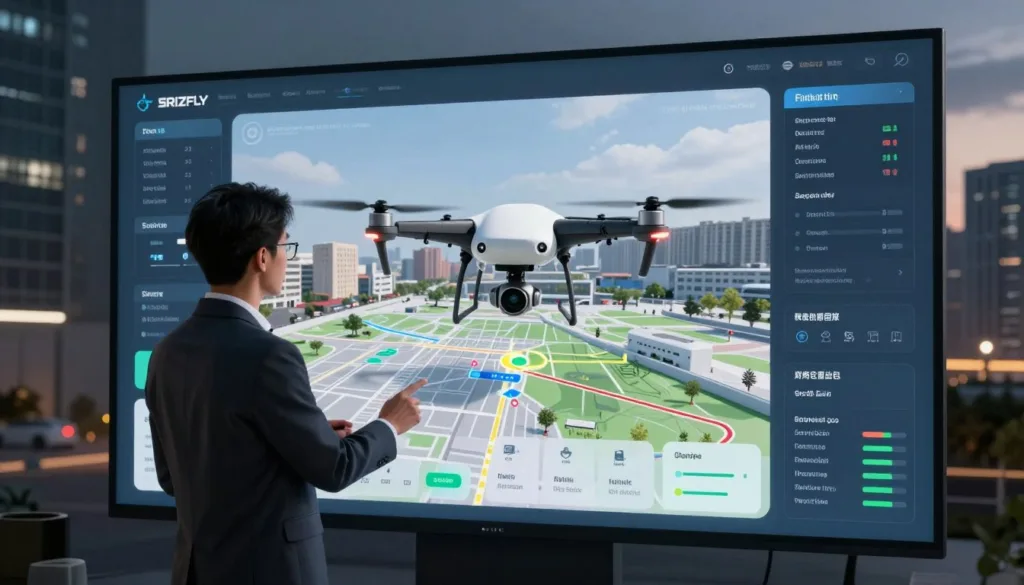
From digital twin to smart route planning
Create a precise digital twin from photogrammetry cameras or LiDAR scans to form the base of planning. Tools like R10Pros photogrammetry rigs and SF10 LiDAR create centimeter-level meshes that planners use to set standoff distances and inspection angles.
Smart flight planners such as AeroMapPro and Hammer Missions read the digital twin to auto-generate coverage routes. Simulation lets engineers tune altitude, speed, camera angle, and image overlap so defect signatures remain detectable. This digital twin to route planning loop shortens mission setup for large structures and improves capture efficiency.
Sensor and data preprocessing pipelines in simulation
Simulated data capture models camera exposure, autofocus behavior, INS/GNSS drift, and auxiliary lighting. Teams can validate minimum detection distance and low-light strategies without risking equipment. For example, testing focus and exposure helps confirm a 2 meter standoff yields the target 0.05 mm resolution.
Preprocessing pipelines in simulation mimic tools such as SkyScanner for batch management, embedded geolocation, field-of-view calculations, and automated quality checks. Inspection data preprocessing attaches geotags, orientation, and FOV metadata to each image so AI and 3D alignment use structured inputs.
AI model training, validation, and comparative approaches
Simulators generate labeled synthetic datasets with controlled defect size, orientation, and lighting. These datasets augment real-world examples to reduce data scarcity and improve model generalization. Teams use the same synthetic sets to compare detectors like YOLO variants, RetinaNet, and Cascade R-CNN against non-deep-learning methods such as fuzzy logic approaches.
Validation uses simulated variations to stress-test models for shadows, rivets, weather, and occlusions. Metrics like precision and recall per defect class let engineers conduct apples-to-apples comparisons. Edge inference testing runs models on target hardware to measure sustained frame rate, latency, and graceful fallback when compute is limited. These steps form the backbone of AI model validation for drones.
End-to-end platforms and management systems
Simulation outputs should feed into inspection management systems that provide 3D visualization, annotation, and historical comparison. Platforms such as Riebo TongTu and Hammer Missions accept simulated missions and sensor data to populate dashboards used by inspectors and asset owners.
End-to-end drone inspection platforms combine mission planning, automated detection, and report generation. Linking detections back to the digital twin enables visual localization and trend analysis for predictive maintenance. Well-executed platform workflows demonstrate measurable ROI across bridges, façades, rooftops, parking structures, and aircraft exteriors through faster inspections and more consistent defect quantification.
Conclusion
Simulation software is now a core enabler for reliable AI-based defect detection drones. By combining realistic digital twins, precise sensor models, and mission planners with AI-in-the-loop testing, teams can find faults in virtual environments before sending a drone into the field. This reduces operational risk and improves inspection quality while supporting better AI defect detection drone ROI.
Key benefits include rehearsing missions in hazardous or hard-to-reach areas, validating lighting and sensor strategies to detect defects down to 0.05–0.1 mm, and using digital twin-driven route planning to ensure full coverage. These drone inspection digital twin benefits translate into standardized data capture that feeds AI models and asset management systems for repeatable, auditable results.
Simulation also supports rigorous model validation. Teams can compare deep learning models such as YOLO, RetinaNet, and Cascade R-CNN against non-learning or fuzzy logic approaches, stress-test against noise and weather, and measure edge inference latency to meet SLAs. When paired with end-to-end platforms like Hammer Missions and Riebo TongTu, simulation outputs become automated reports and long-term trend analysis for maintenance decision-making.
Practical next steps: pilot a simulator-led workflow with SRIZFLY to build digital twins, tune mission plans, and validate AI before field deployment. Decision-makers should request demos of platforms such as AeroMapPro, Hammer Missions, and Riebo TongTu and verify compatibility with DJI, Skydio, Autel, or Parrot fleets. Technical teams can use synthetic datasets from simulation to benchmark models and optimize edge performance, closing the loop between virtual testing and safer, more cost-effective inspections.
FAQ
What is a drone inspection simulator and why use SRIZFLY as an example?
A drone inspection simulator is software that creates realistic digital twins, sensor models, and mission planners to rehearse and validate inspection workflows before field deployment. The SRIZFLY simulator is a leading example used here to frame how simulation accelerates development, testing, and safe deployment of AI-based defect detection drones for bridge, façade, roof, and aircraft inspections. It helps teams reduce risk, cut costs, and improve data quality by enabling repeatable mission rehearsal and AI-in-the-loop testing.
How does simulation reduce safety risk during inspections?
Simulation lets operators rehearse missions for hazardous sites—high piers, cable towers, aircraft surfaces—so teams avoid exposing personnel to heights or confined spaces. It supports route rehearsal in GPS-challenged areas like bridge undersides and verifies lighting and emergency procedures. This planning reduces aborted missions and the need for risky manual inspections.
Can simulation save real operational costs and time on-site?
Yes. Validating missions in simulation shortens field time by optimizing routes, camera settings, and standoff distances. Industry workflows show that well-planned missions can be executed as one-person, one-vehicle operations. Simulated planning also reduces rework and downtime, delivering measurable cost-efficiency for asset owners and inspection teams.
What are the core components a simulator must include?
A complete simulator includes a high-precision digital twin, accurate sensor and payload models (visible, thermal, LiDAR, INS/GNSS degradation), a mission planner with route optimization, and environmental models for lighting, shadows, wind, and weather. These elements let teams test coverage, detection thresholds, and operational limits before flying.
How accurate can defect detection be when using simulation?
With proper sensor models and mission tuning, simulation supports detection down to roughly 0.05–0.1 mm under favorable conditions. High-precision cameras (e.g., R10Pros for photogrammetry) and LiDAR sensors (SF10) contribute to centimeter-level modeling and fine defect visibility when mission parameters—altitude, focus, overlap—are optimized in the simulator.
Which drones and software are commonly modeled in simulators?
Simulators typically represent enterprise drones like DJI Mavic 3 Enterprise, DJI Mavic 3 Enterprise Thermal, DJI M350 RTK, plus platforms from Skydio, Autel, and Parrot. Common inspection and planning tools referenced include AeroMapPro, Hammer Missions, SkyScanner, and Riebo TongTu for post-processing and management integration.
How does AI-in-the-loop testing work inside a simulator?
AI-in-the-loop testing feeds simulated imagery and sensor streams into detection models to measure precision, recall, F1-score, and latency under repeatable conditions. Teams can compare YOLO-family models, RetinaNet, Cascade R-CNN, and non-deep-learning approaches such as optimized fuzzy logic/OLSL. Simulation allows stress-testing against occlusion, rivets, and varying lighting to assess false positive/negative behavior.
Can simulation help validate edge processing and real-time detection?
Absolutely. Simulators reproduce frame rates, encoding, and processing loads to test runtime on edge-class hardware mounted on UAVs. They measure end-to-end latency, throughput, and fallback behavior when compute resources are constrained, helping balance detection accuracy and response time for operational SLAs.
What metrics should I track when validating detection models in simulation?
Track detection accuracy (precision, recall, F1) for each defect class, spatial resolution targets (e.g., 0.05–0.1 mm), coverage/completeness derived from digital twin overlap, and latency/throughput for edge inference. Also benchmark robustness under lighting variation, occlusion, sensor noise, and GNSS degradation to define safe flight envelopes.
How do digital twins support smart route planning?
Digital twins—built via photogrammetry or LiDAR—provide the 3D reference used by planners like AeroMapPro and Hammer Missions to auto-generate routes ensuring full coverage, correct camera angles, and safe standoff distances. High-quality twins shorten planning time; industry examples show a 500-meter bridge model built and ready for route generation in under two hours.
How realistic are environmental and lighting simulations?
Good simulators model sun angle, shadows, dynamic lighting, and weather effects plus wind behavior impacting flight stability. They can reproduce low-light scenarios and test auxiliary lighting strategies (effective at roughly 6 meters) so teams can validate capture quality and AI robustness before live flights.
Can simulation generate labeled datasets for training AI?
Yes. Simulation can produce synthetic, labeled imagery with controlled defect parameters, orientations, and lighting. These datasets augment scarce real-world data, accelerate training, and improve model generalization. They are especially valuable for rare defect types and edge-case conditions.
Are simulators useful for comparing AI algorithms?
Simulators enable direct, repeatable comparisons between models—YOLO variants, RetinaNet, Cascade R-CNN, or fuzzy logic methods—on identical scenes. This apples-to-apples testing reveals data requirements, runtime trade-offs, and relative robustness in noisy environments like aircraft surfaces with rivets and shadows.
How does simulation integrate with inspection management systems?
Simulation outputs—mission logs, imagery, and detection annotations—can be exported to platforms such as Riebo TongTu and Hammer Missions. These systems provide 3D visualization, centralized defect tracking, historical comparison, and automated reporting, turning simulated validation into operational decision support and maintenance planning.
What preprocessing steps should a simulated pipeline mimic?
Simulated preprocessing should model camera exposure, autofocus (laser rangefinder), embedded geotags, orientation metadata, image field-of-view calculations, batch management, and automated quality checks. Tools like SkyScanner illustrate real-world pipelines that prepare imagery for AI ingestion and 3D alignment.
How do simulators help with regulatory and operational readiness?
Simulators let teams rehearse emergency procedures, GPS-denied operations, and lighting adjustments to reduce aborted missions. They provide documentation of tested flight envelopes and performance benchmarks used in risk assessments and to support regulatory submissions or internal SOPs.
What are typical use cases where simulation shows clear ROI?
High-value use cases include bridge inspections, building façade and roof surveys, parking structures, and aircraft exterior checks. Simulation reduces field time, enables automated reports, improves defect quantification, and shortens model-to-action cycles—delivering faster inspections and lower operational cost.
What accuracy and throughput can I expect in practice?
Research and industry workflows report defect detection accuracies such as ~86.67% for certain crack types, and detection down to 0.05–0.1 mm under ideal capture conditions. Throughput depends on edge hardware and model choice; simulation helps determine realistic frame rates and mission timelines before field work.
Which hardware and sensor setups should I test in the simulator first?
Start with commonly used enterprise drones and sensors: DJI Mavic 3 Enterprise or Mavic 3 Enterprise Thermal for general inspections, DJI M350 RTK for heavier payloads, R10Pros photogrammetry cameras for detailed imaging, and SF10 LiDAR for geometry. Validate autofocus, standoff, and auxiliary lighting strategies in simulation to meet resolution targets.
How do I convert simulated outputs into actionable maintenance decisions?
Export detections and annotated images to a management platform like Riebo TongTu or Hammer Missions. Use the digital twin to localize defects, attach historical records, run trend analysis, and generate automated reports. This workflow converts simulated validation into prioritization and maintenance scheduling.
What next steps should inspection teams take to adopt simulation-led workflows?
Pilot a simulator-led workflow (for example SRIZFLY) to build a digital twin, tune mission plans, and validate AI models. Request demos of AeroMapPro, Hammer Missions, and Riebo TongTu to test platform compatibility with your drone fleet. Use simulation to generate synthetic datasets and benchmark edge inference to meet your operational SLAs.