



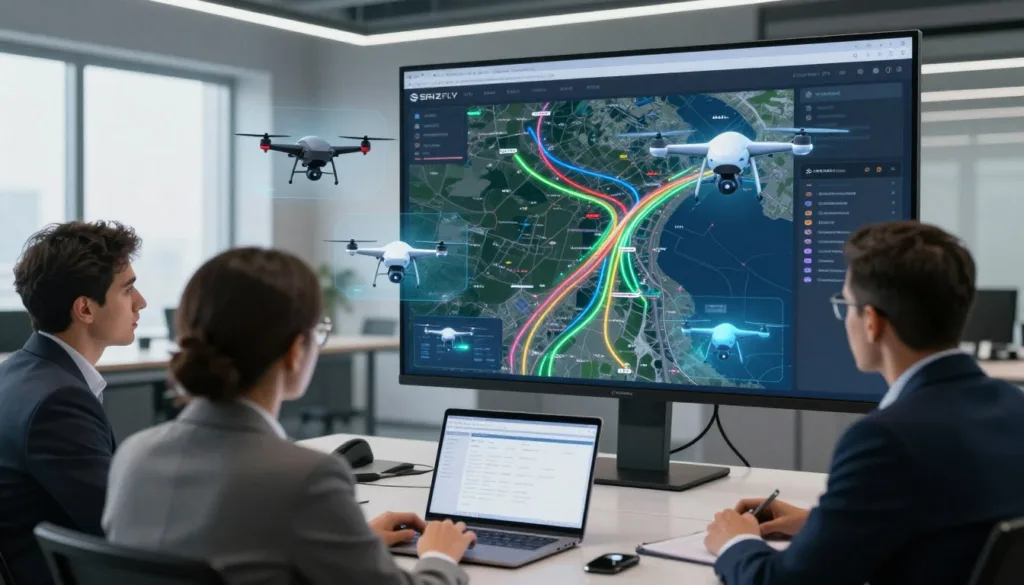
Operating a modern commercial drone fleet requires precise planning and constant oversight. Pilots and operators must navigate strict airspace rules while keeping their aircraft safe. Using advanced UAV traffic management simulation software helps teams test every scenario before taking flight.
The SRIZFLY drone simulator provides a complete digital environment for modern flight missions. Pre-flight preparation involves thorough mission planning, checking airspace restrictions, and reviewing active no-fly zones. Operators can identify required permits and spot other registered flight activities easily.
During operations, real-time aircraft tracking ensures safe routes and detects any dangerous course deviations. The system issues instant warnings if a craft drifts near restricted zones or other airspace users. Post-flight duties finish the workflow with automated logbook updates, incident reviews, and battery management.
Key Takeaways
- Plan missions and review no-fly zones before every flight.
- Test operations safely using dedicated simulation tools.
- Track aircraft in real-time during active missions.
- Receive instant alerts for airspace boundary violations.
- Complete post-flight logs and battery checks efficiently.
UAV Traffic Management Simulation Software: Core Capabilities for Safer Drone Operations
Ensuring safe skies begins with deploying advanced UAV traffic management simulation software across all operational phases. Modern drone missions face unprecedented challenges in crowded and restricted low-altitude airspace. Operators must rely on robust tools that replicate real-world conditions before launching physical aircraft.
Comprehensive simulation platforms bridge the gap between theoretical flight plans and practical execution. They provide safe environments where teams can test protocols without risking expensive hardware or public safety. Successful missions start in the digital twin environment.
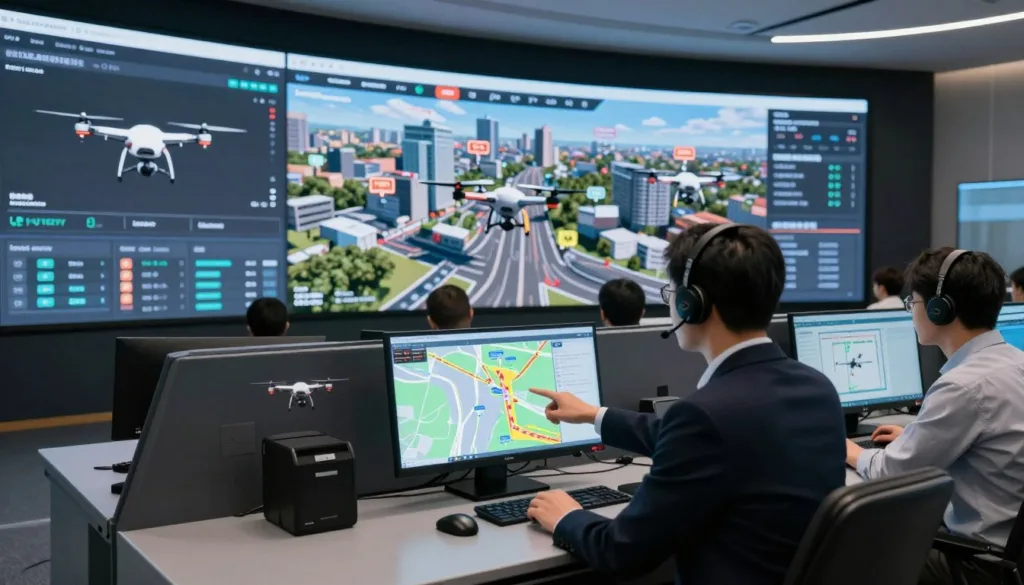
Simulating Complex Airspace and Unmanned Traffic Scenarios
Realistic airspace modeling forms the backbone of any effective training platform. Advanced software incorporates highly detailed 3D maps that mimic urban canyons, rural terrain, and coastal zones. These environments create immersive challenges for pilots and fleet managers alike.
Customizable models allow users to design specific weather patterns, wind shears, and lighting conditions. Operators can introduce multiple moving obstacles like birds, manned aircraft, and rival drones into the simulation. This versatility ensures that teams experience diverse airspace scenarios before facing them in reality.
Underneath the visual layer, sophisticated UAV system models replicate the exact flight dynamics of specific drone models. Every rotor, battery drain rate, and sensor payload is meticulously calculated. This level of detail guarantees that simulation outcomes closely mirror physical flight physics.
Furthermore, robust traffic management systems integrate seamlessly into these virtual worlds. They simulate automated flight routing, geofencing enforcement, and dynamic rerouting protocols. Teams can observe how autonomous fleets interact with centralized airspace databases in real time.
Testing UAS Traffic Coordination and Collision-Avoidance Procedures
Mid-air collisions represent one of the greatest hazards for scaling commercial drone fleets. Simulation software provides a secure sandbox for testing complex traffic coordination algorithms. Developers and operators can evaluate how multiple autonomous units negotiate right-of-way in congested corridors.
Communication networks within the simulation are rigorously tested under various stress levels. Signal latency, GPS interference, and packet loss can be deliberately introduced to measure system resilience. When control systems experience degraded signals, the software reveals how autonomous fail-safes respond.
Advanced anomaly and fault modules inject unexpected mechanical or software failures mid-flight. Operators must troubleshoot motor failures, compass errors, or sudden sensor dropouts while maintaining traffic separation. These stress tests build deep resilience and quick decision-making skills among flight crews.
Specialized testing and research interfaces allow engineers to extract deep telemetry data from every trial. Researchers can analyze collision-avoidance reaction times down to the millisecond. This empirical data drives continuous improvement in onboard collision-avoidance logic.
Measuring Operator Performance and Operational Readiness
Technology alone cannot guarantee mission success; human factors play a critical role in unmanned aviation. Simulation software includes advanced analytics tools to measure pilot and commander performance objectively. Every input, reaction, and procedural step is recorded for post-mission debriefs.
Fleet managers can track key performance indicators such as situational awareness, response times to system alerts, and adherence to standard operating procedures. Operational readiness is quantified through comprehensive scoring matrices. Teams receive clear insights into their strengths and vulnerabilities.
Regular simulation drills help organizations verify that their personnel can handle emergency situations without panicking. By standardizing training through repeatable virtual scenarios, companies elevate their overall safety culture. Ultimately, these rigorous digital evaluations ensure that every deployed team is fully prepared for the realities of modern airspace.
How SRIZFLY Helps Drone Teams Prepare for Real-World Airspace Challenges
Successfully navigating crowded skies starts with structured training inside a virtual environment. Transitioning from basic drone flight to managing complex, multi-operator missions demands a shift in how aviation teams build their skills. Organizations need reliable platforms to test decision-making under pressure without risking expensive hardware or violating safety rules.
The SRIZFLY simulator bridges the gap between theory and execution for remote pilots, fleet managers, and safety officers. By replicating realistic airspace conditions, the platform empowers entire aviation units to rehearse high-stress scenarios safely and effectively.
Building Repeatable Drone Operations Training Programs
Consistency is the backbone of any successful commercial drone program. Aviation leaders must ensure that every remote pilot and dispatch team member follows standard operating procedures. Creating repeatable training programs allows organizations to scale their workforce while maintaining high safety standards.
Using the SRIZFLY platform, instructors can design custom simulation modules that repeat specific airspace conditions. Trainees can practice handoffs, emergency landings, and route adjustments multiple times. This repetition builds muscle memory and sharpens analytical thinking.
Fleet managers can also track individual progress through detailed performance metrics. Reviewing past simulation runs helps instructors identify weak points in a pilot’s decision-making process. As a result, organizations can turn mistakes into valuable learning opportunities before real missions begin.
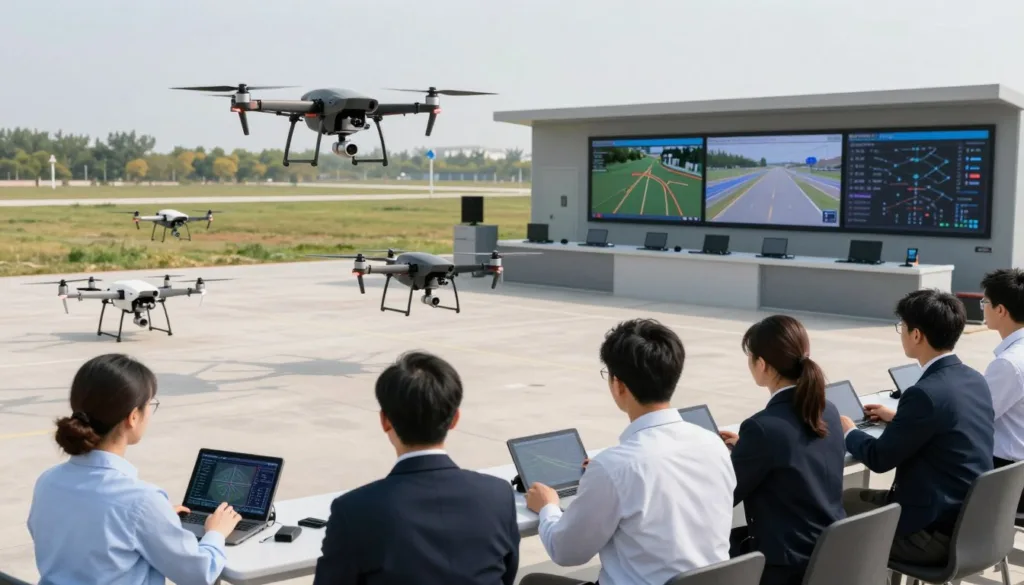
Validating Mission Plans Before Live Deployment
Every successful flight begins long before the drone leaves the ground. Mission planning requires careful analysis of weather, obstacles, and potential air traffic conflicts. Testing these variables in a virtual space prevents costly mistakes during live operations.
Operations leaders use SRIZFLY to run stress tests on proposed flight paths. Dispatch teams can simulate multi-drone delivery routes to spot potential bottlenecks or signal loss zones. If a flight plan creates a high risk of congestion, planners can adjust routes instantly.
This pre-deployment validation gives teams absolute clarity on how a mission will unfold. Knowing that a flight plan has survived rigorous simulation testing builds profound trust among crew members and stakeholders alike.
Improving Safety, Compliance, and Operational Confidence
Safety remains the top priority for every commercial drone enterprise. Organizations must prove their ability to manage risk and operate within established safety boundaries. Utilizing advanced simulation tools demonstrates a proactive commitment to risk management.
The software helps safety managers enforce standard protocols by testing how crews respond to unexpected system failures. Pilots learn to manage lost-link events and sudden airspace restrictions in real time. These exercises foster a deep sense of operational confidence across the entire team.
Furthermore, structured simulation logs provide clear proof of pilot competency and operational readiness. Organizations can review these records internally to refine safety audits and update training manuals continuously.
| Operational Role | Primary Simulation Benefit | Key Focus Area |
|---|---|---|
| Remote Pilots | Builds muscle memory and crisis response | Collision avoidance |
| Fleet Managers | Tracks crew performance and consistency | Standardized training |
| Dispatch Teams | Validates complex multi-drone routing | Airspace coordination |
| Safety Officers | Tests emergency protocols safely | Risk mitigation |
Ultimately, preparing for the future of unmanned aviation requires more than basic flight hours. By integrating comprehensive simulation into daily workflows, drone teams can achieve new levels of efficiency, safety, and operational excellence.
Conclusion
Modern drone operations require more than basic aircraft control. Teams must understand airspace restrictions, manage complex routes, and maintain safe separation at all times.
Pilots need to communicate with other aviation stakeholders and respond to changing weather conditions. Following strict, documented procedures keeps public spaces safe during every single flight.
UAV Traffic Management Simulation Software gives operators a safe way to practice these critical responsibilities before live deployment. Virtual environments let crews test emergency responses without risking expensive hardware or public safety.
Integrating tools like the SRIZFLY drone simulator into daily workflows builds lasting team confidence. Start preparing your flight crews for tomorrow’s airspace challenges today.
FAQ
What is UAV Traffic Management Simulation Software and how does it improve drone operations?
A: UAV Traffic Management Simulation Software is an advanced digital platform designed to replicate complex airspace environments, unmanned traffic flows, and multi-drone coordination. Tools like the SRIZFLY drone simulator help drone teams practice pre-flight planning, in-flight tracking, and post-flight management safely in a virtual environment before deploying live aircraft.
How does the SRIZFLY drone simulator support remote pilot training and fleet management?
The SRIZFLY drone simulator provides structured training for remote pilots, instructors, fleet managers, dispatch teams, safety managers, and UAS operations leaders. By utilizing realistic 3D maps, customizable scenarios, and communication networks, teams can improve decision-making, test control systems, and validate mission plans without risking hardware.
What phases of flight operations can be practiced using traffic management simulation tools?
Operators can practice all phases of flight. Pre-flight phases cover mission planning, airspace restriction checks, no-fly zone reviews, and permit identification. In-flight phases focus on real-time aircraft tracking, monitoring planned routes, detecting deviations, and managing warnings. Post-flight phases involve logbook updates, incident reviews, maintenance records, and battery management.
Why is pre-flight mission planning critical in UAV operations?
Effective pre-flight planning ensures that remote pilots comply with airspace restrictions, identify no-fly zones, secure necessary permits, and remain aware of other registered flight activity. Using a UAV simulator allows teams to rehearse these checks and verify mission parameters to drastically reduce operational risks.
Can simulation software help teams handle airspace anomalies and in-flight emergencies?
Yes. Advanced simulation platforms feature anomaly and fault modules alongside traffic management systems. These tools allow operators to experience unexpected system failures, traffic conflicts, and restricted airspace breaches, building the necessary response skills required for safe live deployments.