



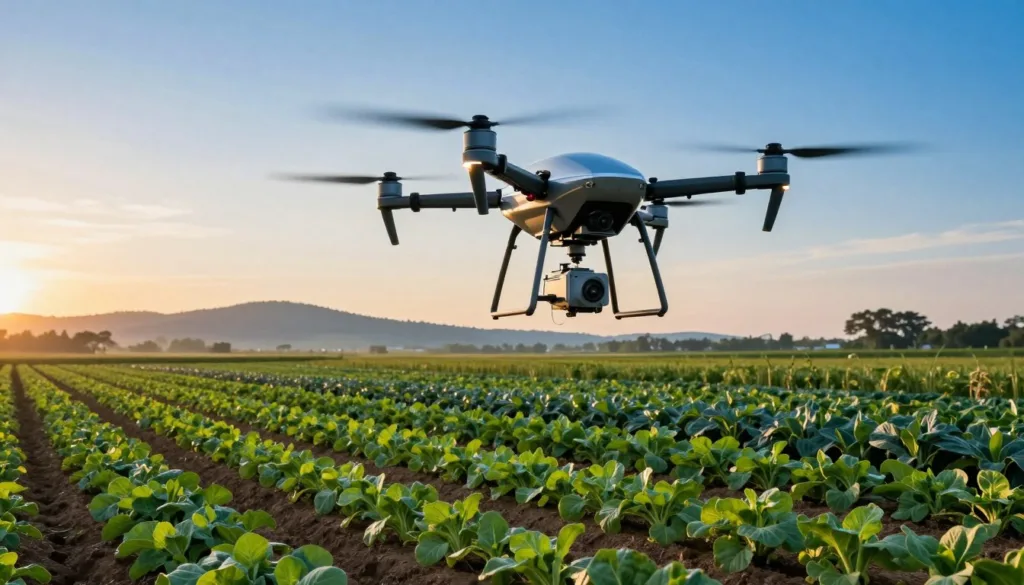
Drone crop protection simulation lets growers and teams review flight plans and spray decisions before field use. It connects crop sensing, decision-making, and spray release in one process. This helps users study how each step may affect the next.
A systematic review of 168 core publications from 2013 through 2024 describes UAV spraying as a way to target crop protection. It also notes challenges, including weather effects, pesticide mixing, and coordination among system parts. An agricultural drone simulator can help teams examine these issues in a controlled setting.
This article explores UAV spraying simulation, from flight and spray modeling to path planning and field validation. It also introduces the SRIZFLY drone simulator as the simulator-centered focus, without assuming specific features or results.
Key Takeaways
- Simulation helps teams assess crop-protection plans before field use.
- Effective spraying links crop sensing, decisions, and spray execution.
- Environmental conditions and system coordination remain key challenges.
- Simulation supports careful review, but does not replace field validation.
- SRIZFLY is the simulator-centered focus of this article.
Simulation of Drone-Based Crop Protection Operations
A precision agriculture simulation can link crop detection, treatment decisions, and drone spraying in one workflow. It lets growers test how field data guides pesticide application planning, from spotting a problem area to setting a spray rate. The model can include UAV platforms, real-time pesticide mixing, and adaptive variable-rate spraying.
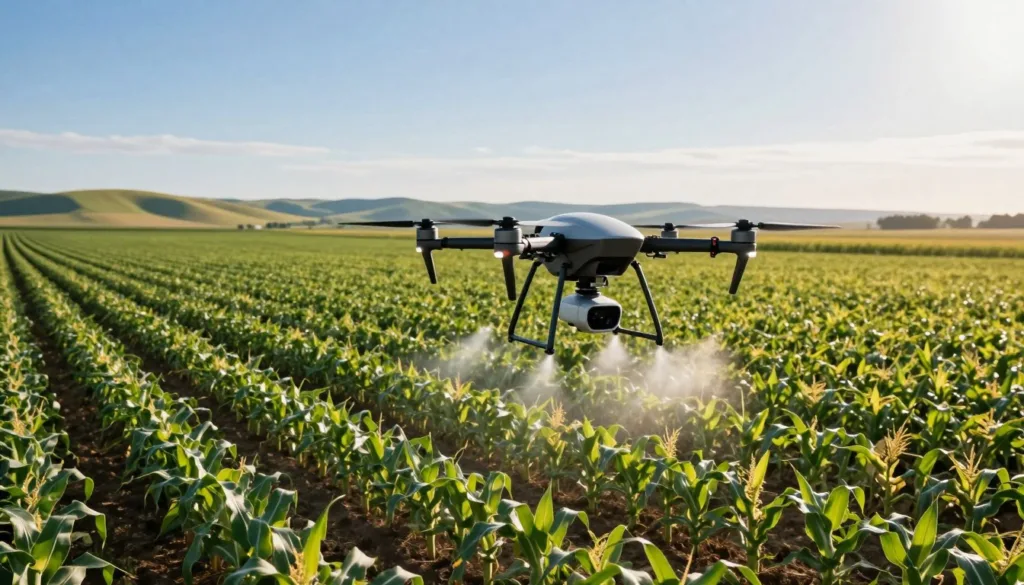
Reported UAV operations can cover 10 to 15 hectares per hour, though actual rates depend on the aircraft, field layout, and task. Research reviews report pesticide-use reductions of 30% to 50% and off-target drift reductions above 30% for precision application methods. Separate UAV studies report pesticide-use reductions of 46% to 75% compared with ground-based application. These figures come from different studies; they are not guaranteed results for every farm or setup.
Simulation helps teams examine these factors before crop protection operations begin. For small farms, equipment costs can pose a barrier, especially for LiDAR and multispectral sensors. Operators may need training to use the tools and interpret field data. Testing different setups in a model can help clarify what a farm needs for safe, practical UAV crop spraying.
Modeling UAV Flight, Downwash, and Spray Deposition
Computational fluid dynamics for agriculture can map airflow around a drone and track how spray moves toward crops. A UAV downwash simulation lets researchers test flight speed, wind, and nozzle settings before field work. These models can show where droplets may land and where spray drift modeling may be needed.
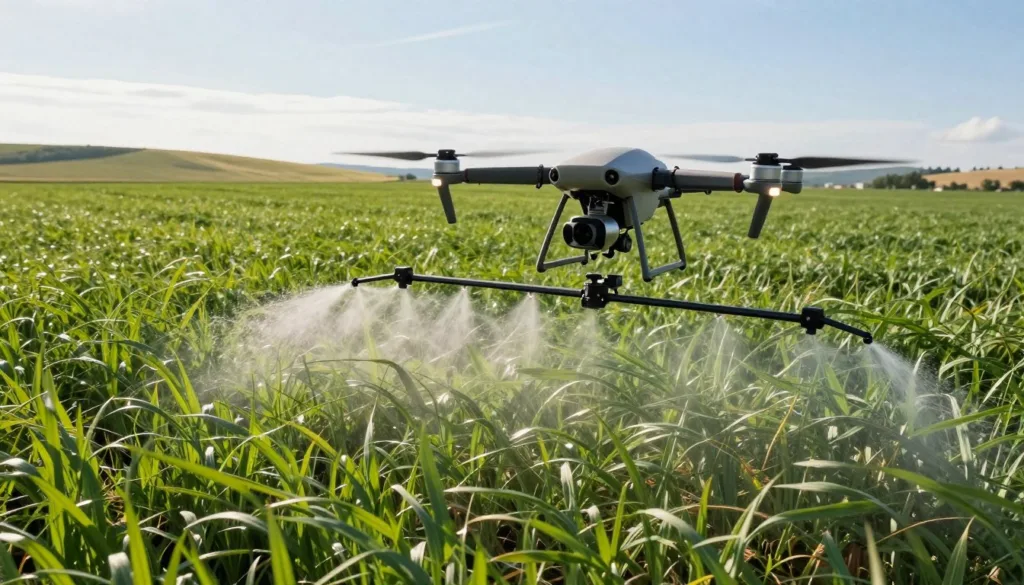
One study used ANSYS Fluent 2019 R2 to model a DJI MG-1S crop-protection UAV. The simplified design kept the propellers, control-module shell, and water tank. Researchers used the shear-stress transport k–ω turbulence model, with a computational domain of 48,851,963 nodes.
In verification tests, simulated lift error was 4.41% at 3,000 rpm and 10.23% at 4,000 rpm. Wind-speed error was below 1 meter per second at most sample points, while spray-deposition-ratio error stayed below 10%. A regression model for droplet deposition had a root mean square error of 6.5%.
During farmland tests, predicted and measured deposition volumes differed by no more than 30%. The study used the simulated patterns to guide UAV position offsets and nozzle-flow adjustments.
Simulating Crop Detection and Variable-Rate Spraying
A crop detection simulation can test how a drone spots pests and turns sensor data into spray decisions. Systems that combine RGB and multispectral cameras, LiDAR, ultrasonic sensors, and RTK-GPS can assess crop conditions and target locations. Multispectral tools may use NDVI or SAVI to flag stressed plants.
Reported deep-learning trials identified pests with 89–94% accuracy under tested conditions. In strong light or when pests were hidden, accuracy fell to 60–70%. Sensor errors can shift target positions by 0.3–0.8 meters, so simulations can test how detection limits affect precision pesticide application.
Models can compare fixed spraying with variable-rate spraying, which adjusts output as the drone moves. Reported PWM spray control systems respond in as little as 10–50 milliseconds. Studies report 30–50% lower pesticide use and more than 30% less off-target drift with PWM methods. Multi-sensor fusion has been linked to 30–50% reductions in off-target contamination.
Simulation settings can include flight heights of 1–3 meters, speeds of 2–5 meters per second, and nozzle flow rates of 0.5–1.2 liters per minute. Mixing tests matter, too: reported homogeneity exceeded 85% for liquid pesticides, while suspension concentrates reached 70–75%, in part due to particle settling.
Optimizing Drone Flight Paths and Energy Use
Route simulations let teams compare flight paths before a drone enters a field. For crop protection drone path planning, they can show how route length, supply-point trips, and spray coverage affect energy use.
A 2024 study by Yue Shen, Lingfei Zhang, Yayun Shen, Jincheng Chu, and Hui Liu tested an adjacent contention method. The team modeled a 420-by-200-meter site in MATLAB and built a drone and site model in RflySim.
The method assigns operating distances to particles, which represent possible routes. Neighboring particles compete over those distances. This design aims to prevent missed points and reduce the chance that traditional particle swarm optimization settles on a weaker route.
Across 10 planning rounds, the adjacent contention method found the lowest-energy route nine times. Traditional particle swarm optimization used 16.16% to 38.14% more energy in those rounds. In RflySim, the method cut planned energy use by 25.15% compared with the traditional approach.
Flight tests with an M300 at the same site showed 34.48% lower energy use for planned operations. The study reported shorter returns to the supply point and less energy spent on travel that did not support spraying. These route comparisons can inform UAV flight path optimization, drone energy consumption estimates, and planning for multi-drone operations.
Validating Simulation Results Before Field Deployment
Before simulation results guide field work, teams should compare them with real measurements. UAV simulation validation can reveal where a model matches conditions and where it needs adjustment.
A computational fluid dynamics spray study compared modeled wind and spray deposition with experiments. Wind-speed errors stayed below 1 meter per second at most sample points. Deposition-ratio errors were under 10%. In farmland tests, predicted spray volume differed from measured volume by no more than 30%. This spray deposition validation helps show how well a model represents field conditions.
A path-planning study tested algorithms in RflySim and flew a DJI M300 at a 420-by-200-meter site. The adjacent contention algorithm used 34.48% less energy than traditional particle swarm optimization in those tests.
Field checks should account for strong light, occlusion, and sensor error. These conditions can reduce sensing accuracy, with positioning deviations of 0.3 to 0.8 meters reported. Agricultural drone field testing should reflect expected flight paths, weather, sensors, and nozzle settings. Such checks support crop spraying safety before wider use.
Conclusion
Agricultural drone simulation helps teams assess flight routes, UAV airflow, crop detection, spray deposition, and variable-rate control before field deployment. Together, these steps support drone-based crop protection as a connected process: detect a problem, choose a response, and apply treatment with care.
A review of 168 publications from 2013 to 2024 found promising results under specific study conditions. Deep-learning models identified targets with 89–94% accuracy, while PWM variable-rate spraying cut pesticide use by 30–50%. A path-planning method also reduced energy use by 25.15% in RflySim and 34.48% in M300 field tests compared with traditional particle swarm optimization.
These findings are not guaranteed for every crop, drone, spray mix, or field. Still, simulation can help refine precision spraying systems and support sustainable pesticide application. The review also points to practical priorities: use lightweight edge devices and pruned neural networks to reduce delays, improve mixer design with CFD, and combine sensor data to account for drift.
Before adopting a system in the field, test it against local crops, weather, equipment, and operating rules. Careful validation can show where drone-based crop protection performs well and where it needs adjustment, helping growers make informed choices about safer, more efficient spraying.