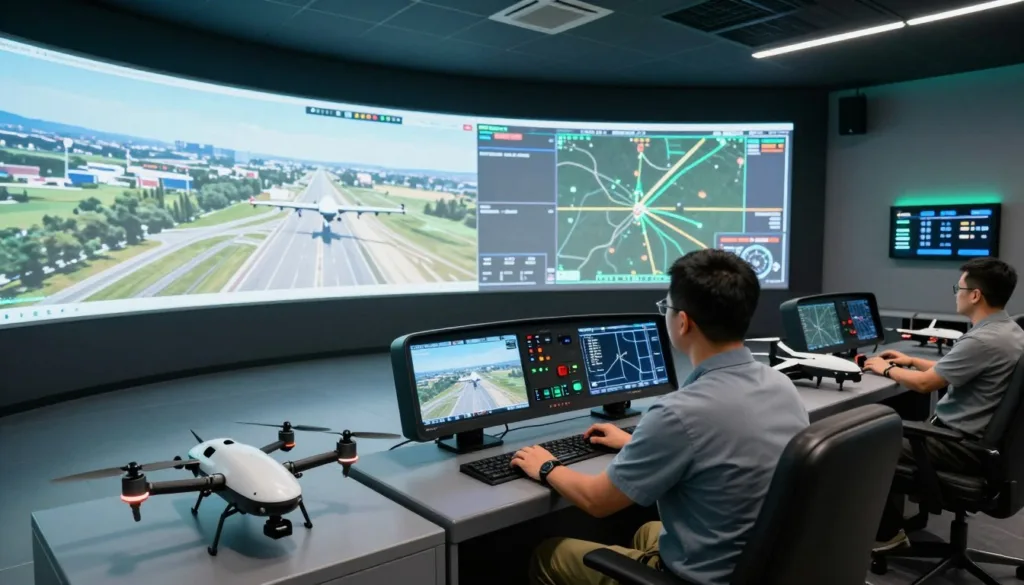
Welcome to the exciting world of security drone simulation software. This technology transforms how teams prepare for real-world missions. It creates a powerful bridge between classroom learning and field operations.
Modern platforms offer a completely risk-free training environment. Mistakes here become valuable lessons, not costly accidents. This approach builds essential skills while prioritizing safety above all.
Unmanned Aerial Vehicles (UAVs) are now vital for modern protection services. They handle tasks from perimeter checks to emergency response. Proper preparation for your operators has never been more critical.
The right simulation system builds confidence and competence. Personnel can practice complex, realistic scenarios long before flying actual equipment. This method closes the gap between theory and practical application.
Investing in quality virtual training reduces equipment damage. It also boosts mission success rates and strengthens your entire operational protocol. Whether coaching new recruits or veterans, customizable scenarios mirror your specific challenges.
This guide will explore top solutions and compare their features. We’ll look at the latest innovations and provide clear insights. Our goal is to help you make the best choice for your team’s needs.
Key Takeaways
- Advanced simulation platforms provide a safe, cost-effective environment for mastering UAV operations.
- Realistic virtual scenarios allow personnel to practice for complex missions without any physical risk.
- Effective training directly improves mission success rates and reduces equipment repair costs.
- Customizable scenarios ensure the training matches your organization’s specific challenges and environment.
- This technology is essential for building operator confidence and competence before live deployment.
- A quality simulator bridges the gap between theoretical knowledge and hands-on field application.
- Investing in this training strengthens overall operational protocols and team preparedness.
Top Security Drone Simulation Software for Advanced Training
The market for advanced UAV training tools is rich with powerful options. You’ll find everything from defense-grade systems to affordable commercial platforms. Your choice depends on budget and specific training goals.
Overview and Key Benefits
Implementing a virtual training platform offers major advantages. It leads to significant cost savings by preventing aircraft damage. Learning curves accelerate in a completely safe space.
Personnel can repeat scenarios for standardized skill assessment. They practice high-risk maneuvers with no real-world consequences. This builds deep confidence before any live deployment.
| Platform | Key Feature | Best For |
|---|---|---|
| Zephyr Drone Training Simulator | Customizable mission scenarios | Detailed operational rehearsals |
| Drone Racing League Simulator | High-speed flight physics | Reflex and agility development |
| DJI Flight Simulator | Hardware compatibility | Teams using DJI product models |
Comparing Leading Solutions
When evaluating the top drone simulators, consider several factors. Look at the depth of scenario customization available. Check for compatibility with your existing UAV models.
Multi-user capabilities are vital for coordinated team exercises. Seamless integration with current operational protocols is also key. The right solution scales with your program’s growing needs.
Innovative Features and Technological Advancements
The latest wave of technological progress brings unprecedented realism and adaptability to virtual training. Companies like CAE Inc. now deliver highly realistic environments with smart, AI-driven scenario customization. This evolution creates a powerful, dynamic learning experience.
Realistic Virtual Environments
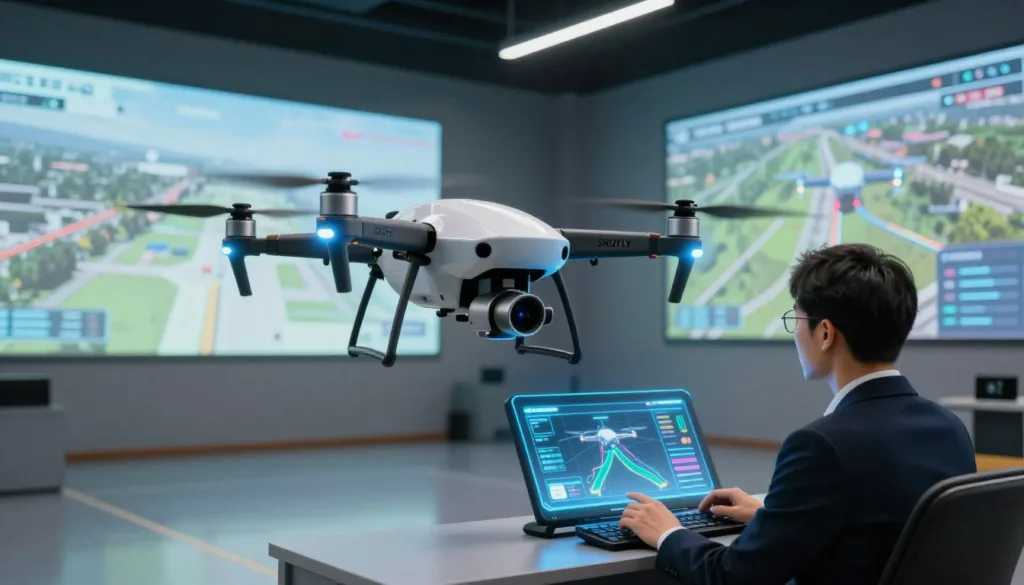
Modern platforms generate photorealistic worlds. They replicate specific venues, urban layouts, and facility perimeters with stunning accuracy. Trainees feel truly present.
These environments include real-world weather and lighting. Operators practice in challenging low-light or night conditions they will face on actual missions. The technology goes beyond visuals.
Accurate physics modeling for different UAV types is standard. Authentic sensor feedback and communication latency are simulated. Even battery depletion patterns mirror your real fleet’s performance.
AI-Driven Customization and Scenario Planning
Artificial intelligence represents a game-changer for training planning. Systems can automatically generate diverse security situations. They adapt difficulty based on an operator’s performance in real-time.
This introduces unexpected variables that test decision-making under pressure. Modular architectures, like those from Leonardo S.p.A., let you build custom curriculums. Combine routine patrol simulation with complex multi-UAV emergency response drills.
Real-time data integration is key. Platforms can incorporate current threat intelligence and site-specific vulnerabilities. Interactive tools provide immediate feedback on operator metrics like navigation accuracy and response times.
Market Insights and Industry Leaders in Drone Simulation
Industry insights reveal a booming sector where virtual preparation platforms are becoming essential business investments. The global market for these systems is set to more than double by 2030. This growth is fueled by rising demand from both commercial and defense sectors.
Key players offer diverse solutions. Defense giants like Lockheed Martin provide military-grade fidelity. Companies like DroneSimPro deliver cloud-based platforms for smaller operations.
Profiles of Leading Companies
Raytheon Technologies focuses on secure communication protocols. General Atomics Aeronautical Systems specializes in long-endurance UAV applications. Meanwhile, Aero Simulation Technologies creates cost-effective tools for budget-conscious organizations.
L3Harris Technologies integrates encrypted data training. This variety ensures there’s a system for every need and scale.
Economic and Environmental Impact
The economic analysis is compelling. Virtual training cuts equipment damage by up to 90%. It also slashes the time needed for operator proficiency by half.
“Investing in high-fidelity simulators delivers a clear return, protecting assets while building skill,” notes an industry report.
Environmental insights add another layer. UAV networks have a tiny carbon footprint. This makes them attractive for businesses aiming to meet sustainability goals.
Over the coming years, these dual benefits of cost and ecology will continue to drive market expansion. The future for advanced training tools looks exceptionally bright.
Conclusion
The journey to mastering unmanned flight begins not in the sky, but within a powerful virtual world. Investing in this training is a strategic move that builds capable, confident operators. It prepares teams for real challenges without real-world consequences.
Modern platforms deliver field-tested experience. Skills practiced here translate directly to better performance with actual UAVs. This approach slashes risk and protects valuable equipment during the learning process.
As demand for skilled operators grows, this technology becomes essential. It allows teams to test new procedures and refine safety protocols in a controlled space. The right systems scale with your needs.
Choosing a simulation product is about future-proofing your team’s readiness. Look for realistic physics, relevant scenarios, and a proven track record. This investment pays off in sharper skills and more successful drone missions from day one.
FAQ
How does this type of training benefit new operators?
It provides a completely safe space to learn. Pilots can practice complex flight maneuvers, understand UAV protocols, and experience system failures without any real-world risk. This builds critical muscle memory and confidence before ever touching a physical unit.
What makes a virtual environment effective for preparation?
Top platforms use advanced graphics and physics engines to replicate real-world conditions. This includes changing weather, different times of day, and various urban or rural landscapes. This realism ensures that the skills learned translate directly to actual field operations.
Which companies are leaders in this specialized technology?
The market includes established defense contractors and innovative tech firms. Companies like CAE, L3Harris Technologies, and Israel Aerospace Industries offer high-fidelity platforms. These industry leaders continuously push the boundaries of what’s possible in virtual training.
Is implementing this technology cost-effective for a business?
Absolutely. While there’s an initial investment, it reduces long-term expenses dramatically. Organizations save on vehicle wear-and-tear, fuel, and potential accident costs. It also allows for scaling up training programs without proportional increases in logistical overhead or safety planning burdens.
Can these tools prepare teams for communication during missions?
Yes, many advanced systems include robust team training modules. These simulate full mission operations, requiring clear communication between pilots, payload operators, and ground personnel. Practicing these protocols in a simulated setting is crucial for seamless real-world execution.
How do modern platforms handle custom scenario creation?
They often feature powerful editor tools and AI-driven systems. Instructors can build specific training missions tailored to unique operational needs or potential threats. This allows for practicing highly specialized tasks and adapting to new intelligence or changing risk models.