



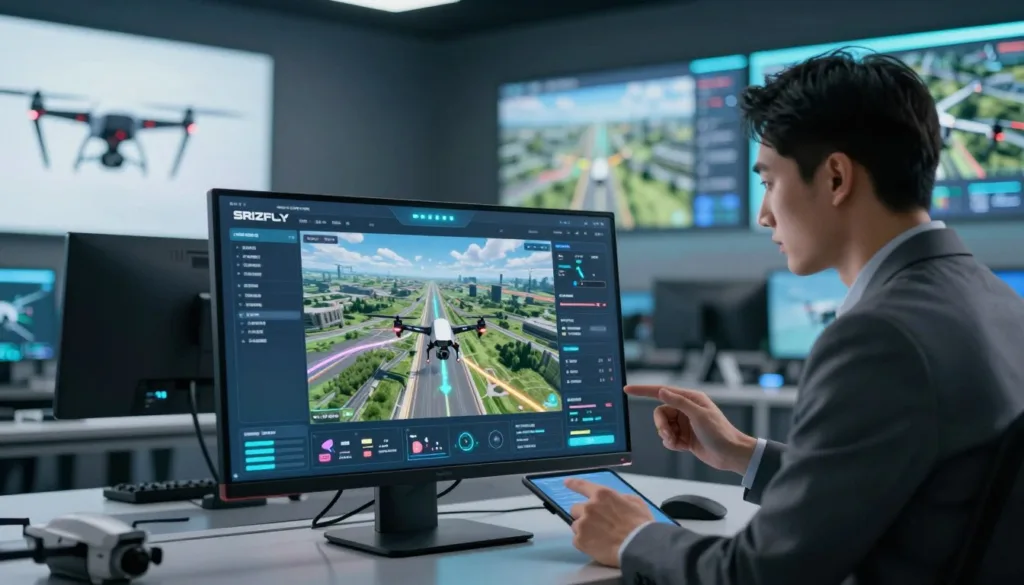
Modern aviation professionals face the constant challenge of balancing theoretical knowledge with real-world flight demands. To master complex maneuvers safely, pilots now rely on Intelligent drone simulation software to refine their skills before heading to the field.
The SRIZFLY drone simulator serves as a premier tool for this purpose. It provides a highly controlled environment that mimics actual flight conditions with incredible accuracy. By utilizing advanced rendering, this platform allows operators to practice high-stakes missions without risking expensive equipment.
This technology effectively bridges the gap between classroom learning and practical experience. Whether you are a beginner or a seasoned pilot, mastering these digital tools is essential for success in today’s competitive aerospace industry.
Key Takeaways
- SRIZFLY provides a safe, risk-free environment for flight training.
- Advanced rendering technology ensures realistic flight physics and visuals.
- Pilots can master complex maneuvers without damaging physical hardware.
- The platform acts as a vital bridge between theory and field application.
- Modern aviation professionals use these tools to maintain high safety standards.
The Evolution of Intelligent Drone Simulation Software
The landscape of aviation training has shifted dramatically over the last decade. Early flight trainers were often limited by low-resolution graphics and simplified flight models that failed to capture the true essence of piloting. Today, intelligent drone simulation software has emerged as the gold standard for both hobbyists and commercial operators.
This rapid evolution reflects a broader trend in technology where digital tools no longer just mimic reality; they recreate it with startling accuracy. By leveraging advanced computational power, these platforms provide a safe, cost-effective, and highly efficient way to build essential flight skills.
Bridging the Gap Between Virtual and Physical Flight
A high-quality virtual flight environment is essential for bridging the divide between classroom theory and real-world application. Modern simulators utilize complex physics engines to replicate wind resistance, gravity, and battery depletion in real-time. This level of detail ensures that the muscle memory developed during practice translates directly to the field.
When pilots train in a realistic virtual flight environment, they encounter scenarios that would be too dangerous or expensive to attempt in person. Consider the following benefits of this transition:
- Precision Physics: Accurate modeling of drone aerodynamics and environmental factors.
- Risk-Free Learning: The ability to crash and restart without damaging expensive hardware.
- Scenario Variety: Access to diverse landscapes, from urban centers to remote industrial sites.
“The true power of simulation lies in its ability to prepare a pilot for the unexpected, turning potential failures into valuable learning moments.”
The Role of AI in Modern Flight Dynamics
The integration of artificial intelligence has fundamentally changed how we approach pilot education. AI-powered drone training algorithms now monitor every movement, providing instant, data-driven feedback that helps users refine their technique. Unlike static programs, these systems adapt to the specific skill level of the pilot.
By utilizing AI-powered drone training, instructors can identify subtle errors in flight patterns that might otherwise go unnoticed. This personalized approach accelerates the learning curve significantly. As intelligent drone simulation software continues to advance, the line between the digital and physical worlds will only become more blurred, offering unprecedented opportunities for mastery.
Ultimately, the adoption of AI-powered drone training ensures that operators are not just flying, but flying with purpose and precision. Whether navigating complex obstacles or executing precise maneuvers, the modern virtual flight environment provides the foundation for safe and successful operations.
Understanding the SRIZFLY Ecosystem
At the heart of every successful flight mission is a robust virtual flight environment, which is exactly what the SRIZFLY platform provides. By leveraging a modular design, this software ensures that every pilot experiences high-fidelity physics and responsive controls. The system is built to handle complex data streams without compromising on visual or mechanical accuracy.
Core Architecture of SRIZFLY Technology
The SRIZFLY drone simulator utilizes a unique, layered architecture designed for speed and reliability. This framework separates the physics engine from the rendering pipeline, allowing for low-latency communication between external inputs and the virtual world. Such a design ensures that pilot commands are processed in real-time, mirroring the behavior of physical aircraft.
Because the architecture is modular, developers can update specific components without disrupting the entire simulation. This flexibility allows the software to maintain a consistent virtual flight environment even when running intensive training scenarios. The engine is optimized to manage high-frequency data packets, which is essential for maintaining stability during complex maneuvers.
Integration Capabilities with Existing Hardware
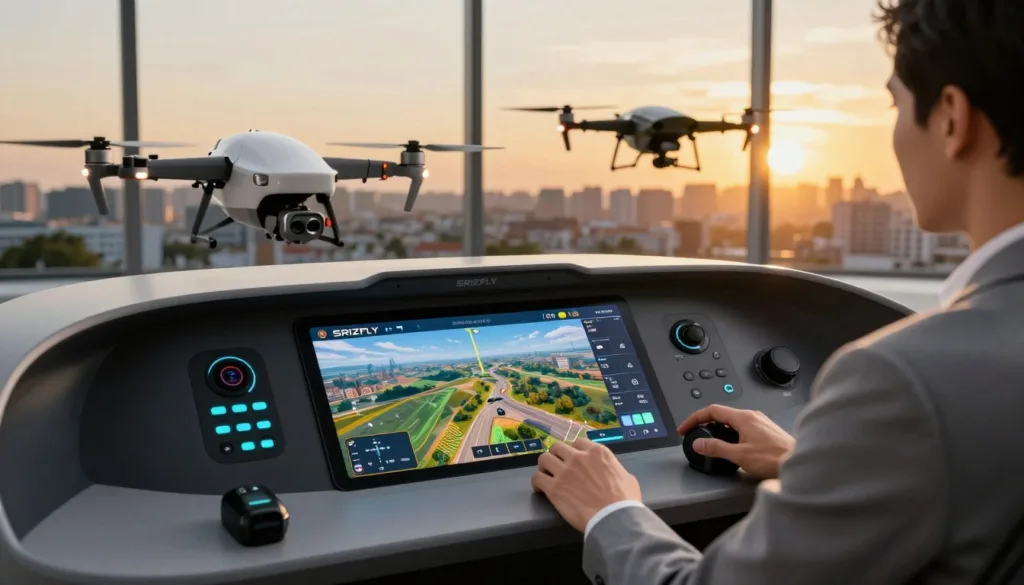
A major advantage of the SRIZFLY drone simulator is its ability to interface with a wide range of external hardware. Whether you are using professional-grade radio controllers or specialized flight sticks, the software provides plug-and-play compatibility. This ensures that the transition from the simulator to the field is as smooth as possible.
The platform supports various hardware configurations to accommodate different training needs:
- Standard RC Transmitters: Direct USB or wireless connection for authentic tactile feedback.
- Enterprise Flight Consoles: Full integration for industrial-grade control setups.
- VR Headsets: Immersive visual support for enhanced spatial awareness.
- Custom API Hooks: Allows developers to link proprietary hardware sensors directly into the simulation.
By maintaining a consistent performance profile across these devices, the software guarantees that your training remains accurate. This level of integration makes it a versatile tool for both hobbyists and commercial operators who demand precision in their virtual flight environment.
Key Benefits of SRIZFLY for Flight Training
Mastering drone flight requires a safe environment where mistakes do not result in costly hardware damage. By utilizing advanced flight training software, organizations can provide a controlled space for students to hone their skills. This approach ensures that every trainee builds confidence before ever touching a physical controller.
Reducing Operational Risks in Pilot Education
Traditional drone pilot education often involves significant financial exposure due to potential crashes and equipment repairs. SRIZFLY eliminates these concerns by providing a virtual sandbox that mimics real-world physics with high precision. Students can practice aggressive maneuvers or complex flight paths without the fear of destroying expensive gear.
This risk-free environment allows instructors to push students to their limits. When a pilot makes an error in the simulator, the only consequence is a reset button. This pedagogical advantage fosters a faster learning curve and encourages experimentation that would be too dangerous in the real world.
Simulating Complex Weather and Environmental Variables
Real-world flight conditions are rarely perfect, and pilots must be prepared for sudden changes. Our platform allows trainers to inject unpredictable weather patterns into the simulation. From high-velocity wind gusts to heavy fog, trainees learn to adjust their flight dynamics in real-time.
Preparing for these challenging conditions is essential for professional certification. By mastering these variables in a digital space, pilots gain the situational awareness needed to handle actual missions safely. The following table highlights the core advantages of using simulation over traditional methods.
| Feature | Traditional Training | SRIZFLY Simulation |
|---|---|---|
| Hardware Risk | High (Crash potential) | Zero (Virtual only) |
| Weather Control | Dependent on nature | Fully customizable |
| Cost Efficiency | Expensive (Maintenance) | Highly cost-effective |
| Learning Speed | Slow (Setup time) | Rapid (Instant reset) |
Advanced Mission Planning Capabilities
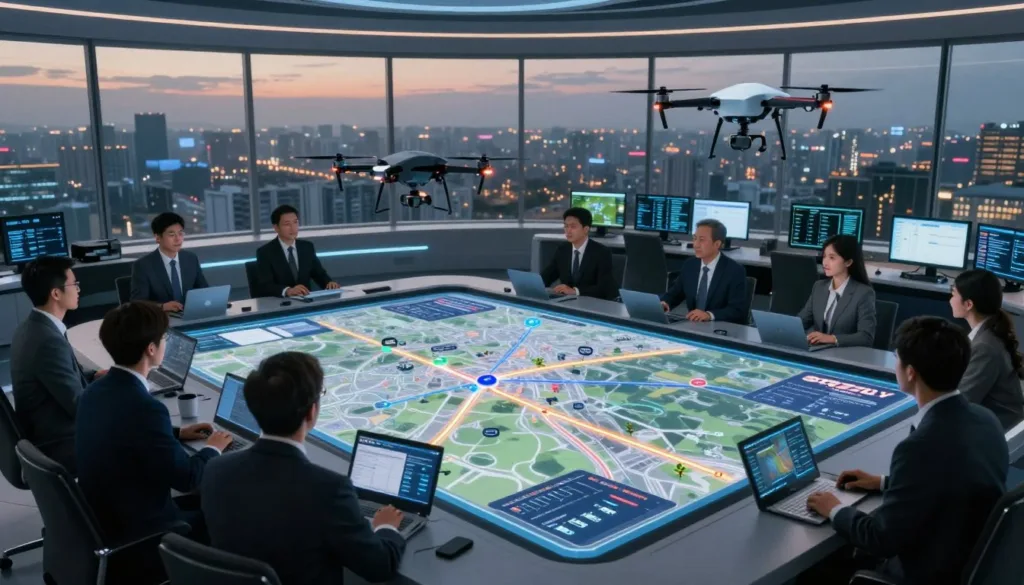
Achieving precision in the sky starts long before the rotors even begin to spin. Effective drone mission planning is the foundation of every successful flight, especially when tasks involve complex industrial environments. By utilizing high-fidelity software, operators can map out every detail of a flight path to ensure safety and accuracy.
This level of preparation is essential for modern commercial drone operations. It allows teams to visualize potential risks and optimize flight patterns before deploying hardware in the field. By simulating these scenarios, organizations can significantly reduce the likelihood of errors during live missions.
Automated Pathfinding and Obstacle Avoidance
The core of autonomous drone flight lies in the ability of the software to calculate the most efficient route while identifying hazards. SRIZFLY utilizes advanced algorithms to perform automated pathfinding, which helps drones navigate around static and dynamic obstacles in real-time.
This feature is particularly useful in cluttered environments where manual control might be risky. The system continuously scans the virtual surroundings to adjust the flight path instantly. This intelligent obstacle avoidance ensures that the drone maintains a safe distance from structures, power lines, or other aerial vehicles.
Strategic Deployment for Commercial Operations
Scaling commercial drone operations requires a reliable framework that can handle multiple missions simultaneously. Strategic deployment involves using simulation to test how drones perform in various urban or restricted zones. This process helps managers determine the best launch points and flight corridors for maximum efficiency.
By integrating autonomous drone flight protocols, companies can execute repetitive tasks with consistent results. This reliability is a game-changer for industries that rely on frequent inspections or data collection. Ultimately, robust drone mission planning allows businesses to operate with confidence, knowing that their fleet is prepared for any challenge.
SRIZFLY Features for Industrial Inspection
SRIZFLY is changing how companies approach complex site inspections through high-fidelity simulation. By providing a safe, virtual environment, it allows teams to test flight paths before entering hazardous zones. This industrial drone inspection capability ensures that every mission is planned with maximum precision and minimal risk.
High-Fidelity Digital Twin Generation
The core of modern asset management lies in the creation of accurate virtual replicas. Digital twin technology allows operators to map physical infrastructure into a 3D space with millimeter-level accuracy. This process enables engineers to identify structural weaknesses without ever leaving the office.
“The ability to simulate an entire industrial site in a virtual environment allows for a level of foresight that was previously impossible in traditional field operations.”
By utilizing these replicas, teams can run stress tests on bridges, power lines, and pipelines. This proactive approach helps in identifying potential failures before they manifest in the real world. It turns raw data into actionable insights for better decision-making.
Predictive Maintenance Modeling for Drone Fleets
Effective drone fleet management requires more than just scheduling flights; it demands a deep understanding of hardware health. SRIZFLY integrates predictive modeling to track the wear and tear of components based on simulated flight hours. This helps managers anticipate when a motor or battery might fail.
By analyzing performance data, organizations can schedule maintenance during downtime rather than during critical operations. This strategy significantly extends the lifespan of expensive equipment. It also ensures that the fleet remains mission-ready at all times.
| Feature | Traditional Inspection | SRIZFLY Simulation |
|---|---|---|
| Risk Exposure | High | Minimal |
| Data Accuracy | Variable | High-Fidelity |
| Maintenance | Reactive | Predictive |
| Cost Efficiency | Low | High |
Ultimately, the combination of these tools creates a safer and more efficient workflow. Companies that adopt these technologies gain a competitive edge in the market. Investing in digital twin technology and smart drone fleet management is the future of industrial safety.
Regulatory Compliance and Safety Standards in the US
Navigating the complex landscape of aviation law requires more than just flight hours; it demands rigorous adherence to federal standards. For professionals, staying updated with the latest FAA Part 107 requirements is essential to avoid penalties and ensure safe skies. SRIZFLY provides a robust framework that helps operators align their training protocols with these federal mandates.
By integrating high-fidelity simulation into your workflow, you can ensure that your commercial drone operations remain fully compliant. This proactive approach minimizes legal risks while fostering a culture of excellence. It allows teams to practice complex maneuvers in a controlled environment before taking to the real-world airspace.
Meeting FAA Requirements Through Simulation
The path to certification often involves demonstrating proficiency in various flight scenarios. Drone pilot education is significantly enhanced when trainees can repeatedly practice emergency procedures and navigation tasks without risking expensive hardware. Simulation acts as a bridge, ensuring that every pilot is prepared for the challenges of the National Airspace System.
Using simulation software allows organizations to maintain high drone safety standards across their entire fleet. Pilots can master flight dynamics and obstacle avoidance in a virtual space that mirrors real-world conditions. This level of preparation is vital for passing certification exams and maintaining operational licenses.
Data Logging and Reporting for Certification
One of the most critical aspects of federal compliance is the ability to provide accurate documentation of flight experience. SRIZFLY automates the collection of performance metrics, creating a reliable audit trail for every session. This data is invaluable when you need to prove competency to regulatory bodies.
Effective reporting systems offer several advantages for your business:
- Automated flight logs that track total hours and specific maneuvers performed.
- Detailed performance analytics to identify areas where a pilot may need additional training.
- Standardized reporting formats that simplify the submission process for commercial drone operations.
- Secure storage of training records to support long-term drone pilot education goals.
By leveraging these digital tools, you ensure that your organization consistently meets drone safety standards. Reliable data logging transforms the way you manage pilot development and regulatory reporting. It provides the transparency needed to operate with confidence in an increasingly regulated industry.
Hardware Compatibility and System Requirements
Achieving high-fidelity simulation results requires a robust hardware foundation tailored for complex flight environments. When you invest in advanced software, the underlying system must be capable of processing vast amounts of visual and physics data without interruption. Reliable hardware ensures that your training sessions remain immersive and productive.
To maintain peak performance, users should prioritize components that handle high-resolution textures and complex lighting models. A stable system prevents lag, which is essential when you are conducting a detailed industrial drone inspection in a virtual space. Consistent frame rates are the backbone of a realistic simulation experience.
Optimizing GPU Performance for Real-Time Rendering
The Graphics Processing Unit (GPU) acts as the primary engine for rendering the intricate environments found in modern flight software. For professional users, a high-end dedicated graphics card is non-negotiable to achieve smooth, real-time rendering. This power allows the software to calculate complex shadows and reflections that mimic real-world conditions.
When performing an industrial drone inspection, the ability to see fine details on infrastructure is critical. A powerful GPU ensures that these visual elements remain sharp even during rapid camera movements. We recommend utilizing hardware that supports the latest ray-tracing technologies to maximize visual accuracy.
Controller Integration and Haptic Feedback Support
The physical connection between the pilot and the drone is just as important as the visual display. Integrating professional-grade controllers allows for a seamless transition from the simulator to actual flight operations. This level of precision is vital for effective drone mission planning and execution.
Many advanced setups now include haptic feedback systems to provide tactile responses during flight. These vibrations help pilots feel the drone’s interaction with the environment, such as wind resistance or proximity to obstacles. By incorporating these tools into your drone mission planning workflow, you build the muscle memory necessary for safe and efficient real-world flights.
Consistency in hardware selection ultimately leads to better training outcomes. Whether you are using standard remote controllers or specialized flight sticks, ensure your system drivers are updated regularly. This simple step guarantees that your input devices communicate perfectly with the simulation engine.
Comparing SRIZFLY Against Traditional Simulators
When evaluating simulation tools, the gap between traditional systems and the SRIZFLY drone simulator becomes immediately apparent. Many legacy platforms rely on outdated codebases that fail to replicate the nuances of modern flight dynamics. Organizations looking to modernize their flight training software must prioritize systems that offer both precision and speed.
Latency and Physics Engine Accuracy
The core advantage of this platform lies in its ultra-low latency architecture. Traditional simulators often suffer from input lag, which creates a disconnect between the pilot’s controller movements and the aircraft’s response. By utilizing real-time drone rendering, the software ensures that every micro-adjustment is reflected instantly in the virtual environment.
Physics engine accuracy is equally vital for professional training. While older systems approximate flight behavior, this solution calculates aerodynamic forces with high fidelity. This level of detail allows pilots to experience realistic stall conditions, wind shear, and complex maneuvers that are essential for safe operations.
Scalability for Enterprise-Level Training
Effective drone fleet management requires a platform that can handle multiple concurrent users without performance degradation. Traditional software often limits the number of active drones, making it difficult to simulate large-scale industrial missions. In contrast, this architecture is built to scale, supporting complex scenarios involving dozens of aircraft simultaneously.
Enterprise organizations benefit from the ability to deploy standardized training modules across global teams. This consistency ensures that every pilot meets the same rigorous safety standards regardless of their location. The following table highlights the key differences between legacy systems and this advanced solution.
| Feature | Legacy Simulators | SRIZFLY Platform |
|---|---|---|
| Physics Fidelity | Basic Approximation | High-Precision Modeling |
| Rendering Speed | Variable Latency | Real-Time Performance |
| Fleet Capacity | Single-User Focus | Enterprise Scalability |
| System Integration | Closed Ecosystem | Open API Support |
By choosing a robust SRIZFLY drone simulator, companies can significantly reduce the time required for pilot certification. The combination of superior physics and scalable infrastructure makes it the premier choice for modern drone fleet management and professional flight training software needs.
Future Trends in Intelligent Drone Simulation
Innovation in the simulation sector is moving at an unprecedented pace, driven by the need for smarter, faster, and more autonomous systems. As we look ahead, intelligent drone simulation software will become the backbone of global aviation development. These tools are evolving to handle increasingly complex environments that mirror the unpredictability of the real world.
The Impact of 5G and Edge Computing
The rollout of 5G networks is a game-changer for the industry. By providing ultra-low latency, 5G allows for the seamless transmission of massive datasets between the drone and the simulation environment. This connectivity is essential for real-time decision-making in high-stakes scenarios.
Edge computing further enhances this by processing data locally on the hardware rather than relying solely on distant cloud servers. This shift ensures that AI-powered drone training remains responsive even in remote locations. Pilots can now experience near-instant feedback, which is critical for mastering complex flight maneuvers.
Advancements in Autonomous Swarm Simulation
The future of flight lies in the ability to manage multiple units simultaneously. We are seeing rapid progress in autonomous drone flight, where swarms of drones must coordinate without human intervention. Advanced simulation platforms are now capable of modeling thousands of agents in a single virtual space.
These simulations rely heavily on digital twin technology to create high-fidelity replicas of physical environments. By integrating real-time data streams, these digital twins allow developers to test swarm logic under extreme conditions. This ensures that when the drones take to the sky, they are prepared for any variable they might encounter.
| Feature | Current Capability | Future Outlook |
|---|---|---|
| Data Processing | Cloud-based latency | Edge-native speed |
| Swarm Size | Limited coordination | Massive, autonomous fleets |
| Environment | Static models | Dynamic digital twins |
| Connectivity | Standard Wi-Fi/4G | Integrated 5G networks |
The integration of these technologies will undoubtedly lead to safer and more efficient operations. As these tools mature, the barrier between virtual testing and physical deployment will continue to fade. The future of aviation is being written in code today.
Conclusion
SRIZFLY represents a major shift in how pilots prepare for complex aerial missions. This software provides the tools needed to navigate the skies with confidence and precision.
Adopting this platform helps operators stay ahead of evolving FAA drone regulations. It creates a reliable environment to practice maneuvers while keeping strict adherence to current industry requirements.
Prioritizing drone safety standards remains vital for every commercial operation. Using high-fidelity simulation ensures that every pilot understands the risks before taking off in the real world.
Visit the official SRIZFLY website to download the trial version today. Reach out to the sales team to discuss how this technology fits your specific training needs. Start your journey toward professional flight mastery now.
FAQ
What distinguishes SRIZFLY from standard flight simulators on the market?
SRIZFLY is an intelligent drone simulation software specifically engineered for aviation professionals. Unlike basic trainers, it utilizes a sophisticated physics engine and high-fidelity rendering to replicate real-world flight dynamics. This allows pilots to transition seamlessly from a virtual flight environment to actual field operations with platforms like the DJI Matrice 350 RTK or Skydio X10.
How does the AI-powered drone training adapt to individual pilot needs?
The SRIZFLY ecosystem incorporates advanced AI drone training algorithms that monitor user inputs in real-time. By analyzing performance data, the software provides personalized feedback and adjusts the difficulty of complex maneuvers. This tailored approach accelerates drone pilot education and ensures that operators are prepared for the nuances of autonomous drone flight.
Can SRIZFLY help my organization meet FAA Part 107 requirements?
Yes. SRIZFLY is designed to align with US aviation laws and FAA requirements. The platform features comprehensive data logging and reporting tools that track pilot hours and competency levels. By maintaining these high drone safety standards, enterprise users can provide the necessary documentation for certification and regulatory audits.
How does digital twin technology improve industrial drone inspection?
Through high-fidelity digital twin generation, SRIZFLY creates exact virtual replicas of critical infrastructure. This allows operators to conduct industrial drone inspection simulations on assets like power grids or bridges without any physical risk. Furthermore, predictive maintenance modeling helps managers identify potential issues within their drone fleet management strategy before they result in hardware failure.
What are the hardware requirements for optimal real-time drone rendering?
To ensure a low-latency experience, we recommend a PC equipped with a high-performance NVIDIA GeForce RTX GPU. Optimizing GPU performance is crucial for real-time rendering of complex environments. Additionally, the software supports haptic feedback and professional-grade controller integration to provide the most realistic tactile experience during drone mission planning.
Does the simulator account for unpredictable weather and environmental variables?
Absolutely. One of the core SRIZFLY features is the ability to simulate complex weather patterns, including wind shear, thermal currents, and varying precipitation levels. Training in these simulated conditions is essential for reducing operational risks during high-stakes commercial drone operations.
How does SRIZFLY facilitate advanced mission planning and obstacle avoidance?
The software includes sophisticated tools for automated pathfinding and obstacle avoidance. Pilots can engage in strategic deployment exercises, programming flight paths that navigate around urban structures. These autonomous drone flight features are critical for scaling commercial operations safely in restricted or crowded airspaces.
What future technologies are being integrated into the SRIZFLY platform?
We are currently exploring the impact of 5G and edge computing to reduce latency even further. Future updates will focus on autonomous swarm simulation, allowing a single operator to manage multiple units simultaneously. This evolution in intelligent drone simulation software will ensure that SRIZFLY remains the industry leader for enterprise-level training and advanced digital twin technology integration.