



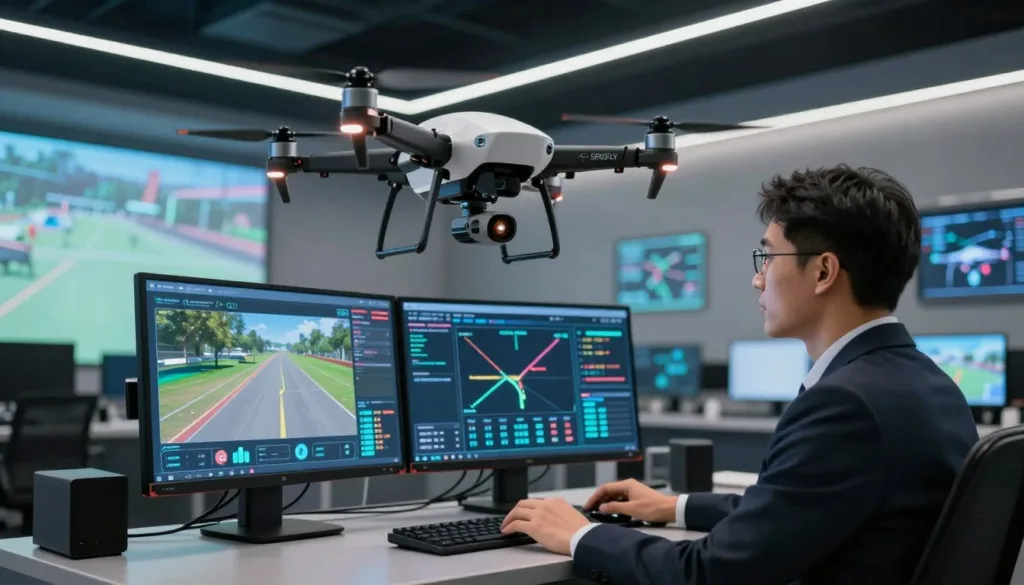
The SRIZFLY drone simulator leads a new wave of AI-driven drone simulation software that blends realistic flight physics with machine learning for autonomy testing. Built for U.S. operators, educators, and developers, SRIZFLY works alongside research efforts such as Project AirSim and commercial platforms like SIMNET to make aerial autonomy simulator tools practical for real programs.
Project AirSim, launched from Microsoft research, shows why large-scale AI drone training matters. AirSim provides virtualized urban and rural worlds so autonomy stacks can learn edge cases, bad weather behavior, and landing in constrained sites. Those same goals drive SRIZFLY’s design: train perception, collision avoidance, and payload-aware flight dynamics without costly field failures.
Cloud-native platforms such as SIMNET offer a different but complementary approach. SIMNET integrates design, CFD-style visualizations, and SITL links to ArduPilot for rapid prototyping. Together, these tools shorten development cycles and support mission rehearsal, SORA/BVLOS planning, and XR drone training on headsets like Meta Quest.
Key Takeaways
- SRIZFLY and Project AirSim focus on large-scale autonomy training using simulated real-world environments.
- AI-driven drone simulation software reduces risk by exposing autonomy to rare edge cases and bad weather.
- SIMNET adds cloud-native workflows for design, analysis, and pilot or operator training.
- XR drone training boosts retention and cuts live-flight hours through immersive rehearsal.
- Combining research platforms and commercial simulators speeds certification, prototyping, and operational readiness.
AI-driven drone simulation software: features, XR integration, and real-world use cases
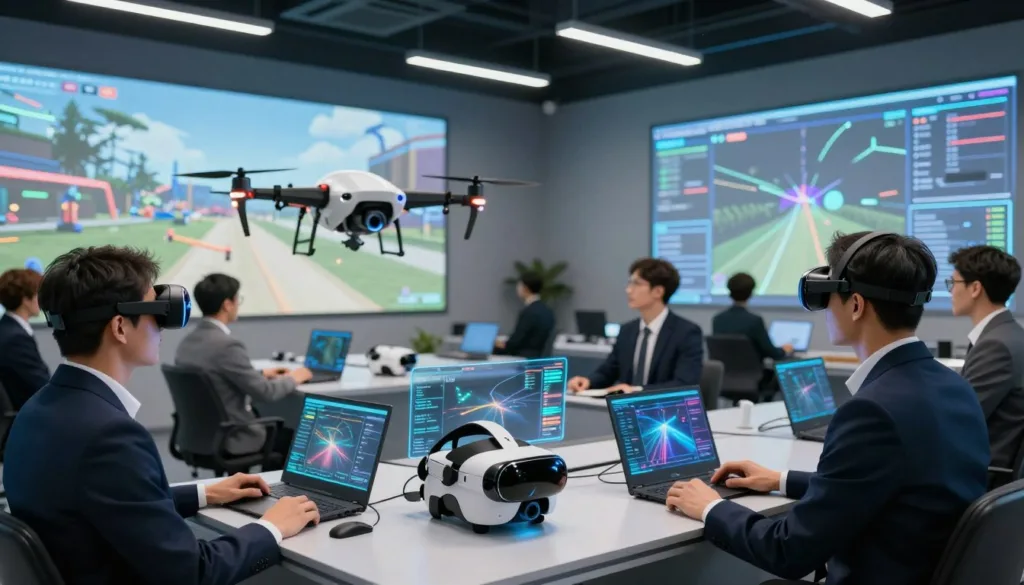
Modern drone simulation platforms combine autonomy testing with immersive XR tools to speed development and lower risk. Research and products inspired by Project AirSim autonomy show how AI and deep learning for drones can be trained in varied scenes before hardware flights. Teams use perception stack simulation and synthetic data generation to expose models to glare, occlusion, and sensor noise.
Core AI capabilities and autonomy testing
Autonomy testing centers on sensor fidelity and control loops. Perception stack simulation reproduces camera, LiDAR, and radar artifacts so vision pipelines face real-world challenges.
Synthetic data generation fills gaps in rare-case coverage. Developers craft edge cases like low light, bird strikes, and payload shifts to harden anomaly detection and decision layers.
XR, VR, and AR integration for immersive pilot and operator training
XR drone training spans VR pilot training and AR mixed reality drone rehearsal to match training goals. VR pilot training offers full immersion for emergency drills. AR mixed reality drone rehearsal overlays guidance on real spaces to build situational awareness.
Head-mounted displays for drone simulation, such as Meta Quest and Varjo, plug into flight sims to deliver depth cues and latency testing. Paired controllers and real RC transmitters preserve muscle memory during rehearsal.
Simulation fidelity: physics engines, flight dynamics, and validation
High-fidelity flight dynamics simulation relies on engines like Unity and Unreal Engine to model aerodynamics and rendering. Physics-based drone models capture thrust, torque, and frame geometry to avoid unrealistic handling.
Wind and gust modeling mixes steady vectors with stochastic noise to test recovery. System identification tunes simulator parameters against real flight logs so virtual trajectories match hardware within accepted error.
Applied scenarios: infrastructure inspection, last-mile delivery, and urban air mobility
Drone inspection simulation focuses on high-resolution imaging, sensor fusion, and anomaly detection near towers and bridges. Training teaches obstacle avoidance and precise maneuvering under glare and gusts.
Last-mile delivery drone training covers payload effects, battery planning, and landing variability in dense neighborhoods. Simulation introduces unexpected obstacles and human factors to validate safe drops.
Urban air mobility simulator scenarios scale dynamics and procedures for larger vehicles. AAM training scenarios include vertiport ops, route optimization, and passenger safety workflows for air taxis and cargo drones.
Operational workflows and commercial platforms for training, design, and validation
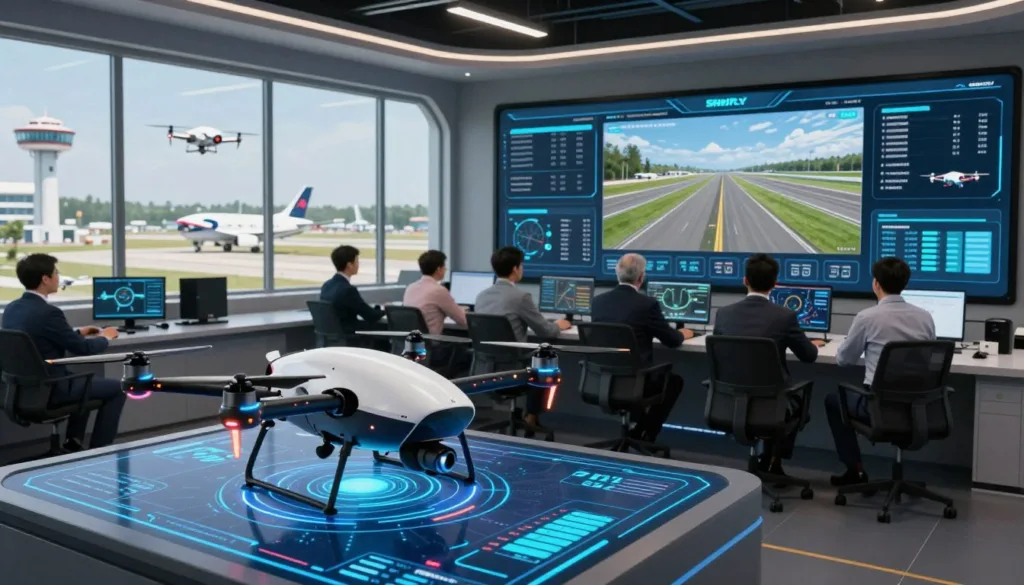
SIMNET brings design, simulation, and training into one cloud workspace. The platform acts as a cloud-native drone simulator that supports rapid design-for-simulation and digital twin drone training. Teams can move from concept to flight rehearsal without switching tools.
Design workflows let engineers build or recreate airframes using a parametric parts library. Users run trade studies and quick CFD-style visualizations that yield instant flight-time and range predictions. Outputs export as STEP or STL for CAD and 3D printing, cutting prototype cycles and cost.
Virtual testing and flight runs include manual piloting, autonomous checks, and SITL ArduPilot simulation. SIMNET links to common ground control stations such as QGroundControl and Mission Planner. Simulation logs export to CSV for analysis and support worldwide terrain for realistic mission rehearsal.
Pilot training features a catalog of ready-made courses plus custom content. Operators rehearse BVLOS scenarios, terrain-following, and failsafe drills under varied weather and failure modes. LMS integration records trainee scores and builds compliance-ready proficiency records for regulators.
Academic and industry users report faster iterations and better operational readiness. Universities like Embry-Riddle and the Technical University of Munich use the platform for coursework and research. Industry pilots run validation campaigns that combine system ID, flight-log replay, and scenario libraries.
Deployment comes with managed updates, tech support, and trial accounts. An onboard AI assistant helps users with tasks and troubleshooting. Licensing tiers accommodate students, research labs, and commercial operators seeking scalable simulation capacity.
For commercial adoption, start small with focused pilot programs for delivery, inspection, or advanced air mobility. Use digital twin drone training and recorded mission rehearsal to validate concepts. Feed simulator outputs into regulatory documents and training systems to streamline certification paths.
| Workflow | Key Capabilities | Primary Benefits |
|---|---|---|
| Design-for-simulation | Parametric parts library, virtual wind tunnel, STEP/STL export | Faster CAD iterations, reduced prototyping cost, accurate performance forecasts |
| Virtual testing | SITL ArduPilot simulation, GCS links, worldwide terrain, VR support | Realistic validation, support for autonomy testing, direct flight-log analysis |
| Pilot training | Course catalog, custom scenarios, LMS integration | Regulatory traceability, measurable proficiency, scalable instructor control |
| Operational validation | Mission rehearsal, scenario libraries, CSV export for analysis | Safer BVLOS rollouts, data-driven approvals, repeatable validation runs |
| Deployment & support | Managed updates, AI assistant, flexible licensing | Low IT overhead, rapid onboarding, academic and commercial access |
Conclusion
AI-driven drone simulation software conclusion: modern simulators accelerate autonomy development and cut real-world risk. Platforms such as Microsoft Project AirSim let teams train perception and control stacks on diverse, edge-case scenarios. That early virtual testing reduces costly flight hours and surfaces failure modes before hardware is deployed.
XR training benefits are clear for pilots and operators. VR and AR sessions raise situational awareness and improve skill transfer compared with some traditional methods. Using XR lowers environmental impact and training cost by replacing many live flights with repeatable, instrumented scenarios.
Validated physics models and cloud-native systems support scalable drone training and certification work. Techniques like replaying flight logs and system identification help prove hover, drift, trajectory fidelity, and gust response. These benchmarks feed regulatory evidence and strengthen SORA readiness when teams submit risk assessments for BVLOS or advanced air mobility operations.
Practical next steps for U.S. teams include phased pilot programs focused on infrastructure inspection, last-mile delivery, and AAM. Integrate simulator outputs into LMS records, request vendor demos or free trials such as SIMNET, and track research projects like Project AirSim and Flightmare. Design a clear adoption plan—design, validation, operator training, regulatory evidence—to keep programs current and mission-ready.