



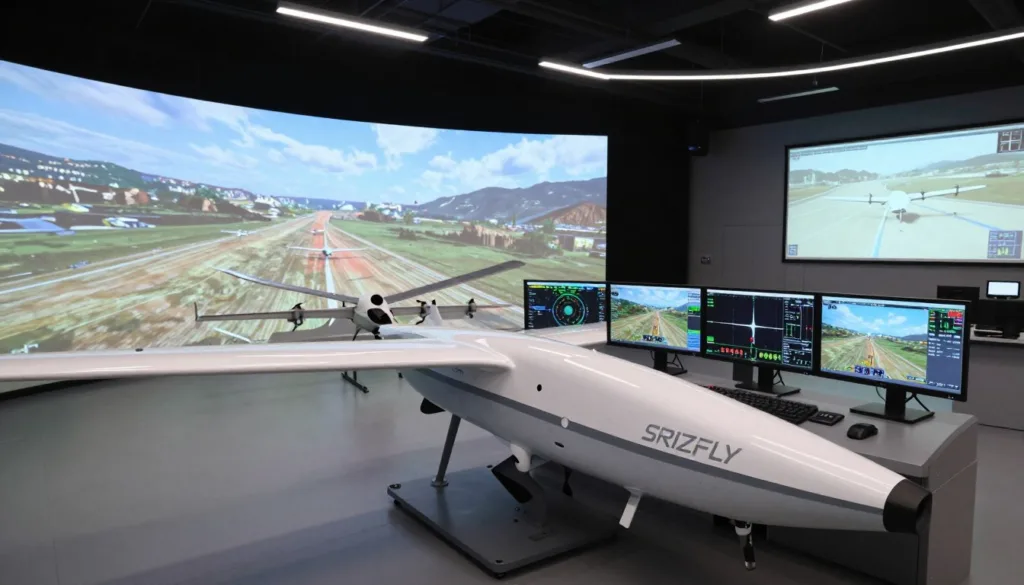
Fixed-wing unmanned aerial vehicles serve critical roles across industries today. From delivery operations to environmental monitoring, tower inspection, mapping, logistics, and agriculture, these platforms deliver consistent performance and long endurance. Energy efficiency makes them ideal for extended missions where traditional multicopters fall short.
Real-world testing brings significant challenges. Weather constraints limit training schedules. Regulatory restrictions require special permissions. Physical flight tests drain budgets fast. Equipment damage from crashes adds unexpected costs. Your team needs a better way to prepare pilots and develop controllers safely.
Small UAV training solutions address these pain points head-on. Simulation enables year-round, controlled practice without weather delays or regulatory barriers. You test edge cases and failure scenarios risk-free. Your engineers iterate on designs rapidly. Training happens in repeatable conditions every single time.
Drone simulation technology transforms how organizations approach fixed-wing development. Defense contractors validate autopilots before flight tests. Research institutions explore novel control algorithms safely. Commercial enterprises train operators cost-effectively. Educational programs prepare students without expensive equipment losses.
SRIZFLY brings expertise in unmanned aerial vehicle modeling systems to enterprises and institutions across North America. We understand the unique demands of fixed-wing platforms. Our solutions accelerate innovation while maximizing safety and reducing operational expenses. Your success in the UAV industry starts with intelligent simulation.
Key Takeaways
- Fixed-wing UAVs require specialized simulation for safe and efficient training across delivery, inspection, and agricultural applications
- Small UAV training solutions eliminate weather delays, regulatory complications, and crash-related equipment costs
- Drone simulation technology enables year-round pilot training and rapid controller development without real-world flight risks
- Unmanned aerial vehicle modeling systems accelerate innovation for defense, research, and commercial enterprises
- SRIZFLY simulators reduce training time by 50 percent while improving operational safety and decision-making
- Risk-free testing of edge cases and failure scenarios strengthens system reliability before actual deployment
- Simulation-based approaches lower total development costs and compress project timelines significantly
Understanding Small Fixed-Wing UAV Architecture and Dynamics
Building accurate simulations of small fixed-wing unmanned aerial vehicles starts with understanding the core physics that governs their flight. We recognize that successful UAV architecture modeling requires precise knowledge of how sensors, propulsion systems, and aerodynamic forces interact in three-dimensional space. This foundation transforms simulation from a training tool into a trusted partner for your flight control development.
The key to realistic behavior lies in recognizing that different measurement systems must work together seamlessly. Inertial measurement units and velocity estimators sit at specific physical locations on your aircraft, not at the center of gravity. This creates the need for careful mathematical transformations that connect all measurements to a single reference point.
Sensor Frame to Center of Gravity Transformation
Sensor frame transformation represents one of the most critical aspects of accurate UAV architecture modeling. Your aircraft’s inertial measurement unit captures data from its mounted position, yet flight dynamics equations require all inputs at the center of gravity.
The transformation process involves three essential components:
- Distance vectors connecting sensor locations to the aircraft center of gravity
- Angular velocity effects that influence velocity readings
- Angular acceleration and centripetal terms affecting acceleration calculations
For platforms like the Skywalker X8, engineers position the body frame origin at the aerodynamic center, which coincides with the nominal center of gravity calculations. This alignment simplifies the mathematics while maintaining physical accuracy. The velocity transformation equation accounts for rotational motion, ensuring that linear and angular motion integrate correctly. Acceleration transformation demands additional complexity—it must capture how the aircraft’s spinning motion affects how sensors perceive acceleration.
Without proper sensor frame transformation, your simulation will diverge from real-world aircraft behavior almost immediately. Inaccurate data feeds into control algorithms, creating a disconnect between virtual testing and actual flight performance.
Propulsion Force and Moment Calculations
Propulsion modeling determines how effectively your simulated aircraft responds to control inputs. Thrust and torque calculations depend on three interconnected variables that change throughout flight:
- Airspeed relative to the surrounding air
- Motor rotation speed measured in revolutions per minute
- Advance ratio describing propeller efficiency
These parameters directly influence how much force your propeller generates at any given moment. An aircraft flying faster through the air experiences different propeller efficiency compared to hovering conditions. Understanding aerodynamic dynamics simulation means recognizing these real-world variations.
Your propulsion model must account for how these forces translate to motion around the body frame coordinates. Thrust acts primarily along the aircraft’s longitudinal axis, generating forward motion. Torque creates rotational effects that pilots must counteract with control surfaces. When you combine propulsion forces with aerodynamic forces and gravity, the complete picture of aircraft motion emerges.
Aerodynamic System Modeling Fundamentals
Aerodynamic forces represent the third pillar of accurate aerodynamic dynamics simulation. Lift and drag emerge naturally when air flows across wings and fuselage surfaces. These forces depend on airspeed, angle of attack, and atmospheric density.
Aerodynamic modeling uses stability frame coefficients—mathematical representations of how lift and drag vary with flight conditions. The stability frame aligns with the relative wind direction, making it the natural reference for aerodynamic forces. Your simulation must transform these stability frame values into body frame coordinates for integration with propulsion and gravity forces.
We guide you through this transformation because it unlocks the true potential of simulation-based development. When center of gravity calculations, sensor transformations, and aerodynamic forces work together with precision, your virtual aircraft behaves identically to its physical counterpart.
“Accurate simulation requires understanding how every force and measurement connects to the aircraft’s actual motion. This foundation enables controllers developed in simulation to work reliably during real flight operations.”
The mathematical frameworks we’ve outlined form the backbone of high-fidelity simulation. They represent the difference between training systems that improve controller performance and systems that merely look realistic on screen. Our simulators integrate these proven physics models, giving your team confidence that every hour spent in the virtual environment translates directly to safer, more effective real-world operations.
Simulation of Small Fixed-Wing Unmanned Aerial Vehicles
Dynamic simulation forms the foundation of modern fixed-wing UAV development. Our fixed-wing UAV simulation software integrates all critical components into a unified system that accurately predicts aircraft behavior. You can test control algorithms, refine system identification, and train vision-based controllers before deploying to physical hardware. This approach eliminates costly field test failures and accelerates your development timeline.
The simulation process computes system dynamics by combining aerodynamic forces, propulsion forces, and gravitational forces in the body frame. We apply Newton’s second law to calculate linear and angular accelerations. Position and attitude dynamics operate in the NED (North-East-Down) inertial frame, providing accurate real-world predictions. This physics-based approach ensures our unmanned aircraft virtual testing delivers reliable results.
Our flight simulation platforms support diverse aircraft configurations, including flying wings with elevon control surfaces. The system automatically transforms elevon inputs into equivalent elevator and aileron commands, enabling accurate modeling of platforms like the Skywalker X8. This flexibility means you can simulate your specific aircraft design without complex workarounds.
The simulation workflow follows an iterative development cycle. You design control logic, test it virtually, analyze results, and refine your approach—all without risking hardware damage. Educational institutions gain hands-on flight dynamics experience for students. Commercial enterprises conducting inspection, mapping, or logistics operations can prototype autonomous behaviors and test edge cases like wind gusts and sensor failures safely.
High-fidelity UAV dynamics simulation improves development efficiency by 50% or more. Your team controls throttle, elevator, aileron, and rudder inputs while observing resulting accelerations, velocities, attitudes, and positions. Small aircraft modeling tools provide the transparency needed for mission-critical validation before real-world deployment.
SRIZFLY simulators bridge the gap between theoretical understanding and practical application. Our small aircraft modeling tools enable you to achieve your operational objectives faster, safer, and more cost-effectively. Start your risk-free 10-day trial today and discover how simulation accelerates your fixed-wing UAV success.
Photorealistic Environment Rendering with Gaussian Splatting Technology
Creating realistic virtual environments for UAV training requires cutting-edge rendering technology. Gaussian Splatting technology transforms how we build digital twins of real-world spaces. This approach delivers photorealistic UAV simulation that captures every detail of your operational environment. The technology replaces older methods with faster, higher-quality results that match real-world conditions.
We are excited about this breakthrough because it changes everything for vision-based simulation. Your training environments can now look and behave exactly like the spaces where your drones will actually operate. This eliminates the gap between simulation and reality, helping your team prepare for real missions with confidence.
Building 3D Gaussian Splat Simulation Environments
Creating a 3D environment rendering with Gaussian Splatting starts with image collection. You will need approximately 2,000 images captured from different positions throughout your operational area. These images form the foundation for your entire simulation.
The process uses established tools like COLMAP to calculate camera details and positions. The system learns these camera intrinsics automatically, saving you hours of manual work. Once collected, your images train the Gaussian Splat model in about 15 minutes on modern GPUs.
The results speak for themselves:
- Rendering speed of 0.004 seconds per 960×720 image
- Photorealistic visual quality matching real-world conditions
- Support for any camera pose within the scanned area
- Rapid deployment from collection to training
Real-to-Sim Data Collection and Camera Calibration
Accurate camera calibration for drones ensures your simulation matches reality. The real-to-sim transfer process requires precise alignment between your virtual environment and actual coordinates. ArUco markers provide this alignment automatically.
Your team places these markers throughout the operational area. The system detects them and aligns the entire 3D environment rendering to world coordinates. This step is critical for vision-based simulation because your drone’s camera must see the virtual world in the same way it sees the real world.
| Calibration Component | Purpose | Impact on Simulation |
|---|---|---|
| Camera Intrinsics | Focal length and lens distortion | Ensures rendered images match camera hardware |
| Camera Extrinsics | Position and orientation in space | Aligns virtual poses with real-world locations |
| ArUco Markers | Physical reference points | Anchors simulation to world coordinates |
| World Frame Alignment | Coordinate system calibration | Enables direct sim-to-real transfer |
The calibration workflow is straightforward. Your team collects images, marks reference points, and lets the system handle the mathematics. This approach delivers accuracy without complexity.
Digital versus Analog Camera Simulation Variants
Your drone’s camera choice affects both simulation and real-world performance. Gaussian Splatting technology supports both digital and analog camera variants, giving you flexibility.
Digital cameras deliver superior image quality in your photorealistic UAV simulation. They capture fine details needed for advanced vision-based simulation tasks like autonomous landing and inspection work. The tradeoff is added weight on your platform.
Analog cameras are lighter, which matters for small fixed-wing UAVs. Your platform can carry less payload weight, extending flight time and operational range. The image quality is lower, creating a different training environment. Your controller learns to work with the specific camera system you will actually use.
We recommend matching your simulation camera type to your real hardware. A controller trained on digital camera images may perform differently with an analog camera in the field. Our simulators let you create variants for each option:
- Digital variant: Premium image quality, realistic detail capture, heavier sensor weight
- Analog variant: Lighter sensor, extended flight duration, simplified visual features
- Mixed variants: Test controller robustness across multiple camera types
This flexibility means you train controllers specifically for your equipment configuration. Your real-to-sim transfer becomes seamless because the simulation matches your actual hardware exactly.
“Controllers trained in photorealistic environments can transfer to real hardware with minimal performance degradation, with research showing 80-100% success rates in zero-shot sim-to-real deployment.”
Your success depends on preparation. Photorealistic environment rendering with Gaussian Splatting technology gives you that advantage. You get to practice vision-based autonomy in virtual spaces that look and behave like reality. This transforms how you develop autonomous inspection, surveillance, and delivery applications.
Ready to build your digital twin? Start with SRIZFLY’s advanced simulation tools. We provide everything you need to create photorealistic environments, calibrate your cameras, and train vision-based controllers. Our 10-day free trial lets you experience the difference that cutting-edge 3D environment rendering makes for your team. Take the first step toward faster development and safer training today.
Aerodynamic Modeling and System Identification Methods
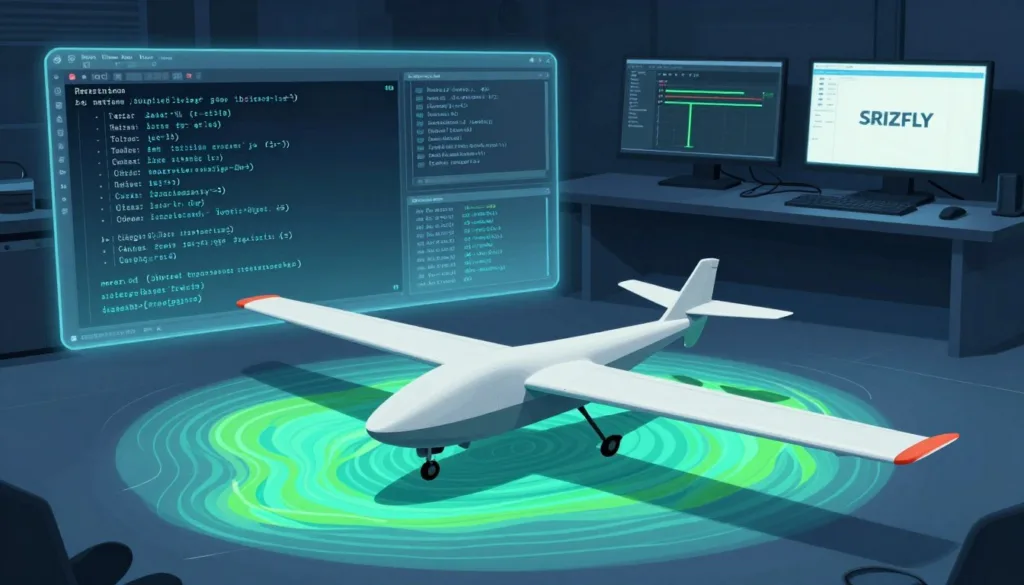
Accurate aerodynamic modeling forms the foundation of reliable UAV simulation. We use proven system identification UAV techniques to transform real flight data into predictive models that capture your aircraft’s unique behavior. This process bridges the gap between theoretical aerodynamics and actual aircraft performance, enabling simulations that faithfully reproduce how your specific platform responds to control inputs and environmental conditions.
The output error method serves as our primary approach for identifying flight dynamics parameters. This time-domain technique collects measured states and control inputs during actual flight tests, then iteratively adjusts model parameters until simulated outputs match real-world data with minimal error. The process delivers high-fidelity models that predict aircraft response accurately across your operational envelope.
Flight Data Collection and Model Structure
Our identification workflow begins with comprehensive flight testing. We record essential flight dynamics parameters including position, velocity, attitude angles, angular rates, and control surface deflections. This data feeds into a parametric aerodynamic model where lift, drag, and moment coefficients are expressed as polynomial functions of angle of attack, sideslip angle, and nondimensional angular rates.
The aerodynamic model typically includes:
- Stability frame coefficients: lift (CL) and drag (CD)
- Body frame moment coefficients: pitch (Cm), roll (Cl), and yaw (Cn)
- Dependencies on control surface deflections from elevator, aileron, rudder, and throttle
- Environmental factors including wind tunnel data validation
Parameter Estimation and Model Validation
Coefficient estimation relies on optimization solvers that minimize discrepancies between simulated and measured outputs. Stepwise regression techniques systematically evaluate which model terms contribute meaningfully to prediction accuracy. This balances complexity against overfitting—too simple and critical dynamics get missed; too complex and the model captures noise rather than true aerodynamic behavior.
| Model Component | Key Variables | Validation Method | Impact on Simulation Accuracy |
|---|---|---|---|
| Lift Coefficient (CL) | Angle of Attack, Elevator Deflection | Wind Tunnel Data Comparison | Controls vertical forces and pitch response |
| Drag Coefficient (CD) | Angle of Attack, Speed | Flight Test Validation | Affects deceleration and energy management |
| Pitch Moment (Cm) | Angle of Attack, Angular Rate | Output Error Method Analysis | Determines pitch stability and control authority |
| Roll Moment (Cl) | Bank Angle, Angular Rate | Cross-Validation Testing | Controls rolling motion and wing-level stability |
| Yaw Moment (Cn) | Sideslip Angle, Rudder Input | Coordinated Turn Analysis | Affects directional stability and turn coordination |
Real-World Applications and Benefits
For enterprises conducting tower inspections in gusty conditions or mapping mountainous terrain, accurate aerodynamic modeling techniques ensure controllers maintain stability despite wind disturbances. Agricultural operations benefit from models that predict performance during crosswind spraying missions.
Educational institutions gain access to industry-standard identification methods that prepare students for aerospace careers. SRIZFLY simulators incorporate validated aerodynamic modeling workflows, allowing you to customize models for your specific airframes. This capability means controllers developed in simulation perform reliably when deployed to your physical fleet, reducing development risk and accelerating mission readiness.
Our data-driven approach, grounded in established aerospace methods, gives you confidence that simulation results are trustworthy and actionable for your operations.
Vision-Based Control Systems for Fixed-Wing UAVs
Vision-based UAV control represents a fundamental shift in autonomous flight operations. Traditional fixed-wing aircraft rely on GPS for navigation and positioning. Vision-based control systems eliminate this dependency, enabling autonomous fixed-wing navigation using only onboard camera imagery. This capability opens new possibilities for operations in GPS-denied flight environments—indoor facilities, urban canyons, tunnels, and areas where GPS signals are blocked or jammed.
Your organization can deploy autonomous aircraft in challenging environments where conventional systems fail. Emergency responders can navigate GPS-denied flight zones during rescue missions. Infrastructure inspectors can access confined spaces beneath bridges and inside industrial structures. Military and defense applications gain resilience against GPS jamming and signal spoofing.
The transformation from GPS-dependent to vision-centric control represents a major engineering challenge. Our team at SRIZFLY has developed simulation-based training methods that bridge this gap effectively and reliably.
Imitation Learning and Domain Randomization Techniques
Imitation learning drones learn by watching expert demonstrations. The training process works in two stages:
- An expert controller with perfect state information demonstrates desired flight behaviors in simulation
- A vision-based student controller observes camera imagery and learns to replicate those behaviors
This approach avoids manual design of complex vision processing pipelines. The controller learns effective image-to-control mappings directly from training data.
Domain randomization strengthens these trained systems. During simulation training, we systematically vary visual appearance—colors, textures, lighting conditions, and weather effects. This technique forces imitation learning drones to ignore superficial visual details. Controllers learn to focus on geometric cues and motion patterns that remain consistent across appearance changes.
The results speak clearly:
- Controllers trained with domain randomization show dramatically improved real-world robustness
- Systems generalize across different environments and lighting conditions
- Overfitting to specific simulation textures is eliminated
Leader-Follower Visual Tracking Applications
One compelling application demonstrates visual tracking systems in action: autonomous aircraft following another aircraft using only camera input. This leader-follower configuration enables formation flight, aerial refueling operations, and cooperative missions.
Research using photorealistic Gaussian Splatting environments shows remarkable performance:
| Performance Metric | Result | Significance |
|---|---|---|
| Tracking Success Rate | 100% across 30 trials | Consistent reliable performance |
| Maneuver Types Tested | Three different flight patterns | Diverse operational scenarios |
| Leader Appearance Robustness | Success with changed visuals | Generalization capability confirmed |
These results validate that visual tracking systems can maintain precise formation control without GPS or external positioning infrastructure. Your operations gain flexible multi-aircraft coordination capabilities.
Zero-Shot Sim-to-Real Transfer Capabilities
The ultimate validation: deploying simulation-trained controllers directly to physical hardware without additional real-world training. This is zero-shot sim-to-real transfer—controllers developed entirely in simulation work on actual aircraft immediately.
Autonomous landing serves as the critical test case. Landing represents a safety-critical maneuver requiring precise control and real-time decision-making. Controllers trained using sim-to-real transfer techniques achieved 80% success in autonomous landing tasks. This demonstrates that photorealistic simulation combined with proper training methodology can effectively bridge the gap between simulation and physical reality.
Your development timeline accelerates significantly:
- Eliminate expensive field testing iterations
- Reduce hardware damage from training failures
- Deploy capabilities faster to production aircraft
- Lower overall development costs substantially
“The convergence of photorealistic simulation and machine learning enables autonomous capabilities that were previously impossible without extensive real-world testing.”
SRIZFLY simulators provide the photorealistic environments, accurate aerodynamic dynamics, and comprehensive training frameworks you need. Our platform enables your team to develop vision-based UAV control systems confidently. Enterprise clients in inspection, surveillance, and emergency response gain the tools to operate in GPS-denied environments. Educational institutions teach students cutting-edge machine learning and computer vision applied to real aerospace challenges. Start your 10-day free trial today and experience how simulation accelerates your autonomous flight development.
Propeller Thrust and Torque Modeling for Small UAVs
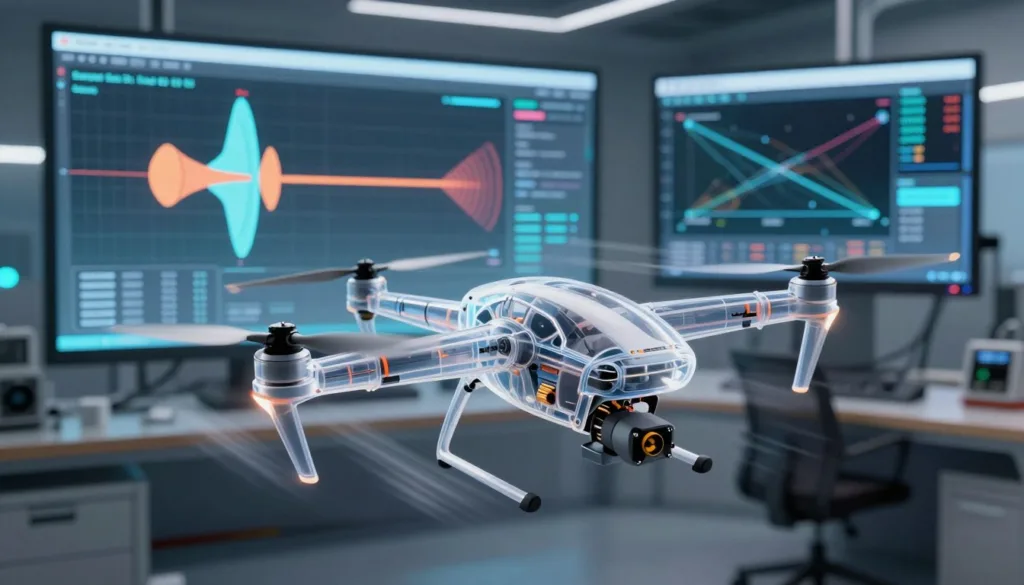
Propeller performance drives everything in fixed-wing UAV simulation. Getting this right means your virtual aircraft behaves like the real one. We focus on the physics and mathematics that govern how propellers generate thrust and torque across different flight conditions. This knowledge forms the foundation for accurate motor speed simulation and helps predict how your aircraft will climb, accelerate, and maintain altitude during missions.
Small UAVs rely on propeller thrust modeling to deliver predictable performance in autonomous flight. The propeller system interacts with airspeed and motor rotation in complex ways. Understanding these interactions lets us build simulators that match real-world behavior. Your pilots and controllers need this fidelity to train effectively and test safely before deployment.
Advance Ratio and Coefficient Calculations
The advance ratio represents a dimensionless number that captures the relationship between forward flight speed and propeller rotation. We calculate it using the formula J = (2π V_a)/(Ω_p D), where V_a is airspeed, Ω_p is motor speed, and D is propeller diameter. This single parameter predicts how thrust and torque change across the entire flight envelope.
Thrust coefficients (C_T) and torque coefficients (C_Q) vary with advance ratio in predictable patterns. We model C_Q as a second-order polynomial: C_Q0 + C_Q1·J + C_Q2·J². We represent C_T using a third-order polynomial: C_T0 + C_T1·J + C_T2·J² + C_T3·J³. These polynomial models come from wind tunnel data or flight testing. Once we have these coefficients, torque calculations UAV become straightforward multiplication problems in the simulation.
The advance ratio tells us when the propeller operates efficiently and when it struggles. At low advance ratios, the propeller generates maximum thrust but requires significant power. At high advance ratios, efficiency drops. Your mission profiles determine which operating points matter most. Training systems need to model these transitions accurately.
| Flight Condition | Advance Ratio Range | Thrust Coefficient Behavior | Torque Coefficient Behavior | Motor Speed Simulation Need |
|---|---|---|---|---|
| Hover / Takeoff | 0.0 – 0.2 | Maximum (C_T highest) | High power demand | Maximum RPM required |
| Climb | 0.2 – 0.4 | High value | Moderate to high | Near-maximum RPM |
| Cruise | 0.4 – 0.7 | Moderate | Lower demand | Optimized RPM range |
| High-Speed Flight | 0.7 – 1.2 | Declining | Continues decreasing | Reduced RPM acceptable |
| Descent | 0.8 – 1.5 | Very low or negative | Low power demand | Minimal RPM needed |
Gyroscopic Effects in Rear-Mounted Propeller Configurations
The rotating mass of the propeller creates angular momentum. When your aircraft pitches or yaws, this momentum generates moments that resist motion—these are gyroscopic effects propeller. For small UAVs, this phenomenon is often overlooked but becomes significant with larger propellers or higher rotation speeds.
We model gyroscopic torque using the equation M_prop,gyro = [I_p Ω̇_p; I_p Ω_p r; -I_p Ω_p q]. Here, I_p represents propeller inertia, Ω̇_p is motor acceleration, and q and r are pitch and yaw rates. This three-component moment acts across all aircraft axes.
Pusher propeller dynamics differ from traditional front-mounted designs. Rear-mounted propellers, common in platforms like the Skywalker X8, reverse the sign of gyroscopic torque compared to front-mounted configurations. This detail matters when developing controllers. Ignoring this sign reversal causes handling problems and control instability in simulation.
- Gyroscopic effects emerge from rotating propeller mass and angular momentum
- Moments generated depend on motor speed and aircraft rotation rates
- Pusher propeller dynamics require careful sign convention management
- Higher rotation speeds amplify these effects significantly
- Control systems must account for gyroscopic coupling to perform optimally
SRIZFLY simulators incorporate comprehensive propeller thrust modeling and gyroscopic effects into our platforms. We handle the complex mathematics so you focus on mission objectives. Your autonomous controllers train on accurate dynamics. Your pilots experience realistic handling characteristics. We deliver the fidelity serious development demands.
Ready to experience simulation that matches your real-world UAV behavior? Start your 10-day free trial with SRIZFLY today and discover how accurate propulsion modeling accelerates your development timeline.
Lightweight Indoor Fixed-Wing Platforms and Hardware Integration
Indoor flight environments demand specialized design approaches that differ fundamentally from outdoor operations. A lightweight fixed-wing UAV operating indoors must navigate tight spaces while maintaining stable flight. The physics of flight reveal why weight matters critically: a 150-gram aircraft requires approximately 7 meters per second minimum airspeed and an 8.7-meter turning radius, while a 300-gram aircraft needs 10 meters per second and a 17.5-meter radius. This difference determines whether your indoor flight platforms can operate safely in a gymnasium or require a massive warehouse.
Our approach to hardware integration drones focuses on keeping aircraft weight minimal without sacrificing capability. We achieve this through sensor-minimal aircraft designs that employ lightweight FPV camera systems weighing just 9 grams. Rather than burdening the aircraft with heavy onboard processors, we use offboard computation where video streams to ground stations for processing. This architecture enables sophisticated vision-based autonomy while keeping the airframe light enough for practical indoor operations.
The ROS integration UAV framework creates a bridge between your autonomous control software and the aircraft’s physical systems. Arduino-based interfaces convert ROS commands into standard RC control signals, enabling seamless communication. Safety mechanisms matter too—frame-quality monitoring using Structural Similarity Index (SSIM) alerts pilots when video quality degrades, preserving safe operation in challenging conditions.
Key Hardware Specifications for Indoor Operations
| Aircraft Weight Class | Minimum Airspeed | Turning Radius | Indoor Venue Size Required | Best Use Case |
|---|---|---|---|---|
| 150 grams | 7 m/s | 8.7 meters | 20m width gymnasium | Educational labs, controlled research |
| 300 grams | 10 m/s | 17.5 meters | 40m+ width warehouse | Advanced research, professional testing |
Camera System Options for Vision-Based Control
Your vision system choice shapes both performance and weight. Analog cameras offer lighter weight and lower latency, ideal for real-time FPV control. Digital cameras provide superior image quality for post-flight analysis at the cost of additional weight. Most operators select based on their primary mission:
- Analog FPV systems: 9 grams, minimal latency, suitable for pilot control
- Digital cameras: Higher resolution, better for autonomous navigation systems
- Hybrid approaches: Combine lightweight analog for control with digital recording
Assembly and maintenance efficiency distinguish practical platforms from theoretical designs. New users assemble complete aircraft in under 10 hours. Crash repairs take approximately 2 hours with readily available replacement parts costing a fraction of the original platform price. This rapid turnaround proves essential for educational institutions where multiple students learn simultaneously and occasional crashes are inevitable learning moments.
Integration Features for Autonomous Systems
The hardware integration drones architecture supports both manual and autonomous flight modes. Pilots can instantly reclaim control from autonomous systems when needed, ensuring safety during learning phases. The ROS integration UAV ecosystem provides access to extensive open-source libraries for perception, planning, and control. Your development team gains immediate capability for sophisticated autonomous behaviors without building control systems from scratch.
Indoor flight platforms deliver year-round repeatable experiments independent of weather constraints. Your research remains consistent regardless of outdoor conditions. This controlled environment accelerates development cycles for inspection systems, delivery prototypes, and surveillance applications. When combined with simulation validation, indoor flight platforms provide the final validation step before outdoor deployment.
We understand that your success depends on accessible, reliable hardware. SRIZFLY provides complete solutions spanning simulation development through physical validation. Our lightweight fixed-wing UAV platforms integrate seamlessly with our industry-leading simulators, giving you confidence in your autonomous systems before they fly indoors or outdoors. Start your journey with our 10-day free trial of simulation platforms to design your flight controller, then test it on hardware that responds predictably to your innovations.
Conclusion: Advancing Fixed-Wing UAV Development Through Simulation
The journey through small fixed-wing UAV simulation reveals a powerful truth: simulation is not just a convenience. It is a transformative technology that changes how drones are developed, tested, and deployed in the real world. You have explored how precise modeling of architecture, dynamics, propulsion, and aerodynamics creates high-fidelity virtual environments. These spaces allow you to develop and test controllers safely before any real flight occurs. Photorealistic rendering through Gaussian Splatting technology enables vision-based autonomy with minimal gaps between simulation and reality. This unlock GPS-denied operations that are critical for inspection, surveillance, and emergency response missions. The fixed-wing simulation benefits extend far beyond training—they reshape your entire development process.
The practical advantages of SRIZFLY simulator advantages speak directly to your bottom line. UAV training efficiency improves by 50% or more when you use our platforms. Development costs drop significantly because you eliminate expensive and risky flight tests of unfinished systems. Innovation accelerates when your team can iterate rapidly in virtual environments. Safety improves because edge cases get thoroughly tested before deployment. Drone development solutions built on simulation foundations produce autonomous flight testing results with success rates of 80 to 100%. For tower inspection, mapping, logistics, and agriculture enterprises, this means developing autonomous behaviors that increase operational efficiency and reduce human risk. For schools and training centers, our tools prepare students for careers in the growing UAV industry. For government and public sectors, our solutions enable reliable autonomous systems for critical emergency rescue and urban management missions.
SRIZFLY stands apart through industry-leading photorealistic simulation environments, validated dynamics models, comprehensive training frameworks for vision-based autonomy, and flexible support for diverse hardware configurations. Our competitive pricing delivers exceptional value for your simulation ROI. The unique 10-day free trial removes all risk from your decision—experience the photorealistic environments firsthand, evaluate the accurate dynamics, and test vision-based controller training workflows with your own team. We are committed to your success with expert technical support and solutions updated with the latest research advances. Your success drives us forward. The future of autonomous fixed-wing UAV operations is being built today in simulation environments. Contact us now to start your free trial and discover how SRIZFLY simulators can transform your development process.
FAQ
What is fixed-wing UAV simulation and why is it critical for drone development?
Fixed-wing UAV simulation is a virtual environment that accurately replicates the physics, aerodynamics, and dynamics of small unmanned aerial vehicles. It’s critical because fixed-wing platforms must maintain airspeed to generate lift and are governed by complex nonlinear aerodynamics. Simulation enables year-round, repeatable testing without weather constraints, regulatory limitations, or the high costs associated with outdoor flight testing. Our SRIZFLY simulators provide the platform to develop and validate controllers safely and efficiently, reducing training time by 50% or more while accelerating innovation.
How does sensor frame to center of gravity transformation affect simulation accuracy?
Inertial measurement units (IMUs) and velocity estimators are physically located at specific positions on the aircraft, but flight dynamics equations require measurements at the center of gravity (CG). Sensor frame to CG transformation uses rotation matrices and cross products to account for the physical offset between sensor location and CG, ensuring that angular velocities are properly transformed. This transformation is essential for high-fidelity simulation—without it, simulated aircraft behavior will not match actual platform performance, compromising controller development and validation.
What role does propulsion modeling play in accurate fixed-wing UAV simulation?
Propulsion modeling determines how thrust and torque depend on airspeed, propeller rotation speed, and advance ratio—key parameters that dictate aircraft performance. Accurate propulsion modeling ensures your simulated aircraft behaves exactly like the physical platform, enabling reliable controller development. SRIZFLY simulators incorporate comprehensive propulsion models including gyroscopic effects, which are particularly important for platforms with larger propellers or rear-mounted (pusher) configurations like the Skywalker X8.
How do aerodynamic coefficients transform between stability frame and body frame?
Aerodynamic forces naturally occur in the stability frame (where lift, drag, and moment coefficients are defined), but equations of motion are solved in the body frame. This transformation involves converting aerodynamic forces based on angle of attack and sideslip angle into the body-fixed coordinate system where aircraft acceleration and motion are calculated. Understanding this transformation is essential for building high-fidelity simulations—our simulators incorporate these proven mathematical models, giving you confidence that training conducted in simulation transfers effectively to actual flight operations.
What practical benefits does simulation provide for drone application enterprises?
For enterprises in tower inspection, mapping, logistics, and agriculture, simulation delivers concrete operational advantages: controllers can be designed, tested, and refined in the virtual environment with zero risk and minimal cost. Simulation enables rapid prototyping of autonomous behaviors and thorough testing of edge cases—wind gusts, sensor failures, challenging maneuvers—that would be dangerous or impractical to test on physical aircraft. The result is accelerated development, lower operational costs, and enhanced safety. Our data-driven approach shows that high-fidelity simulation can improve development efficiency by 50% or more.
How does Gaussian Splatting technology transform vision-based controller development?
Gaussian Splatting (GSplat) enables vision-based controller development with unprecedented realism by creating 3D environments that render photorealistic images from any camera pose. This is essential for training vision-based navigation, tracking, and landing systems. You collect images across your operational area, use established computer vision tools for calibration, and train the GSplat model in minutes rather than hours. Controllers trained in photorealistic GSplat environments can transfer to real hardware with minimal performance degradation—research shows 80-100% success rates in zero-shot sim-to-real deployment.
What is the workflow for creating digital twins of operational environments?
The workflow involves three key steps: collecting images across your operational area (whether an indoor arena, inspection site, or agricultural field), performing camera calibration and world-frame alignment using techniques like ArUco marker detection to ensure simulated camera poses correspond exactly to real-world coordinates, and training the Gaussian Splat model. This efficient process means you can rapidly create custom digital twins that mirror your specific operational conditions, enabling highly relevant simulation-based development and testing.
What are the tradeoffs between analog and digital cameras for fixed-wing UAV simulation?
Analog cameras are lighter (critical for small platforms constrained by weight limits) and have lower latency, but produce noisier, lower-quality images. Digital cameras offer superior image quality and clarity, essential for sophisticated vision processing, but add weight that reduces maneuverability in indoor spaces. SRIZFLY simulators support both configurations, giving you flexibility to optimize for your specific priorities. For platforms operating in space-constrained environments, analog systems maintain the lightweight architecture necessary for indoor operations.
How does system identification bridge the gap between theoretical models and real aircraft behavior?
System identification uses the output error method—a proven approach that iteratively adjusts model parameters until simulated trajectories match actual flight data with minimal error. The workflow involves conducting flight tests while recording states (position, velocity, attitude, angular rates) and control inputs, then processing this data through identification algorithms. Aerodynamic model structure balances complexity: too simple and the model misses important dynamics; too complex and it overfits to noise. Our approach uses stepwise regression to systematically evaluate which terms contribute meaningfully to prediction accuracy, ensuring models that are both accurate and generalizable.
Why is accurate aerodynamic modeling important for enterprises operating in challenging conditions?
For enterprises operating UAVs in challenging conditions—wind gusts during tower inspection, turbulence in mountainous terrain mapping, or crosswinds during agricultural operations—accurate aerodynamic models are essential for developing robust controllers that maintain stability and performance across the full operational envelope. Controllers developed without accounting for real aerodynamic behavior will fail when deployed to physical platforms. SRIZFLY simulators incorporate validated identification workflows that enable you to customize models for your specific airframes and operational conditions, ensuring controllers perform reliably in real-world deployment.
How does imitation learning enable vision-based autonomous flight without manual vision processing?
Imitation learning trains a vision-based student controller to mimic an expert controller that has access to perfect state information. The expert demonstrates desired behaviors in simulation; the student learns to replicate those behaviors using only camera images. This approach sidesteps the difficulty of manually designing vision processing pipelines, instead learning effective image-to-control mappings directly from data. Combined with domain randomization—which systematically varies visual appearance during training—controllers learn to focus on geometric and motion cues that remain consistent across appearance changes, dramatically improving real-world robustness.
What does zero-shot sim-to-real transfer mean and why is it revolutionary?
Zero-shot sim-to-real transfer means deploying controllers trained entirely in simulation to physical hardware without any real-world fine-tuning. This is revolutionary because it dramatically reduces development timelines and costs—no need for expensive hardware testing to validate controller performance. An 80% success rate in autonomous landing (a safety-critical maneuver) demonstrates that photorealistic simulation combined with proper training techniques can reliably bridge the sim-to-real gap. For enterprises developing autonomous inspection and surveillance applications where vision-based navigation is essential but real-world testing is expensive and risky, this capability is transformative.
How do leader-follower visual tracking applications work for autonomous UAV operations?
Leader-follower tracking enables one UAV to autonomously follow another using only visual information, with applications in formation flight, aerial refueling, and cooperative missions. The follower UAV processes camera imagery to extract relative position and motion information about the leader, then commands its own control surfaces to maintain desired separation and orientation. Research results showing 100% tracking success demonstrate the maturity of these methods. For enterprises requiring multi-UAV operations, this capability enables coordinated autonomous systems without reliance on GPS or external infrastructure.
Why does GPS-denied autonomy matter for inspection and emergency response operations?
GPS signals are unavailable or unreliable in many critical operational environments: indoor facilities, under bridges, in urban canyons, and near dense structures. Vision-based autonomy enables UAV operations in these GPS-denied zones where traditional GPS-based navigation fails. For defense applications, vision-based control provides resilience against GPS jamming. For emergency responders conducting rescue operations in buildings or disaster areas, vision-based UAVs provide essential reconnaissance capability. SRIZFLY simulators provide the photorealistic environments and training frameworks needed to develop robust vision-based controllers for these mission-critical applications.
What is advance ratio and how does it affect propeller performance in simulation?
Advance ratio is a dimensionless parameter that captures the relationship between forward flight speed and propeller rotation—essentially comparing how fast the aircraft moves through the air versus how fast the propeller spins. Thrust and torque coefficients vary with advance ratio in well-characterized ways that can be captured through polynomial models, determined from wind tunnel data or flight testing. Understanding advance ratio is key because it governs propeller performance across the entire flight envelope. For your operations, accurate thrust modeling ensures simulated aircraft will climb, accelerate, and maintain altitude just like physical platforms, essential for training pilots and testing autonomous controllers.
How do gyroscopic effects from propeller rotation impact fixed-wing UAV dynamics?
The rotating mass of the propeller creates angular momentum that generates moments when the aircraft pitches or yaws. These gyroscopic moments can be an order of magnitude smaller than aerodynamic moments but become significant with larger propellers or higher rotation speeds. We specifically address rear-mounted (pusher) propeller configurations common in platforms like the Skywalker X8, where sign conventions differ from traditional front-mounted (tractor) configurations. This level of detail matters when developing controllers that must account for all coupled dynamics—gyroscopic effects can influence handling qualities and must be properly modeled for optimal controller performance.
Why is lightweight design essential for indoor fixed-wing UAV operations?
Physics dictates that heavier aircraft require higher airspeeds to generate sufficient lift, which in turn increases turning radius. We provide concrete numbers showing that a 150g platform can maneuver comfortably in typical gymnasium or arena spaces (20m width), while heavier platforms with onboard computers become impractical for indoor environments. This insight is particularly valuable for educational institutions setting up UAV labs in existing facilities and for research organizations seeking year-round testing capability. SRIZFLY’s sensor-minimal approach keeps aircraft weight minimal while enabling sophisticated vision-based autonomy through ground-based processing of FPV camera streams.
What is the sensor-minimal architecture and how does it benefit UAV development?
The sensor-minimal approach uses lightweight FPV cameras that stream video to ground stations where processing occurs, rather than burdening the aircraft with heavy onboard computation. This architecture keeps aircraft weight minimal—critical for indoor maneuverability—while still enabling sophisticated vision-based autonomy. Hardware integration includes ROS compatibility for seamless software development, Arduino-based interfaces that bridge ROS commands to standard RC control signals, and mode-switching that allows human pilots to instantly reclaim control from autonomous systems. Safety mechanisms like SSIM-based frame-quality monitoring demonstrate our commitment to practical, safe solutions: if video quality degrades, the system alerts pilots to intervene.
How does ROS integration support rapid UAV controller development?
Robot Operating System (ROS) compatibility enables seamless integration between simulation environments and physical hardware. Developers can write controller code that runs identically in simulation and on real platforms, reducing the cognitive load of managing separate development environments. Arduino-based interfaces bridge ROS commands to standard RC control signals, enabling ground station computers to command aircraft control surfaces. This integration accelerates development timelines because controllers validated in SRIZFLY simulation can be deployed directly to physical platforms with confidence, minimizing the debugging and validation cycles required in real-world testing.
Why is rapid assembly and low-cost maintenance important for educational UAV programs?
Educational settings involve multiple students learning to fly, and occasional crashes are inevitable parts of the learning process. Platforms that can be repaired quickly and inexpensively maximize learning time and minimize frustration. For research labs, fast turnaround means more experimental iterations and faster progress toward innovation objectives. Lightweight indoor platforms with accessible design enable students and researchers to understand aircraft construction, troubleshoot issues, and maintain equipment without extensive downtime or budgetary strain. This practical consideration directly supports your educational mission by keeping students engaged and productive.
How do SRIZFLY simulators compare to traditional outdoor flight testing for UAV development?
Traditional outdoor flight testing faces significant limitations: weather constraints eliminate many testing days, regulatory restrictions limit where and when you can fly, and costs accumulate quickly with hardware wear and fuel consumption. SRIZFLY simulators provide year-round, repeatable, controlled environments where development and training occur risk-free. You can conduct thousands of test iterations in simulation before committing to physical flight testing, dramatically reducing development costs and timelines. Our simulators improve training efficiency by 50% or more while enabling thorough testing of edge cases that would be impractical or dangerous to test outdoors.
What makes SRIZFLY simulators uniquely suited for drone application enterprises?
SRIZFLY offers industry-leading photorealistic simulation environments created through Gaussian Splatting technology, validated dynamics models grounded in rigorous system identification methods, comprehensive training frameworks for vision-based autonomy including imitation learning and domain randomization, flexible support for diverse hardware configurations (analog and digital cameras, various airframes), and exceptional price-performance ratios. Our unique 10-day free trial offers a risk-free opportunity to experience these capabilities firsthand and evaluate how our simulators can transform your development process. Our expert team provides ongoing technical support and continuously updates our solutions with the latest research advances.
How does domain randomization improve real-world robustness of vision-based controllers?
Domain randomization systematically varies visual appearance during training—textures, colors, lighting conditions, and environmental details—to prevent controllers from overfitting to specific simulated appearance characteristics. By training on randomized environments, controllers learn to focus on geometric and motion cues that remain consistent across appearance changes. This dramatically improves real-world robustness because the controller has learned to recognize essential features rather than memorizing simulation-specific details. The result is controllers that transfer to physical hardware with high success rates despite the visual differences between photorealistic simulation and real-world imagery.
What specific applications benefit most from vision-based autonomous fixed-wing UAVs?
Vision-based autonomous fixed-wing UAVs excel in applications requiring GPS-denied autonomy: indoor facility inspection, under-bridge assessment, urban canyon surveillance, precision agricultural monitoring in areas with dense canopy, emergency rescue operations in GPS-limited environments, and perimeter surveillance near structures. The ability to navigate and accomplish mission objectives using only onboard camera imagery eliminates dependence on external infrastructure, enabling operations in challenging environments where traditional GPS-based systems fail. SRIZFLY simulators provide the development platform to create robust vision-based controllers optimized for your specific application requirements.
How can educational institutions use SRIZFLY simulators to prepare students for UAV industry careers?
SRIZFLY simulators provide comprehensive tools that teach students industry-standard methods across the full UAV development pipeline: flight dynamics and control theory through high-fidelity simulation, system identification techniques for aerodynamic modeling, vision-based autonomy through imitation learning and domain randomization, and practical hardware integration through ROS-compatible platforms. Students gain hands-on experience with cutting-edge technologies without requiring expensive flight tests or risking hardware damage. Our hardware designs support educational budgets while providing authentic engineering challenges. Graduates emerge with portfolio-ready experience in simulation, autonomy, and embedded systems—precisely the skills demanded by the rapidly growing UAV industry.
What does the 10-day free trial of SRIZFLY simulators include?
Our 10-day free trial provides full access to our industry-leading simulation platform, enabling you to experience photorealistic environments created with Gaussian Splatting technology, evaluate the accuracy of our dynamics models, test vision-based controller training workflows including imitation learning and domain randomization, and assess the flexibility of our hardware integration capabilities. This risk-free trial allows enterprises, educational institutions, and research organizations to validate how SRIZFLY simulators can transform your development process before making any commitment. Our expert team is available to provide guidance and support throughout your trial period.
How do SRIZFLY simulators support development of controllers for autonomous inspection missions?
For tower inspection, bridge assessment, and infrastructure monitoring, SRIZFLY simulators enable development of robust autonomous controllers through several capabilities: creation of digital twins specific to your inspection areas using Gaussian Splatting technology, realistic simulation of challenging conditions (wind gusts, complex structures, variable lighting), testing of vision-based navigation and target tracking without risking expensive hardware, and validation of controllers across diverse scenarios