



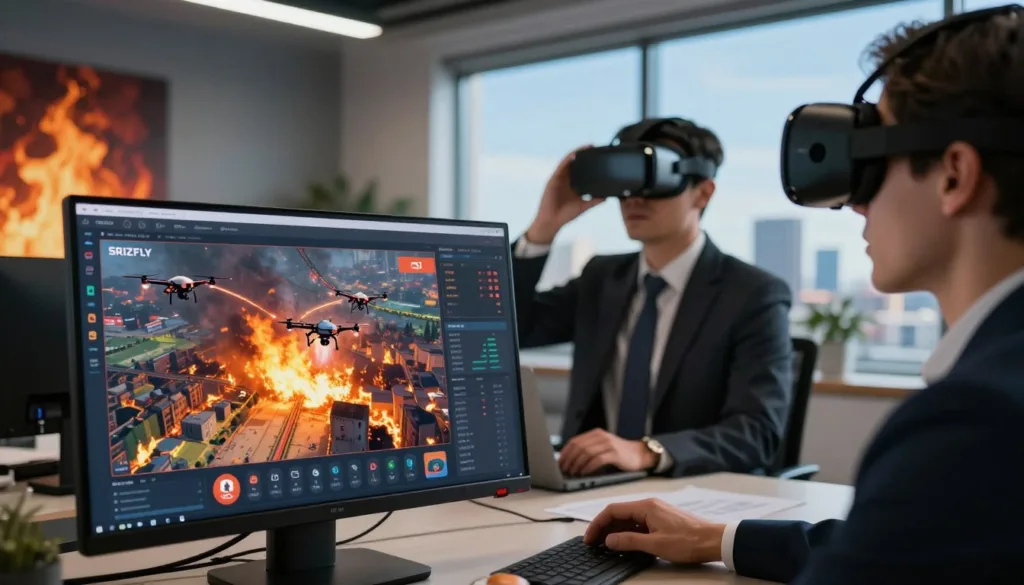
Canada’s fire services face bigger, faster-moving wildfires and tighter budgets. Advanced firefighting drone simulation software gives crews a way to rehearse complex incidents without the cost and risk of live burns.
These platforms combine autonomous aerial fleet emulation, multispectral sensor modeling, and real-time data feeds to create realistic virtual fire training scenarios. Trainers can practice aerial reconnaissance, thermal hotspot detection, and coordinated resource deployment while tracking outcomes in a controllable digital twin firefighting environment.
Modern simulators reflect industry systems such as SRIZFLY’s enterprise modules and support popular hardware like DJI, Skydio, and Teledyne FLIR sensors. By offering scalable, safety-by-design exercises, wildfire simulation tools reduce environmental impact and let agencies refine tactics, communication, and incident command before they face a real blaze.
Key Takeaways
- Firefighting drone simulation software enables realistic, risk-free rehearsals for crews in Canada.
- Virtual fire training models aerial reconnaissance, thermal detection, and multi-agency coordination.
- Digital twin firefighting environments support repeatable drills and post-incident analysis.
- Enterprise-grade simulators emulate DJI, Skydio, and Teledyne FLIR-class sensors for fidelity.
- Simulation reduces environmental impact and improves decision-making under pressure.
Why Modern Fire Training Needs Advanced Simulation
The rise in climate-driven wildfire patterns has changed how agencies prepare. Fires now move faster and behave unpredictably. Training must mirror smoke, wind shifts, and rapid spread to build sound decision-making under pressure.
Changing wildfire patterns and training challenges in Canada
Canada faces longer fire seasons, erratic winds, and larger burn areas. Teams from British Columbia to Nova Scotia must train for varied terrain and extreme weather. Realistic rehearsal helps crews adapt to the new normal without waiting for rare live incidents.
Limitations of traditional live exercises and environmental impact
Live burns teach valuable skills but carry risks: equipment wear, air pollution, and uncontrolled escape. Logistics and safety limits mean fewer repetitions. Urban departments like FDNY have shown how aerial tools change situational awareness, yet running many live drills is often impractical.
Benefits of simulated, risk-free rehearsal for decision-making
Simulation vs live burns gives trainers a safer, cheaper path to mastery. Virtual exercises let crews repeat scenarios, test aerial reconnaissance, and practice thermal interpretation without harming the landscape. Tools such as SRIZFLY enable harsh-weather practice and scenario scaling for municipal and provincial teams.
Risk-free firefighting practice supports rapid learning. Drones and simulated multispectral feeds let responders practice search, hotspot detection, and coordination with incident command. Repeated rehearsal builds confidence and improves outcomes when real fires strike.
Core Features of Advanced Firefighting Drone Simulation Software
The platform brings together realistic flight dynamics, sensor chains, and secure networking so teams can train for complex wildfire and urban incidents. It simulates fleets of autonomous and piloted drones while modeling thermal, infrared, and visible sensors for mission-grade rehearsal.
Autonomous aerial fleet simulation and multispectral sensor modeling
Simulators recreate mixed fleets that include models like the Skydio X10 and DJI Matrice 350 RTK to practice formation flying, handoffs, and BVLOS tasks. Multispectral drone simulation reproduces thermal radiometry, near-infrared vegetation indices, and high-resolution electro-optical output so crews can detect hotspots and assess burn severity.
High-fidelity visual and thermal imaging emulation (LiDAR, FLIR-like data)
High-detail LiDAR virtual mapping generates point clouds and elevation models for route planning and line-of-sight checks. FLIR emulation reproduces radiometric signatures similar to FLIR Boson sensors, enabling trainees to interpret temperature gradients and prioritize containment actions.
Secure, real-time data streaming and edge/cloud integration
Encrypted channels support real-time feeds from simulated drones to command centers and mobile units. Secure drone data streaming allows field crews and analysts to review live thermal maps, LiDAR scans, and EO video without exposing sensitive payloads to third parties.
Customizable scenarios and digital twin environment support
Users import GIS layers, vegetation maps, and 3D models to build location-specific drills. Digital twin firefighting environments let incident commanders replay complex interactions between fire behavior, infrastructure, and response assets for iterative training.
How Firefighting Drone Simulation Software Replicates Real-World Dynamics
The best training platforms mix physics and data to recreate how fires behave across Canadian landscapes. Users see how flames react to slope, wind shifts, and fuel type. This makes drills more realistic for crews preparing for mountain wildfires and urban-interface events.
Hybrid combustion simulation combines first-principles models of heat transfer and chemical reaction with machine learning that learns from past incidents. The result is faster, more adaptive predictions for dynamic conditions. Trainers can test scenarios where a sudden wind change forces a rapid reroute of resources.
Hybrid physics and data-driven behavior
In practice, hybrid combustion simulation blends computational fluid dynamics with pattern recognition trained on historical fires. That mix improves fidelity when fuels and topography interact. Teams using this approach get clearer guidance on likely spread and hotspot migration.
Plume and spread-pattern emulation
Smoke plume modeling and heat plume trajectories are simulated to show visibility, sensor occlusion, and air-quality impacts. Accurate fire spread modeling feeds those plume forecasts so commanders can anticipate secondary hazards and prioritize evacuations.
Weather, terrain, and vegetation coupling
Terrain-integrated wildfire simulation ties local slope, aspect, and vegetation maps into the core model. Weather inputs such as gust fronts and inversion layers alter fire behavior in real time. This lets crews rehearse location-specific tactics for steep alpine canyons or dense boreal stands.
Field-proven simulators, using engines like Unreal with AirSim extensions, deliver realistic atmospheric effects and configurable maps. Trainers can load a watershed or a municipal boundary, then run scenarios that stress-test decision-making under shifting conditions.
Training Workflows and Use Cases for Emergency Responders
Simulation platforms let Canadian crews rehearse complex responses without real-world risk. Trainees run through remote size-ups, review sensor feeds, and test tactics for evolving fires. These exercises pair flight skill drills with operational decision-making so teams gain confidence before entering live incidents.
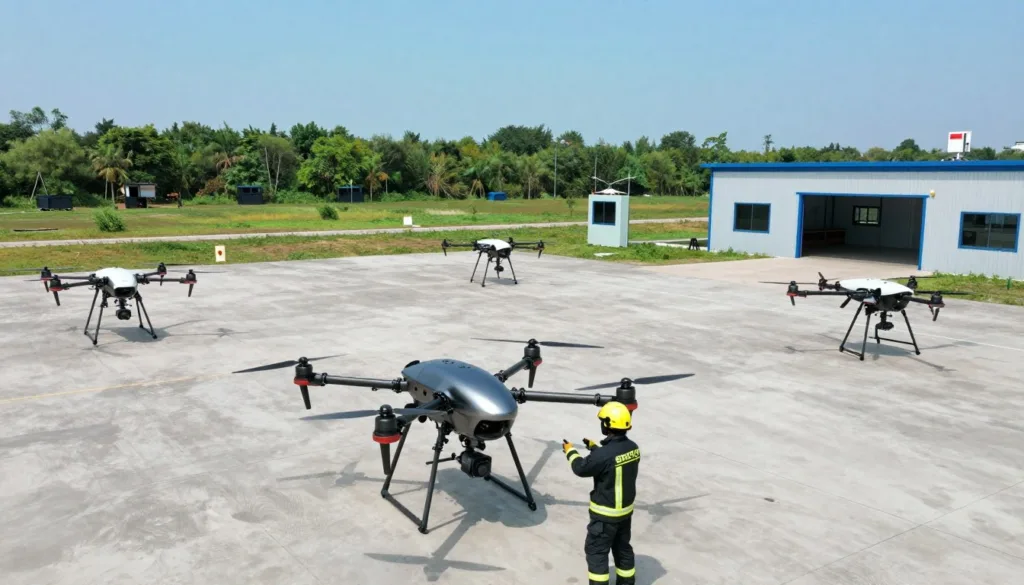
Aerial reconnaissance training focuses on rapid, repeatable drills that mirror real missions. Crews practice automated grid sweeps, manual piloting, and multispectral interpretation. Flight crews learn to translate drone maps into action plans while staying clear of hazards.
Aerial reconnaissance and rapid remote size-ups
Simulated missions reproduce diverse terrain and weather to teach quick remote size-ups. Operators assess fire perimeters, spot ember showers, and coordinate with ground crews. These rehearsals cut exposure and speed up initial strategy setting.
Hotspot detection, search & rescue, and hazardous materials assessment
Hotspot detection simulation trains teams to locate thermal anomalies under smoke and canopy. Search-and-rescue scenarios embed thermal targets and GPS waypoints for timed recoveries. Hazmat drone scenarios present plume mapping and sensor overlays so teams can plan safe standoff approaches.
Incident command exercises: resource allocation and multi-agency coordination
Incident command simulation gives commanders a realistic control layer for assets and radios. Participants allocate helicopters, ground crews, and drone sorties while syncing with agencies like the RCMP or local EMS. Exercises include integrating manned aircraft such as Sikorsky models to practice deconfliction.
Post-incident analysis, documentation, and evidence capture simulation
After-action workflows use high-resolution and thermal imagery for documentation and legal records. Simulated evidence capture helps teams tag frames, export geo-referenced reports, and rehearse chain-of-custody steps. This practice improves reporting and supports continuous learning.
Technical Integration: Digital Twins, Data Fusion, and AI Agents
Modern simulation platforms turn raw drone streams into living models that mirror forests, towns, and critical infrastructure. These systems feed multispectral data fusion pipelines that align thermal, visual, and LiDAR-like layers with cadastral maps to build a practical training environment.
GIS-integrated simulation adds terrain contours, road networks, and infrastructure layers so planners see context at a glance. That context helps make scenario updates fast and location-specific for Canadian wildland-urban interfaces.
Weather forecasts, satellite imagery, and historical incident records join the data flow through normalization layers. Normalized inputs keep the simulator stable while live sensors and statewide camera networks supply early detection cues and verification.
Multi-agent frameworks coordinate virtual units like flight controllers, risk analysts, and mission planners. These AI agents for incident response share state information, negotiate task priorities, and adapt tactics across repeating exercises.
Simulation architectures inspired by industry toolchains combine realistic flight physics, sensor emulation, and autopilot logic so virtual UAVs behave like Skydio or Pixhawk-equipped platforms. That fidelity helps teams rehearse beyond line-of-sight operations with confidence.
Decision-support agents synthesize outputs into clear recommendations for resource staging and containment lines. When agents run alongside a digital twin firefighting model, they surface efficient routing, hotspot priorities, and airspace deconfliction options.
Pluggable modules let agencies extend scenarios with custom GIS layers or new sensor types. This modularity keeps multispectral data fusion and AI agents for incident response usable across small departments and provincial response teams.
Continuous learning loops capture post-exercise outcomes so the next run is smarter. Feeding results back into the GIS-integrated simulation and digital twin firefighting environment tightens realism and improves operational readiness over time.
Safety, Compliance, and Operational Considerations for Canadian Agencies
Agencies planning drone-driven wildfire response need clear operational rules that balance safety and capability. Training with simulated BVLOS firefighting workflows cuts risk during rehearsal while preparing crews for real-world coordination with manned aircraft. Attention to Canadian drone regulations helps teams follow Transport Canada RPAS requirements and NAV CANADA airspace procedures from the start.
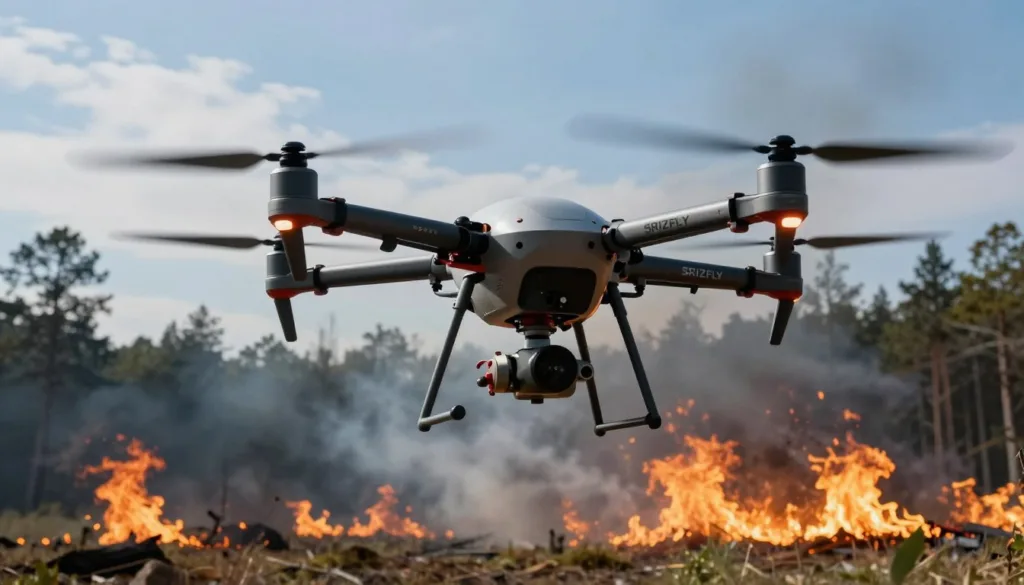
Privacy and secure transmission are top priorities when handling imagery and telemetry from incident zones. Encrypted links and authenticated endpoints protect personal data while enabling command staff to review live feeds. Secure drone telemetry must be verified end-to-end to maintain chain-of-custody for operational records and to meet provincial privacy rules.
Privacy, secure transmission, and data sovereignty options (edge vs cloud)
Edge nodes let remote teams process sensor data close to where it is collected. That reduces latency and minimizes the amount of sensitive data sent to external servers. For agencies concerned about storage and legal jurisdiction, on-premises or localized edge deployment supports data sovereignty edge computing preferences. Cloud-based systems still play a role for centralized updates and training content sharing across regions.
Airspace coordination, BVLOS considerations, and regulatory alignment
Working beyond visual line of sight requires formal risk assessments, approved procedures, and qualified observers when applicable. Canadian drone regulations outline the requirements for BVLOS firefighting operations, including contingency plans and pilot certification. Regular airspace briefings with NAV CANADA and local air traffic services reduce conflict risk with manned aircraft during active incidents.
Scalable deployment models: on-premises, cloud, and edge for remote regions
Different deployments match operational needs. On-premises systems keep sensitive imagery within agency networks. Cloud platforms streamline software updates and cross-agency collaboration. Hybrid models combine secure drone telemetry to local edge nodes with selective cloud syncing for archival and analysis.
Choose a model that fits mission tempo, connectivity limits, and regulatory constraints. Testing each option in drills builds confidence and shows how data sovereignty edge computing, secure drone telemetry, and compliance with Canadian drone regulations work together in practice.
Real-World Examples and Vendor Capabilities
The following examples show how modern simulators link field data with vendor-grade emulation to train teams for complex incidents. Practical demos help Canadian crews test tactics, practice coordination, and validate equipment choices without risking people or property.
Mountain wildfire simulation case study scenarios use autonomous aerial mapping to spot ignition points fast. Radiometric thermal feeds pair with weather models so command centers see evolving hotspots. Hybrid propagation models run multiple spread scenarios and update containment options in minutes. Trainees change tactics on dashboards and watch outcomes update in near real time.
Enterprise simulators offer modular kits that match mission types. The SRIZFLY firefighting module includes flight dynamics, customizable maps, and plugin support for night SAR and industrial inspections. Built on engines like Unreal Engine and connectors such as AirSim, these platforms emulate real controllers and common drone frames so teams train on tools that mirror field hardware.
Hardware-level emulation reproduces sensor outputs and payload behavior. A Skydio simulation should model autonomy features, collision avoidance, and NightSense performance for long-range inspections. Accurate FLIR thermal emulation recreates radiometric outputs from Boson-class sensors and supports hotspot detection workflows.
Simulations must cover a wide fleet mix. Emulated systems should include Skydio X10 autonomy, Teledyne FLIR radiometric sensors, DJI Matrice payloads with Zenmuse H20T functions, and Parrot ANAFI Thermal profiles. Visible cameras, LiDAR point clouds, zoom and spotlight controls, and audible payloads give trainees vendor-specific practice for mission planning and evidence capture.
When vendors expose plugin APIs and controller compatibility, agencies can extend scenarios to oil and gas or wind-farm inspections. Flexible modules let teams load local terrain, test BVLOS tactics, and validate data streams to edge nodes or cloud command centers under realistic latency and security constraints.
Conclusion
Advanced firefighting drone simulation software brings together autonomous aerial systems, real-time data fusion, and digital twin environments to create safe, repeatable training that mirrors real incidents. These platforms capture firefighting drone simulation benefits by combining hybrid physics models and machine learning so teams can rehearse complex scenarios without environmental harm.
Enterprise-grade simulators such as SRIZFLY-style modules show how realistic flight physics, harsh-weather emulation, and modular mission packages enable crews to train safer with drones. Simulated BVLOS missions, thermal hotspot exercises, and multi-agent coordination let agencies refine tactics, resource allocation, and incident command workflows before they face live risks.
Field adoption by departments like the Los Angeles Fire Department, FDNY, and Austin Fire Rescue confirms that drones already enhance reconnaissance, SAR, and hazardous assessments. For Canadian emergency response simulation, these technologies support regulatory alignment, data sovereignty choices, and scalable deployments that fit remote and urban needs.
In sum, investing in simulation technology delivers measurable operational gains: faster decision-making, lower training costs, and stronger interagency coordination. As the ecosystem matures, continued model refinement and real-world validation will keep improving firefighting drone simulation benefits and help teams train safer with drones across Canada.